


How an AI Search Visibility Tool Helps Brands Understand Their Presence in AI Search
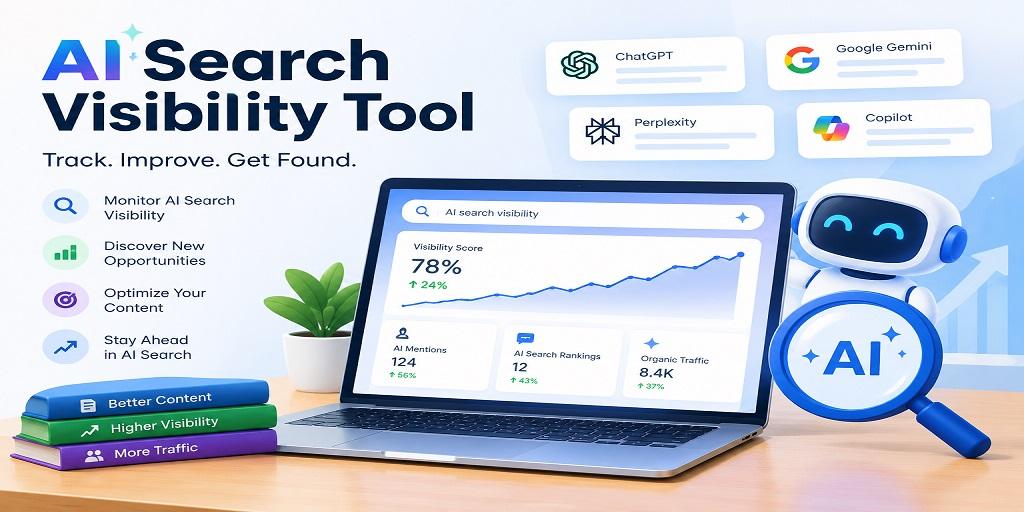
- An AI Search Visibility Tool measures how often and how accurately a brand appears in AI-generated answers from platforms like ChatGPT, Gemini, and Perplexity.
- Traditional rank-tracking metrics miss AI answer engines entirely, creating blind spots for marketing teams.
- Brands that monitor AI citation patterns can adjust content strategy before competitors do.
- Structured, authoritative content is the single biggest factor in earning AI answer inclusion.
Why Traditional Rank Tracking Falls Short in 2026
Search behavior shifted sharply when AI answer engines moved from novelty to primary research tool. A brand ranking on page one of a classic search results page may still be invisible inside a ChatGPT response or a Gemini overview. Those two surfaces operate on different signals: citation authority, entity clarity, and structured content depth rather than keyword density or backlink volume alone.
Marketing leaders who rely only on position-one reporting are measuring the wrong channel. An AI Search Visibility Tool closes that gap by querying AI platforms directly and reporting whether a brand's name, products, or expertise appear in the generated answers, and in what context.
What an AI Search Visibility Tool Actually Measures
The core function is systematic query testing across multiple AI platforms. The tool submits a defined set of prompts relevant to a brand's category, then analyzes the responses for brand mentions, competitor mentions, and the sources cited. Key metrics include:
- Mention frequency: How often the brand appears across a defined query set.
- Mention sentiment: Whether references are positive, neutral, or qualified with caveats.
- Citation source: Which URLs or publications the AI model credits when naming the brand.
- Competitor share of voice: How often rivals appear in the same answer pool.
- Answer position: Whether the brand is the primary recommendation or a secondary mention.
This data gives marketing teams a factual baseline rather than guesswork about AI channel performance.
AI Search Visibility vs. Traditional SEO Tracking: Key Differences
DimensionTraditional SEO TrackingAI Search Visibility ToolPrimary surfaceSearch engine results pagesAI-generated answer panelsCore signal measuredKeyword ranking positionBrand citation frequency and contextUpdate cadenceDaily crawl of SERPsScheduled prompt testing across AI enginesCompetitor insightWho ranks above youWho gets cited instead of you
How Brands Use AI Visibility Data to Improve Content Strategy
Raw visibility scores become useful only when they inform action. When a brand discovers it earns zero citations for a high-intent query category, the corrective path is specific: publish authoritative long-form content on that topic, earn references from publications AI models already trust, and structure pages with clear entity signals so models can extract clean, attributable facts.
Monitoring citation sources also reveals which third-party outlets carry the most weight in AI answers. Brands can then prioritize earning coverage on those publications through earned media and partnerships rather than scattering effort across low-influence channels. According to SparkToro's research on AI chatbot recommendation patterns, a small number of authoritative domains account for a disproportionate share of AI citations, making source targeting a high-leverage activity.
Consistent monitoring, not one-time audits, is what separates brands that adapt to AI search from those that remain invisible inside it. The Schema.org structured data guidelines provide the technical foundation for helping AI models parse entity relationships accurately.
How an AI Search Visibility Tool Helps Brands Understand Their Presence in AI Search FAQ
How is AI search visibility different from a featured snippet?
Featured snippets appear in classic search results and are tracked by keyword position. AI search visibility measures brand mentions inside conversational answer engines like ChatGPT, which operate independently of Google's SERP features and use different ranking signals.
How frequently should brands run AI visibility audits?
Monthly tracking captures meaningful trend data without overwhelming reporting cycles. Brands in fast-moving categories benefit from bi-weekly query testing because AI model training updates can shift citation patterns quickly.
Can small businesses benefit from an AI Search Visibility Tool?
Yes. AI answer engines reference niche expertise frequently, meaning a focused SMB can earn citations in its specialty category ahead of larger generalist competitors. WorkspaceCMS.ai - SEO + AI Campaign integrates AI search visibility tracking alongside content management and managed SEO, making this capability accessible without requiring a dedicated analytics team.

 English
 Arabic
 French
 Spanish
 Deutsch
 Turkish
 Dutch
Dutch
 Italiano
 Russian
 Romaian
 Portuguese (Brazil)
 Greek
Greek
 Bengali