


Saudi Arabia Meat Market Forecast: Growth, Competitive Landscape and Emerging Opportunities, 2026-2034
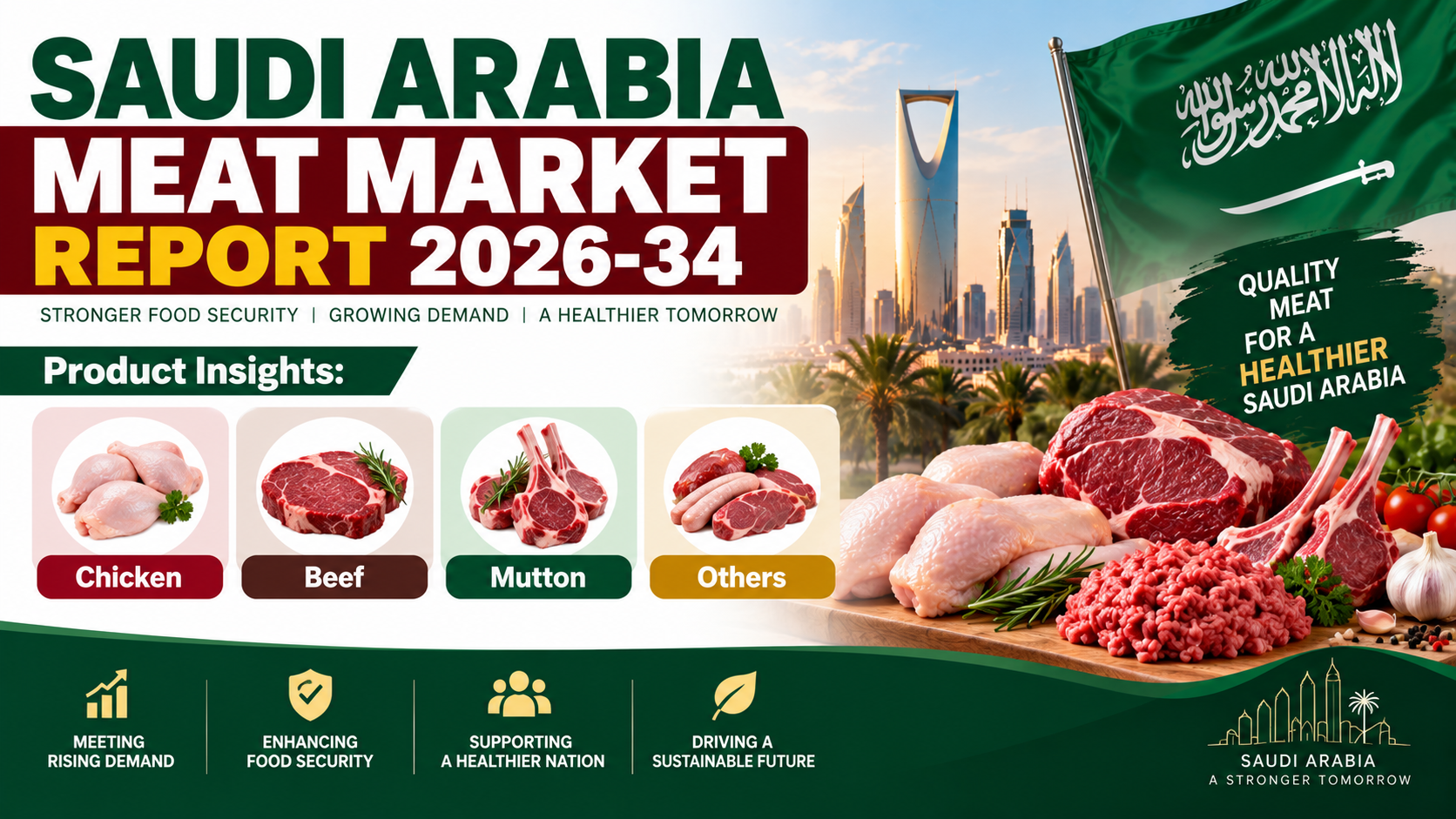
The Saudi Arabia meat market continues to expand on the back of rapid population growth, rising disposable incomes, and a national food security agenda that is pushing both domestic producers and international meat processors to scale up local operations. Poultry remains the dominant protein category given its affordability and versatility, while red meat, particularly beef and mutton, continues to rely heavily on imports even as local production capacity increases. Saudi Arabia meat market size grew from USD 13.99 Billion in 2025 to USD 14.67 Billion in 2026 and is projected to reach USD 21.52 Billion by 2034, growing at a compound annual growth rate of 4.90% from 2026-2034. Widespread preference for different meat products, a shift toward lean and premium cuts, the booming tourism industry, and rapid expansion of retail spaces are among the core factors driving consumption across the Kingdom.
How AI is Reshaping the Future of Saudi Arabia Meat Market?
- AI-Driven Farm and Feed Optimization: Poultry producers are deploying automated, AI-enabled feed mills and biosecurity monitoring systems to improve flock health outcomes and reduce production losses. Tanmiah Food Company's newly inaugurated feed mill in Dahna operates on a fully automated production line with a capacity of 40 metric tons per hour, using data-driven quality controls to optimize feed consistency for its integrated poultry network.
- Smart Cooling and Sustainable Facility Management: Technology partnerships are bringing AI-linked climate and energy management systems into meat processing operations, including a first-of-its-kind geothermal-cooled poultry farm deployment in the Middle East and North Africa region designed to reduce energy consumption at scale.
- AI-Enabled Demand Forecasting for Retail and Foodservice: Meat processors and retailers are using predictive analytics to align production runs with retail and HoReCA demand cycles, reducing spoilage and supporting the shift toward vacuum-sealed and modified atmosphere packaging that extends shelf life and strengthens traceability for halal certified products.
- Automated Quality Control in Processing Plants: New processing facilities entering the market, including large-bird capable production lines, are integrating automated inspection and grading systems to meet the consistency standards required by global quick-service restaurant partners operating in the Kingdom.
Grab a sample PDF of this report: https://www.imarcgroup.com/saudi-arabia-meat-market/requestsample
Saudi Arabia Meat Market Trends and Drivers
Population growth and urbanization remain the foundational demand drivers for the Saudi Arabia meat market. The Kingdom's large and youthful population, combined with a growing expatriate base concentrated in urban centers such as Riyadh, Jeddah, and the Eastern Province, continues to push up per capita meat consumption. Saudi Arabia ranks among the top five countries globally in poultry consumption per capita and leads the wider Middle East and Africa region, with the Kingdom accounting for the majority of regional poultry production.
Government backed food security initiatives under Vision 2030 are actively reshaping the competitive landscape. According to the General Authority for Statistics' Food Security Statistics Bulletin, poultry meat has achieved a self-sufficiency rate of roughly 71 percent, while red meat self-sufficiency stands at around 61 percent, and national policy targets aim to lift broiler chicken self-sufficiency toward 80 percent. This gap between local production and consumption continues to attract both domestic capital and foreign direct investment into new processing capacity, hatcheries, and feed mills across the Kingdom.
Halal certification, traceability, and quality assurance have become decisive purchase factors for Saudi consumers. The Saudi Food and Drug Authority enforces some of the strictest halal standards in the region, which has pushed both local and international processors to invest in certified supply chains. Processed red meat is among the fastest growing segments in the country, supported by busier lifestyles, a rising share of working women, and growing demand for ready-to-cook formats among younger, more Western-influenced consumers who increasingly favor beef alongside traditional preferences for lamb, mutton, and camel.
Import dependence for red meat remains structurally significant, creating opportunities for international trade partnerships. Saudi Arabia has expressed interest in sourcing several hundred thousand tonnes of red meat annually from new supplier markets such as Nigeria, reflecting the Kingdom's ongoing diversification of import sources to secure supply amid domestic water and feed constraints that limit large-scale cattle farming expansion.
Saudi Arabia Meat Market Segmentation
The market can be segmented into the following categories:
Breakup By Type:
- Raw
- Processed
Processed meat is the fastest expanding type segment, driven by convenience oriented consumer behavior, growth in ready-to-cook and frozen formats, and rising retail and foodservice penetration of value-added products such as breaded, marinated, and portioned meat items.
Breakup By Product:
- Chicken
- Beef
- Mutton
- Others
Chicken commands the largest product share given its affordability, cultural centrality, and the scale of domestic production, with market leaders such as Al Watania Poultry, Almarai's Al-Youm brand, and Tanmiah Food Company together controlling a substantial majority of the branded fresh poultry segment, while Brazil-based BRF dominates the frozen poultry meat category through its Sadia and Doux brands.
Breakup By Distribution Channel:
- Supermarkets and Hypermarkets
- Departmental Stores
- Specialty Stores
- Online Stores
- Others
Supermarkets and hypermarkets remain the leading distribution channel, though online stores are recording the sharpest growth as e-commerce grocery platforms expand delivery coverage across major Saudi cities.
Breakup By Region:
- Riyadh
- Makkah
- Eastern Province
- Madinah
- Others
Riyadh and Makkah together account for the largest share of consumption given their population density, tourism inflows tied to religious pilgrimage, and concentration of foodservice outlets.
Competitive Landscape
The report provides a comprehensive analysis of the competitive landscape in the Saudi Arabia meat market with detailed profiles of key companies, including:
- Al Watania Poultry
- Almarai Company (Al-Youm brand)
- Tanmiah Food Company
- BRF S.A. (Sadia, Doux brands)
- Americana Group
- Halwani Brothers Company
- Fakieh Poultry Farms
- Entaj
- NADEC
- Savola Group
Recent News and Developments in Saudi Arabia Meat Market
- December 2025: Tanmiah Food Company launched a new Frozen Breaded Chicken range for retail and foodservice channels made entirely from locally sourced fresh Saudi chicken, reducing reliance on imported frozen chicken breast as raw material and supporting national food security objectives.
- September 2025: Tanmiah Food Company inaugurated a new primary poultry processing plant in Al Majmaa, described as the first facility in the Kingdom capable of handling large birds, alongside an automated feed mill in Dahna with a production capacity of 40 metric tons per hour, as part of an investment exceeding SAR 1.5 billion within the Kingdom over the preceding two years.
- April 2025: Brazilian meat processor BRF and the Halal Products Development Company, a subsidiary of Saudi Arabia's Public Investment Fund, announced a USD 160 million investment in a new poultry and beef processing plant in Jeddah with an annual capacity of approximately 40,000 tons, scheduled to begin operations in mid-2026 and expected to generate more than 500 direct jobs.
- June 2024: Saudi Arabia expressed interest in importing up to 200,000 tonnes of red meat from Nigeria, reflecting the Kingdom's continued diversification of red meat import sources to meet rising domestic demand.
- March 2024: Dairy and food group Almarai announced plans to invest more than USD 4.8 billion under a five-year growth plan spanning its dairy, poultry, and food business segments across Saudi Arabia.
Note: If you require any specific information that is not covered currently within the scope of the report, we will provide the same as a part of the customization.
About Us
IMARC Group is a global management consulting firm that helps the world's most ambitious changemakers to create a lasting impact. The company provides a comprehensive suite of market entry and expansion services. IMARC offerings include thorough market assessment, feasibility studies, company incorporation assistance, factory setup support, regulatory approvals and licensing navigation, branding, marketing and sales strategies, competitive landscape and benchmarking analyses, pricing and cost research, and procurement research.
Contact Us
IMARC Group
134 N 4th St. Brooklyn, NY 11249, USA
Email: sales@imarcgroup.com
Tel No: (D) +91 120 433 0800
United States: +1-201-971-6302

 English
 Arabic
 Spanish
 Portuguese
 Deutsch
 Turkish
 Dutch
Dutch
 Italiano
 Russian
 Romaian
 Portuguese (Brazil)
 Greek
Greek
 Bengali