


Advanced Wire Forming for Industrial Staple Production
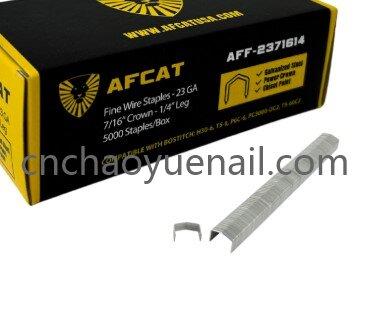
In demanding fastening environments, material stability and forming accuracy directly influence assembly quality, which is why Heavy Wire Staples are manufactured through carefully controlled steel processing and automated forming procedures. A reliable production process begins with consistent wire material and continues through drawing, straightening, cutting, forming, inspection, and packaging. Each stage contributes to dimensional consistency and helps manufacturers supply fasteners suited to professional applications where secure attachment and repeatable installation are important.
Steel selection is one of the most important foundations of staple production. The incoming wire needs a controlled chemical composition, suitable mechanical characteristics, and a clean internal structure so that it can withstand repeated forming operations. Variations in raw material can affect bending behavior, surface quality, and tool stability. For this reason, manufacturers can evaluate incoming steel through documented inspection procedures before it enters the production line. Consistent material preparation provides a more stable foundation for downstream automated processing.
Wire drawing can refine the steel wire while helping establish the working characteristics required for forming. Controlled reduction and proper lubrication are important because excessive friction or inconsistent processing may influence surface condition and production stability. After drawing, straightening equipment prepares the wire for accurate feeding. Stable straightness allows automated machinery to position the material more consistently, reducing irregularities during cutting and bending.
Automated forming technology plays a central role in modern staple production. The wire is continuously fed into forming equipment, where synchronized mechanisms cut, bend, and shape individual fasteners. Accurate tooling geometry is essential because small deviations can influence the finished staple's shape and its interaction with fastening equipment. Automated systems also support repeatable production by reducing variations associated with manual handling and maintaining consistent processing sequences throughout a manufacturing batch.
Tooling management is another important part of production reliability. Forming dies, cutters, guides, and feeding components are exposed to repeated mechanical movement and can gradually experience wear. Preventive maintenance programs help manufacturers identify deterioration before it causes significant changes in product quality. Regular inspection, cleaning, adjustment, and timely replacement of worn components can support stable production while reducing unexpected equipment interruptions.
Surface treatment may also be selected according to the intended application environment. Depending on the required use, steel fasteners can receive appropriate finishing processes that improve surface characteristics and provide additional protection during storage, transportation, or service. Proper treatment requires controlled process conditions because uneven coating or surface preparation can affect appearance and handling. Careful post-treatment inspection helps ensure that finished products remain suitable for their intended supply chain and application requirements.
Compatibility with installation equipment is equally important. Professional fastening operations often depend on pneumatic, electric, or automated tools that require staples with consistent geometry and feeding characteristics. Variations in leg shape, crown formation, or overall alignment may interrupt tool operation. By maintaining controlled forming and inspection processes, manufacturers can produce fasteners designed for predictable interaction with compatible equipment, helping users maintain smoother production workflows.
Quality assurance should cover more than final visual inspection. Modern manufacturing systems can combine incoming material checks, in-process monitoring, dimensional verification, surface inspection, and batch documentation. Automated inspection technologies can identify visible defects or irregularities at production speed, while sampling procedures can provide additional confirmation of finished-product consistency. Traceability records also help manufacturers investigate production variations and maintain clearer control over different batches.
Packaging is another practical consideration because fasteners may travel through several stages before reaching the end user. Proper counting, sorting, packaging, and labeling reduce the possibility of mixed products and make inventory management easier for distributors and industrial customers. Packaging materials should also protect the staples from unnecessary moisture, contamination, and mechanical damage during transportation and storage. Clear identification supports more efficient warehouse handling and helps customers select the appropriate fastening product.
Sustainable production can be addressed through efficient material utilization and process control. Accurate wire feeding and forming reduce unnecessary scrap, while recycling suitable steel production waste can improve material efficiency. Preventive maintenance also contributes to resource management by reducing rejected products caused by worn tooling or unstable equipment. As manufacturing systems become more automated, data monitoring can help identify recurring sources of waste and support continuous process improvement.
For professional users, choosing the right fastener involves considering the application material, installation method, tool compatibility, environmental conditions, and required fastening characteristics rather than relying on a single product attribute. Consistent steel quality and controlled forming remain central to dependable production, while inspection and packaging provide additional support throughout the supply chain. These principles are especially relevant when Heavy Wire Staples are used in applications that demand stable handling and repeatable fastening. For manufacturers, distributors, and industrial buyers looking for more information about available steel fastening products and production capabilities, the product range can be reviewed at https://www.cnchaoyuenail.com/product.

 English
 Arabic
 Spanish
 Portuguese
 Deutsch
 Turkish
 Dutch
Dutch
 Italiano
 Russian
 Romaian
 Portuguese (Brazil)
 Greek
Greek
 Bengali