


Why Should a Paid Advertising Strategy Separate Demand Creation From Demand Capture?
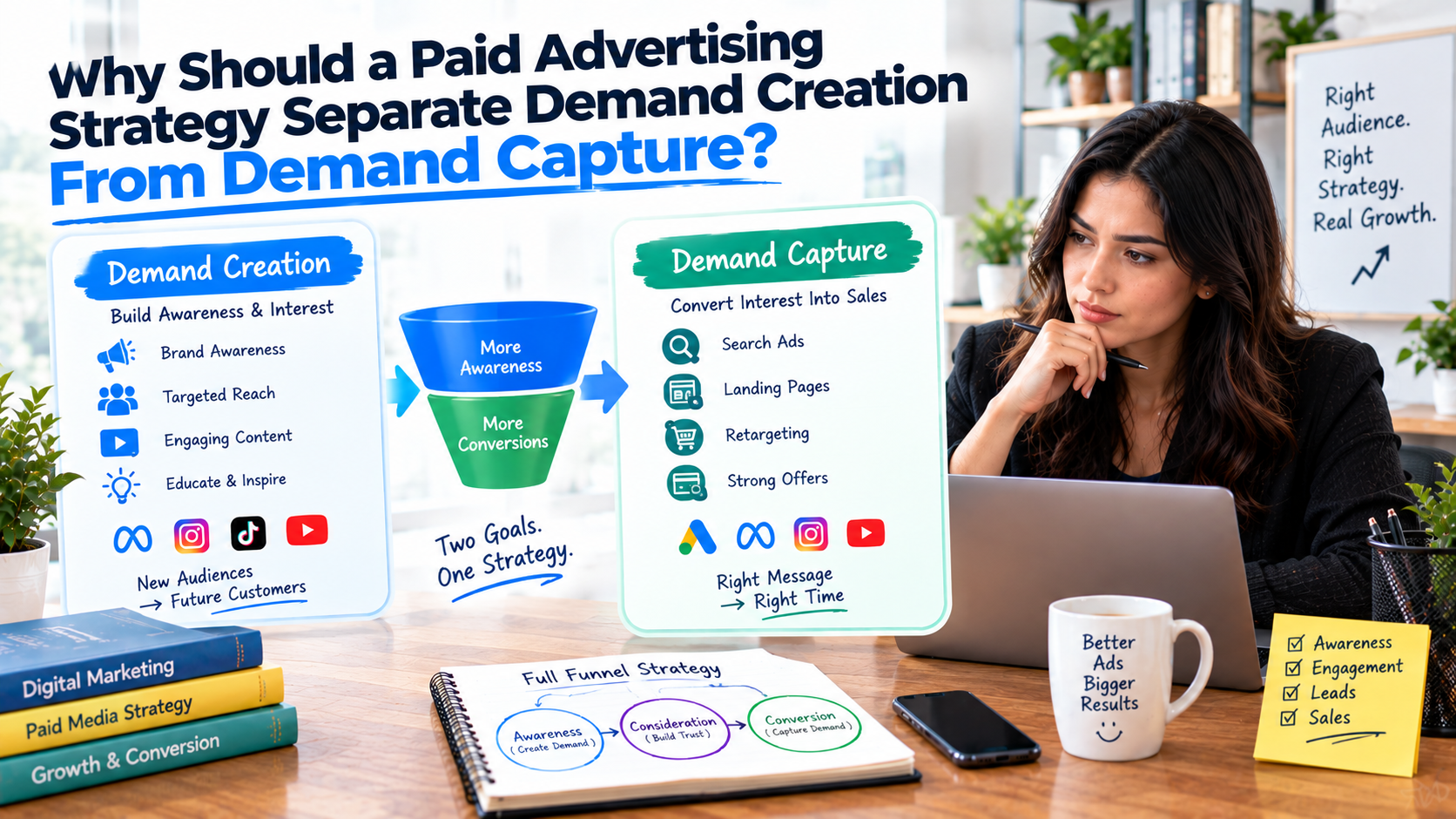
Many businesses expect every advertising campaign to produce an immediate sale. They launch an ad, send visitors to a website, and judge success mainly by the number of direct conversions reported by the platform.
This approach overlooks an important reality: not every potential customer is ready to purchase when they first see an advertisement.
Some people are actively searching for a solution and comparing providers. Others have a problem but do not yet understand the available options. A third group may not even realize that the problem can be solved.
An effective paid advertising strategy recognizes these different levels of awareness. It uses demand-creation campaigns to build interest and demand-capture campaigns to reach people who are already considering action.
Both functions support growth, but they require different messages, platforms, landing pages, and performance expectations.
What Is Demand Creation?
Demand creation introduces people to a problem, opportunity, product category, or different way of solving an existing challenge.
The audience may not be searching for the product yet. The advertisement must first help people understand why the subject matters.
For example, a business owner may know that sales are inconsistent but may not realize that weak advertising creative is limiting campaign performance. Educational content can explain the connection between customer research, creative variety, and profitable scaling.
Demand creation does not mean making people want something they do not need. It helps suitable audiences recognize a relevant problem and understand a possible solution.
Paid social platforms are often useful for this purpose because advertisements can reach people while they browse content, even when they are not actively looking for a product.
What Is Demand Capture?
Demand capture focuses on people who already show buying intent.
They may search for a specific service, visit a product page, compare alternatives, request pricing, or return to the website after an earlier interaction.
Search advertisements are a common example because they can appear when someone enters a relevant query. Retargeting campaigns can also capture existing demand by reaching people who have already visited the website, watched a video, or interacted with the brand.
The campaign does not need to explain the complete category from the beginning. Instead, it should make the offer clear, answer important objections, and provide an easy next step.
Demand capture can produce faster conversions, but it depends on enough suitable people already being interested in the solution.
Why Demand Capture Alone Eventually Reaches a Limit
Campaigns aimed at high-intent audiences can perform well because those people are closer to making a decision. However, the number of ready-to-buy customers is limited.
As more businesses compete for the same group, advertising costs may increase. A company may also begin reaching the same prospects repeatedly without adding enough new people to the market.
This creates a growth ceiling.
The campaign may continue capturing existing demand, but it does little to introduce new audiences to the brand or product category. Over time, the business becomes dependent on people who were already planning to purchase.
Demand creation expands the future pool of potential customers. It gives the brand an opportunity to influence how people understand their problem before they begin comparing providers.
Why Demand Creation Cannot Work Alone
Demand creation attracts attention and builds awareness, but that interest still needs a clear path toward conversion.
A business can publish useful videos and educational advertisements while failing to generate revenue because it does not guide interested viewers toward the next step.
Some people may need a detailed article, product demonstration, case study, comparison page, or consultation before making a decision. Others may be ready to act immediately after understanding the value.
A complete strategy provides suitable next steps for both groups.
Retargeting, search campaigns, email sequences, and focused landing pages can help turn the interest created by earlier messages into enquiries or sales. Without these systems, demand may be generated but captured by a competitor with a clearer offer.
The Creative Message Should Match Customer Awareness
One message cannot effectively serve every stage of the customer journey.
A person who has never heard of the product may not respond to a direct “Buy Now” advertisement. They may first need to understand the problem and its consequences.
Demand-creation creative can use educational hooks, problem explanations, customer stories, demonstrations, or surprising insights. The objective is to make the audience recognize the relevance of the subject.
Demand-capture creative can be more direct. It may focus on product benefits, pricing, proof, offers, comparisons, or common buying objections.
The brand voice should remain consistent, but the information should change according to what the audience already knows.
Businesses that need support with this process can explore professional creative strategy and paid advertising services to understand how messaging can be aligned with different customer stages.
Landing Pages Should Support the Campaign’s Purpose
Sending every advertisement to the same landing page can weaken both demand creation and demand capture.
An educational advertisement may lead to a guide, case study, or detailed explanation. Asking a newly aware visitor to purchase immediately may create too large a step.
A high-intent search advertisement should normally lead to a focused page that clearly presents the relevant solution. Sending this person to a broad homepage may force them to search for information they expected to see immediately.
The page should continue the message introduced in the advertisement. Its headline, proof, offer, and call to action should match the visitor’s level of awareness.
This consistency reduces confusion and makes the journey feel connected.
Budget Allocation Should Reflect the Growth Goal
There is no universal percentage that every business should spend on demand creation and demand capture.
A new brand may need more investment in education and awareness because few people know its name or understand its product category. An established company with strong search volume may have more existing demand to capture.
The buying cycle also matters. A low-cost consumer product may require less education than a complex software service or high-value professional solution.
Businesses should protect campaigns that convert existing demand while reserving a controlled portion of the budget for reaching new audiences and testing fresh messages.
The balance can change as the company learns which activities create qualified interest and how long prospects take to convert.
Measurement Requires More Than Immediate Conversions
Demand-capture campaigns are often easier to measure because the conversion happens closer to the click. Demand-creation campaigns may influence customers earlier in a longer journey.
Someone may see an educational video, visit the website later, search for the brand, and then purchase through another campaign. The final platform may receive most of the conversion credit even though the first advertisement introduced the solution.
This does not mean demand-creation campaigns should escape measurement. Businesses can review video engagement, qualified website visits, branded search growth, assisted conversions, remarketing audience growth, and eventual customer acquisition.
These signals should be considered with total sales and blended marketing performance.
Relevant advertising case studies can also help marketers understand why measurement approaches vary across ecommerce, SaaS, and lead-generation campaigns.
How Can Both Campaign Types Share Insights?
Demand creation and demand capture should not operate as separate departments.
Search queries can reveal the terms high-intent customers use when they are close to purchasing. These terms may inspire clearer educational content and social advertising messages.
Demand-creation campaigns can reveal which customer problems attract attention. Those findings can improve search-ad copy, landing pages, and retargeting creative.
Sales teams also provide valuable information. They can explain what customers already know, which concerns delay decisions, and what finally encourages a purchase.
When these insights are shared, each stage improves the other. The business develops a more accurate understanding of how customers move from first awareness to final action.
Common Mistakes to Avoid
One mistake is judging awareness campaigns entirely by last-click sales. This can cause the business to stop useful campaigns before their wider effect becomes visible.
Another is treating all engagement as valuable. High video views or reactions do not guarantee that the content reached suitable potential customers.
Businesses should also avoid spending heavily on awareness without building retargeting, landing pages, email follow-up, and other ways to capture growing interest.
Finally, demand-capture campaigns should not receive unlimited budget simply because they report a strong return. Increasing spending beyond the available demand can reduce efficiency and create excessive repetition.
Frequently Asked Questions
Is demand creation the same as brand awareness?
They are related, but demand creation is more focused on helping suitable audiences understand a problem and consider a relevant solution. General brand awareness may have a broader objective.
Which platforms are best for demand creation?
Paid social and video platforms are often useful, but the best choice depends on where the target audience spends time and how the product needs to be explained.
Which platforms are best for demand capture?
Search advertising and retargeting are commonly used because they can reach people showing stronger intent. The right platform still depends on customer behaviour.
Can a small business use both approaches?
Yes. A small business can begin with a controlled budget, protect high-intent campaigns, and test a limited number of demand-creation messages.
How long does demand creation take to produce results?
The timeline depends on the product, audience, price, buying cycle, and existing brand awareness. Complex or expensive offers often require a longer evaluation period.
Final Thoughts
Demand creation and demand capture perform different but connected roles. One expands the number of people who understand the problem and solution, while the other helps interested prospects take action.
A balanced paid advertising strategy gives each role the right message, channel, landing page, budget, and measurement method. It also allows insights to move between campaigns rather than keeping them isolated.
Businesses that create interest without capturing it may lose customers to competitors. Those that only capture existing demand may eventually struggle to grow. Sustainable advertising requires both.

 English
 Arabic
 French
 Spanish
 Portuguese
 Turkish
 Dutch
Dutch
 Italiano
 Russian
 Romaian
 Portuguese (Brazil)
 Greek
Greek
 Bengali