


Flame Resistant Fabrics Gain Importance as Workplace Risks Become More Complex
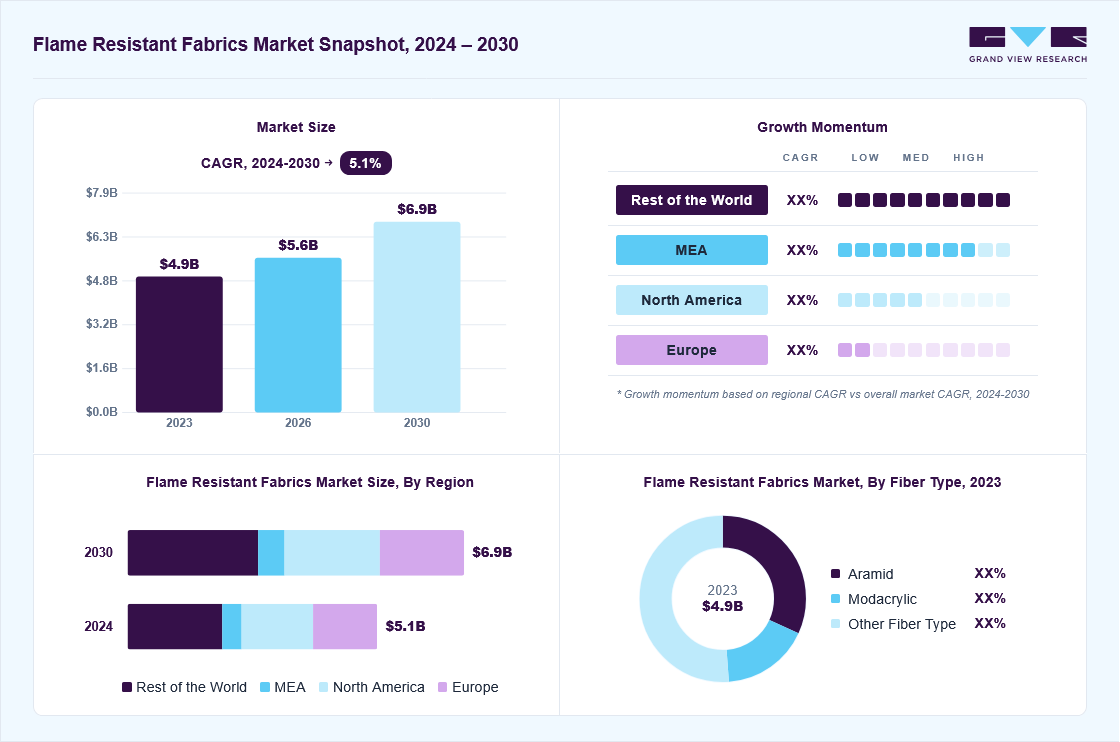
Flame resistant fabrics are becoming increasingly important across industries where workers and equipment face fire, heat, electrical, and thermal hazards. The market was valued at USD 4.9 billion in 2023 and is projected to grow from USD 5.6 billion in 2026 to USD 6.9 billion by 2030, registering a CAGR of 5.1% from 2024 to 2030. Growing emphasis on employee safety, stringent workplace regulations, and demand from high-risk industries are supporting this expansion.
Flame Resistant Fabrics Market Growth Builds on Workplace Safety
The increasing focus on worker protection across hazardous industrial environments is strengthening demand for flame resistant fabrics. Industries including oil & gas, chemicals, mining, electrical utilities, defense, and manufacturing use these materials to help protect workers against fire hazards, electric arc flashes, and thermal exposure. Government agencies and industrial organizations are also enforcing occupational safety standards, encouraging employers to invest in certified protective clothing and safety apparel.
Industrialization and the expansion of energy, infrastructure, and manufacturing activities are further increasing the requirement for personal protective equipment incorporating flame resistant fabrics. At the same time, technological advances are producing lightweight, breathable, and durable protective textiles, improving comfort and performance across industrial workwear, military uniforms, firefighting apparel, and transportation applications.
Market Size and Forecast Point to Steady Expansion
The flame resistant fabrics market is estimated at USD 5.6 billion in 2026 and is expected to reach USD 6.9 billion by 2030. The projected CAGR of 5.1% from 2024 to 2030 reflects sustained demand for protective fabrics across safety-sensitive applications. The market was valued at USD 4.9 billion in 2023.
However, high production and raw material costs remain an important consideration. Advanced fibers and chemically treated protective fabrics can require complex production processes and stringent quality certifications. Certain fabrics may also face limitations involving comfort, breathability, or durability following repeated washing and prolonged industrial use.
Aramid Fibers Lead the Fiber Type Segment
Aramid fibers accounted for the highest share of over 60.8% of global revenue in 2023. Their superior strength and heat-resistant characteristics make them suitable for demanding applications across mining, oil & gas, chemical manufacturing, and other industries requiring worker protection.
Aramid fibers also provide comfort and flexibility, supporting their use in protective clothing. Modacrylic fibers are expected to witness significant growth over the forecast period because they are inherently flame-resistant and can be blended with lyocell, aramid, or polyamide-imide fibers. Their durability, resistance to wrinkling, and chemical and solvent resistance further broaden their applications.
Industrial Safety Drives End-Use Demand
The industrial safety segment dominated the market in 2023 and is expected to grow at the fastest rate from 2024 to 2030. Flame-resistant clothing provides protection against fire hazards and can help reduce the risk of fatal injuries in hazardous workplaces.
Manufacturing, oil & gas, automotive, and utility operations are important areas of adoption, with mandatory workplace safety requirements supporting demand. Military applications also represent a significant area because personnel can face intense heat and fire risks. Rising military expenditure for research, development, and equipment acquisition is expected to support future demand for flame resistant fabrics.
Treated Materials Maintain a Strong Market Position
The treated material type segment dominated the market in 2023. Treated flame-retardant fabrics are chemically treated to increase their resistance to flames and are designed to prevent or slow flame spread.
Demand from oil & gas and petroleum industries is expected to support continued use of treated materials. Meanwhile, inherent flame-resistant fabrics are expected to witness significant growth from 2024 to 2030. Their flame-resistant characteristics come from their chemical composition, with aramid and modacrylic fibers serving as examples. Because their protective properties are inherent in the fabric, these materials provide long-lasting flame resistance that is not washed out over time.
Regional Demand Creates Diverse Growth Opportunities
Asia Pacific accounted for a revenue share of 34.1% in 2023, making it the largest market. Lower production costs and labor availability have attracted multinational manufacturing operations, while increasing concerns surrounding workplace injuries and protective equipment quality are supporting further demand.
North America is expected to witness rapid growth, supported by activity in chemical and oil & gas industries where workers face potential fire hazards. Europe is also anticipated to grow significantly, with flame resistant fabrics supporting military and industrial protective equipment.
Central & South America is expected to witness significant growth as oil & gas, utility, and metallurgy industries expand. Meanwhile, Middle East & Africa is benefiting from expansion in oil & gas operations and infrastructure development, creating additional requirements for protective fabrics.
Product Innovation Shapes the Competitive Landscape
The market is fragmented, with suppliers and manufacturers operating across established and emerging production centers. Companies are investing in operational capacity expansion, joint ventures, partnerships, new product development, mergers and acquisitions, and research and development to strengthen their competitive positions.
FAQ
What trends are shaping the flame resistant fabrics market?
The market is being shaped by stronger workplace safety requirements, demand from high-risk industries, lightweight and breathable textile development, increased use of inherent flame-resistant materials, and continued product innovation.
Which region dominates the flame resistant fabrics market?
Asia Pacific dominated the market with a 34.1% revenue share in 2023. Its market position is supported by manufacturing activity, production-cost advantages, industrial development, and growing demand for protective equipment.
Key Flame Resistant Fabric Companies:
· Nam Liong Global Corporation
· LEVITEX
· U-Long High-Tech Textile Co., Ltd.
· XM Textiles, Henan Zhuoer Protective Technology Co., Ltd.
About us:
Grand View Research, a market research and consulting company, provides syndicated research reports, customized research reports, and consulting services. Grand View Research database is used by the world's renowned academic institutions and Fortune 500 companies to understand the global and regional business environment. Our database features thousands of statistics and in-depth analysis on 46 industries in 25 major countries worldwide.

 English
 Arabic
 French
 Spanish
 Portuguese
 Deutsch
 Turkish
 Dutch
Dutch
 Russian
 Romaian
 Portuguese (Brazil)
 Greek
Greek
 Bengali