


Biomass Pellet Plant DPR in India
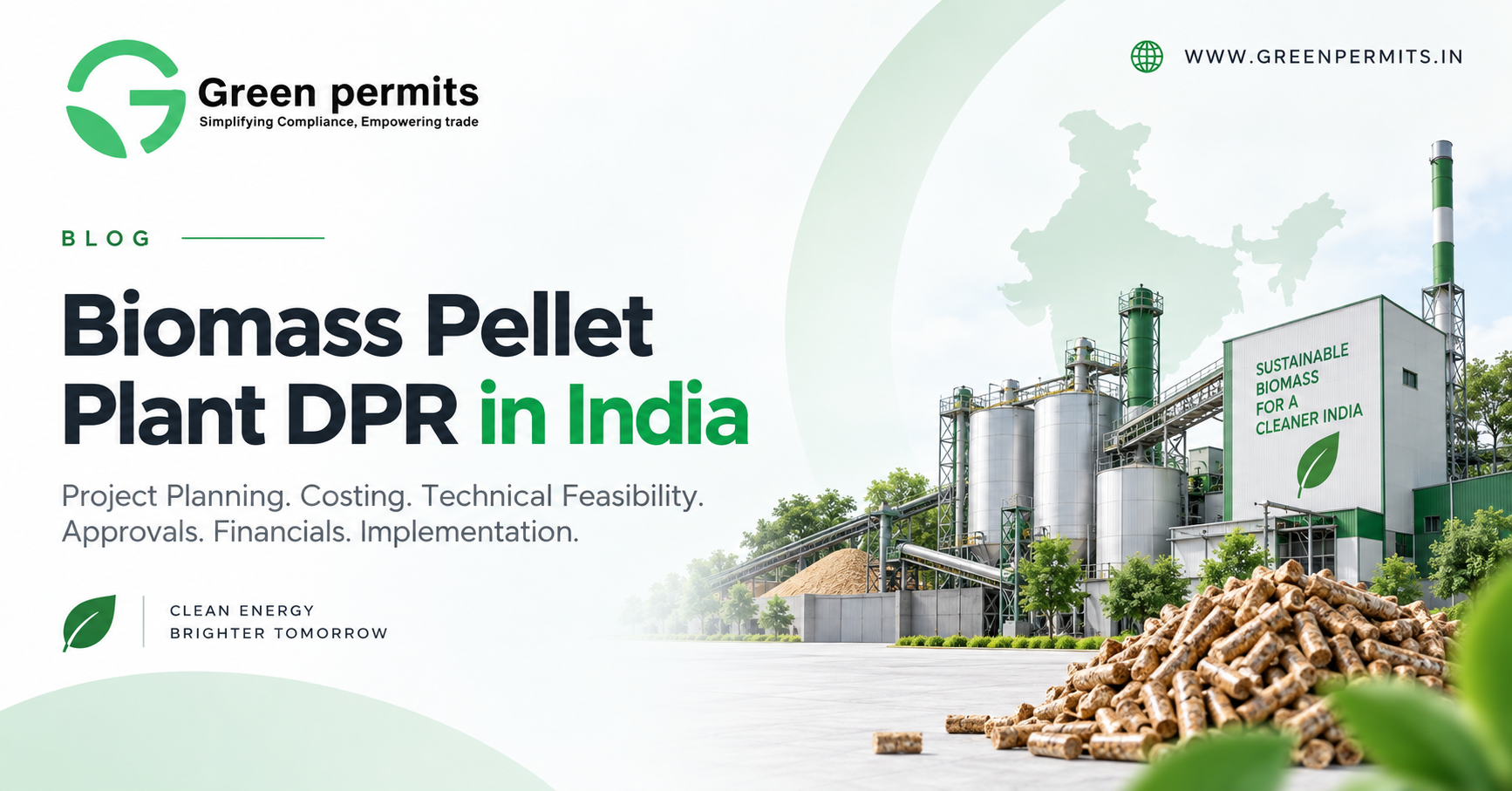
A Biomass Pellet Plant DPR helps investors, entrepreneurs and industrial promoters evaluate the technical feasibility, raw material requirement, machinery, project cost, operating expenses and financial viability of a biomass pellet manufacturing project before major investment.
Biomass pellets are produced by compressing suitable agricultural and biomass residues into dense fuel. Common feedstocks can include sawdust, rice husk, mustard stalk, groundnut shell, bagasse-based residue, wood waste and other suitable biomass materials.
The success of a biomass pellet project depends mainly on feedstock availability, moisture level, pellet quality, plant utilisation, energy consumption, transportation cost and buyer demand.
Green Permits Consulting supports investors with biomass pellet feasibility studies, DPR preparation, feedstock assessment, machinery planning, CAPEX and OPEX estimation, project finance and environmental approval support.
What is a Biomass Pellet Plant?
A biomass pellet plant converts loose biomass into compact cylindrical pellets that are easier to store, transport and use as fuel.
A typical process is:
Raw Biomass → Drying → Size Reduction → Conditioning → Pelletisation → Cooling → Screening → Packing / Storage
The exact process depends on the selected feedstock.
For example, dry sawdust may require less drying compared with high-moisture agricultural biomass. This directly affects machinery, electricity and thermal-energy requirements.
Why Prepare a DPR Before Setting Up the Plant?
A pellet plant may look simple from a machinery quotation, but its profitability depends on many operational factors.
The DPR should answer practical questions such as:
How much biomass is available within the sourcing radius? What is its moisture content? What percentage becomes saleable pellets? How much power and fuel will the plant consume? What price will the buyer pay for pellets?
The core project calculation should be:
Feedstock Cost + Processing Cost + Logistics Cost = Pellet Production Cost
This should then be compared with the expected selling price.
Without this analysis, a project may appear profitable only because transport, drying or working-capital costs were underestimated.
Feedstock Availability is the First Priority
A biomass pellet plant should not be designed before confirming raw material availability.
Potential feedstock may come from farms, rice mills, sawmills, agro-processing units, wood-processing industries and biomass aggregators.
However, biomass supply can be seasonal.
Agricultural residue may be available in large quantities after harvesting but become difficult or expensive to source later in the year.
The project should therefore evaluate:
Annual Availability → Seasonal Pattern → Storage Requirement → Delivered Cost
A 10 TPH pellet plant will not operate efficiently if enough biomass is available for only a few months.
Plant capacity should follow the realistic feedstock supply.
Feedstock Moisture and Quality
Moisture is one of the most important technical parameters in pellet manufacturing.
High-moisture biomass requires additional drying before pelletisation. Drying increases fuel consumption, equipment requirement and production cost.
Feedstock should also be checked for contamination, ash, particle size and consistency.
The DPR should not assume that every tonne of incoming biomass produces one tonne of pellets.
A realistic material balance should consider moisture removal, dust, fines and processing losses.
The better calculation is:
Incoming Biomass → Drying Loss → Processing Loss → Saleable Pellets
This gives a more accurate estimate of annual production.
Selecting the Right Plant Capacity
Plant size should be linked to both feedstock supply and buyer demand.
For example, installing a plant capable of producing 30,000 tonnes per year does not make financial sense if the project can secure only 15,000 tonnes of suitable raw material.
A smaller plant running consistently at higher utilisation may generate better returns than a larger plant operating at low capacity.
The correct sequence is:
Feedstock Study → Buyer Study → Capacity → Machinery → DPR → Project Finance
This reduces over-investment.
Biomass Pellet Plant Machinery
A typical biomass pellet plant may require shredders, grinders or hammer mills, dryers, conveyors, pellet mills, cooling systems, screens, dust-control systems and packing equipment.
Feedstock handling equipment is equally important.
If the project uses multiple agricultural residues, the plant may need a stronger pre-processing system than a facility operating only on sawdust.
Machinery suppliers should be compared on capacity, power consumption, pellet quality, maintenance requirement and actual output under the selected feedstock.
Buying machinery only on the basis of the lowest CAPEX can result in higher operating cost later.
Biomass Pellet Plant Setup Cost
There is no fixed cost for every biomass pellet project.
Investment depends on plant capacity, feedstock, drying requirement, level of automation, storage infrastructure and pollution-control systems.
The total project cost should consider:
Land + Civil Work + Raw Material Storage + Machinery + Electrical System + Pollution Controls + Finished Goods Storage + Working Capital
Working capital can be significant because biomass may need to be purchased and stored during the harvesting season.
A project that ignores seasonal inventory can face cash shortages even when its annual profitability appears attractive.
Buyer Market for Biomass Pellets
Before finalising the plant, the promoter should identify likely buyers.
Biomass pellets can be used in suitable industrial boilers, thermal applications and other approved biomass-fuel applications.
Different buyers may require different pellet specifications.
Important parameters can include calorific value, moisture, ash content, pellet diameter and mechanical strength.
The project should therefore follow:
Buyer Specification → Feedstock Selection → Process Design → Pellet Quality
Producing pellets first and looking for buyers later creates unnecessary market risk.
Transportation Cost Matters
Biomass has relatively low bulk density before pelletisation.
This means raw material transportation can become expensive if the sourcing radius is too large.
The plant should ideally be located close to major feedstock sources while maintaining reasonable access to buyers.
The DPR should calculate delivered raw material cost, not just farm-gate or supplier price.
Even a difference of a few hundred rupees per tonne in transportation can materially affect annual margins when the plant handles thousands of tonnes.
Revenue and Financial Model
The main revenue comes from the sale of biomass pellets.
A basic financial model should calculate:
Annual Pellet Production × Selling Price = Revenue
From this, the project deducts feedstock, electricity, drying fuel, manpower, maintenance, packing, transport and other expenses.
The model should also include gradual capacity utilisation instead of assuming full production from the first month.
For example, the plant may operate at lower utilisation during the initial year while procurement and buyer networks are stabilised.
The DPR should calculate EBITDA, cash flow, break-even, debt servicing and project returns based on realistic assumptions.
Environmental and Regulatory Approvals
A biomass pellet manufacturing facility should assess environmental and local approvals before construction.
Depending on the location, process and fuel system, the project may need Consent to Establish, Consent to Operate, air-pollution-control arrangements, fire-safety approvals, factory-related permissions and other local approvals.
Dryers, material handling and grinding sections can generate dust, so suitable dust-control systems should be part of the original plant design.
The approval requirement should be checked state-wise before machinery and civil construction are finalised.
Project Finance for Biomass Pellet Plant
A biomass pellet project may be financed through promoter equity, term loan and working-capital facilities.
Banks generally evaluate feedstock availability, machinery, buyer demand, promoter contribution, project cost and projected cash flow.
A stronger financing proposal can demonstrate both:
Reliable Biomass Supply + Identified Pellet Buyers
Long-term or recurring supply arrangements can reduce risk from raw material shortages.
Similarly, buyer discussions or offtake arrangements can make revenue projections more credible.
Common Mistakes in Biomass Pellet Projects
One common mistake is installing a large plant before confirming feedstock availability.
Another is using the raw biomass purchase price without including transportation, storage and drying costs.
Projects may also underestimate seasonal working capital or assume unrealistic plant utilisation.
The stronger implementation sequence is:
Feedstock Study → Buyer Assessment → DPR → Site → Approvals → Machinery → Finance → Installation → Commercial Production
How Green Permits Helps with Biomass Pellet Plant DPR
Green Permits Consulting supports investors with biomass feedstock studies, market assessment, feasibility reports, DPR preparation, machinery planning, CAPEX and OPEX modelling, project finance documentation and environmental approval planning.
The objective is to determine whether the plant has sufficient feedstock, suitable buyers and financially workable production costs before major investment is committed.
Learn More About Biomass Pellet Plant DPR
If you are planning a biomass pellet manufacturing project, the DPR should evaluate feedstock availability, moisture, plant capacity, machinery, pellet quality, buyer demand, project cost and working capital before equipment is finalised.
Read more about plant feasibility and DPR consulting services here:
👉 https://www.greenpermits.in/09/biomass-pellet-plant-dpr-cost-financials-setup/
📞 Get Expert Assistance for Biomass Pellet Plant DPR
If you need help with a Biomass Pellet Plant DPR, feasibility study, feedstock assessment, setup cost, machinery planning or project finance, Green Permits Consulting can assist you.
🌐 Website: www.greenpermits.in
📞 Phone: +91 78350 06182
📧 Email: wecare@greenpermits.in

 English
 Arabic
 French
 Spanish
 Portuguese
 Turkish
 Dutch
Dutch
 Italiano
 Russian
 Romaian
 Portuguese (Brazil)
 Greek
Greek
 Bengali