


Military Drone Market: AI, Autonomy and Future Trends
Introduction
The Military Drone Market is becoming an important part of modern defense technology as armed forces expand the use of unmanned aerial systems for intelligence, surveillance, reconnaissance, communications, logistics, and other missions. Military drones range from small tactical systems to larger long-endurance platforms capable of persistent operations.
Recent developments are accelerating innovation across the sector. NATO reported in 2026 that AI, drones, and autonomous systems are reshaping defense capabilities, while its Drone Edge initiative includes more than $40 billion in planned investment in counter-drone capabilities over five years.
The combination of Artificial Intelligence (AI), Machine Learning (ML), advanced sensors, secure communications, and autonomous navigation is expanding the capabilities of military drones. At the same time, governments are increasing research, testing, and procurement activities around unmanned systems.
Military Drone Market Size :
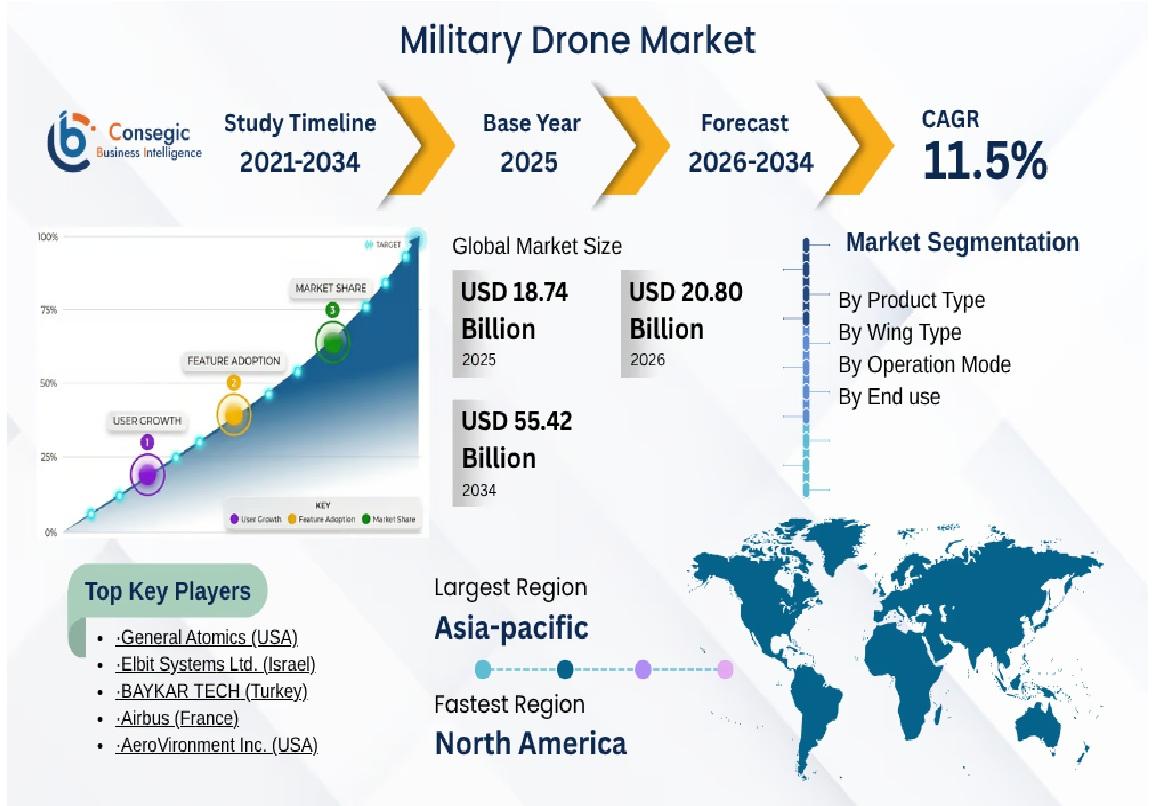
Military Drone Market size is estimated to reach over USD 55.42 Billion by 2034 from a value of USD 18.74 Billion in 2025 and is projected to grow by USD 20.80 Billion in 2026, growing at a CAGR of 11.5% from 2026 to 2034.
Market Snapshot
The Military Drone Market covers unmanned aerial vehicles designed or adapted for defense applications. Depending on their configuration, these systems can support reconnaissance, surveillance, target detection, communications, electronic warfare, logistics, and other military functions.
Major application areas include:
-
Intelligence, surveillance, and reconnaissance
-
Border and maritime monitoring
-
Communications and battlefield networking
-
Logistics and resupply
-
Electronic warfare
-
Training and operational support
-
Counter-drone operations
Defense ministries, armed forces, intelligence organizations, and security agencies represent major end users. Demand is also influenced by the growing importance of networked operations and the ability to collect information without placing personnel directly in certain operating environments.
Growth Drivers
Several factors are supporting development of the Military Drone Market:
-
Increasing defense requirements: Armed forces are expanding unmanned capabilities as part of broader modernization programs.
-
Technological advancements: Better sensors, batteries, propulsion systems, communications, and computing are improving drone performance.
-
Government initiatives: Defense organizations are increasing experimentation, testing, procurement, and industrial cooperation.
-
Autonomous operations: AI and ML are enabling greater automation in navigation, sensing, and data processing.
-
Counter-drone requirements: The growing use of drones is increasing investment in technologies designed to detect, identify, track, and counter unmanned aircraft. NATO announced a major counter-drone investment initiative in July 2026.
-
Industrial expansion: Governments and defense companies are developing production capacity and supply chains for unmanned systems.
Emerging Trends
AI integration is one of the most significant trends. AI-enabled systems can process sensor information, assist with object recognition, support route planning, and improve situational awareness. Machine Learning can help analyze large volumes of operational data and improve selected autonomous functions.
Automation and Digital Transformation are also changing drone operations. Connected command systems can combine information from drones, ground units, satellites, and other sensors.
Manned-unmanned teaming is another developing area. The European Defence Agency's autonomous-systems program specifically identifies cooperative autonomous systems and manned-unmanned teaming as development priorities.
Sustainability is also receiving attention through improved battery technologies, efficient propulsion, lightweight Advanced Materials, and longer operating endurance.
Technology Landscape
Military drone technology combines aircraft design, propulsion, sensors, communications, navigation, computing, and mission-management software.
Modern platforms can incorporate electro-optical and infrared sensors, radar, secure communications, satellite links, navigation systems, and onboard processing. Cloud Technologies and Data Analytics can support centralized analysis of information collected by distributed platforms.
Predictive Maintenance can monitor aircraft components and identify potential maintenance requirements. IoT Integration can connect drones with wider defense networks, while Robotics and autonomous-control technologies support increasingly automated missions.
Industry 4.0 and Smart Manufacturing are also influencing production. Digital design, automated manufacturing, simulation, and advanced materials can help manufacturers improve production efficiency and develop lighter or more durable platforms.
NATO's 2026 innovation activities show the growing emphasis on rapid testing and adoption. Its uncrewed-systems innovation work includes testing, evaluation, validation, and verification activities.
Regional Analysis
North America
North America has substantial activity in military unmanned aviation, supported by defense modernization, research programs, advanced aerospace capabilities, and demand for intelligence and surveillance systems. Investment is also expanding around autonomous technologies, counter-drone capabilities, secure communications, and AI-enabled defense systems.
Europe
Europe is increasing attention to autonomous and unmanned defense technologies. The European Defence Agency is supporting development across air, land, maritime, and cross-domain applications, including autonomy, robotics, AI, advanced computing, and networked systems.
Asia-Pacific
Asia-Pacific presents opportunities driven by defense modernization, maritime security requirements, border monitoring, and investment in indigenous aerospace technologies. Countries across the region are developing and acquiring different categories of unmanned systems for surveillance and operational support.
Latin America
Latin American demand is linked primarily to border surveillance, maritime monitoring, disaster response, and security operations. Military drones can provide persistent aerial observation across large geographic areas, creating opportunities for surveillance-focused platforms and related technologies.
Middle East & Africa
Demand in the Middle East and Africa is influenced by border security, intelligence requirements, maritime surveillance, and defense modernization. Investment opportunities include surveillance drones, autonomous systems, secure communications, and counter-drone technologies.
Investment Opportunities
Investment opportunities are emerging across several segments of the military unmanned-systems ecosystem. These include autonomous navigation, AI-based data processing, advanced sensors, secure communications, propulsion, batteries, and counter-drone technologies.
Potential areas include:
-
Tactical and long-endurance unmanned aircraft
-
AI-enabled surveillance systems
-
Autonomous navigation technologies
-
Counter-drone systems
-
Drone communications and networking
-
Advanced batteries and propulsion
-
Simulation and training technologies
-
Drone fleet-management platforms
Emerging markets may also create opportunities as governments establish domestic manufacturing capabilities and modernize defense technology infrastructure.
Competitive Environment
Competition is increasingly focused on autonomy, endurance, sensor capabilities, communications, payload flexibility, reliability, and manufacturing capacity. Companies and defense organizations are investing in product development, testing, research partnerships, and production expansion.
Partnerships between aerospace companies, software developers, universities, defense agencies, and technology startups are becoming important for accelerating innovation. NATO's 2026 initiatives also emphasize stronger connections between industry and innovation ecosystems.
Product launches are increasingly centered on autonomous capabilities, modular architectures, advanced sensing, and network connectivity. Research investment is also expanding into AI, electronic warfare, cybersecurity, propulsion, and resilient communications.
Key Statistics
-
NATO announced in July 2026 that Allies would invest more than $40 billion in counter-drone capabilities over five years.
-
NATO Allies also aim to train five times as many drone operators by the end of 2027.
-
NATO's 2026 Technical Interoperability Exercise involved approximately 300 participants and 40 companies, testing more than 60 commercial systems and 40 command-and-control software applications for counter-drone operations.
-
NATO launched a September 2026 data challenge seeking AI solutions for detecting, tracking, classifying, and identifying small drones through multi-sensor data fusion.
-
The European Defence Agency's autonomous-systems framework covers development and integration across land, air, maritime, and cross-domain operations.
-
NATO's 2026 strategy emphasizes uncrewed systems and AI as part of broader defense capability development.
Future Outlook Through 2034
The Military Drone Market is expected to evolve toward more connected, autonomous, modular, and data-driven systems through 2034. Future platforms are likely to combine AI, Machine Learning, advanced sensors, secure networks, autonomous navigation, and improved onboard computing.
One important development will be the integration of drones into wider defense networks rather than treating them as standalone aircraft. Multiple unmanned platforms may increasingly share information with command systems, other aircraft, ground units, and maritime assets.
Counter-drone technologies will also remain closely connected to market development because the increasing deployment of unmanned aircraft creates demand for detection and response capabilities. NATO's recent investments and testing programs demonstrate the scale of current attention to this area.
Advances in Advanced Materials, batteries, Green Technologies, Robotics, Smart Manufacturing, and autonomous software could further improve endurance, reliability, and production efficiency. Through 2034, the market is therefore likely to be shaped by the convergence of aerospace engineering, AI, communications, robotics, and digital defense infrastructure.
FAQ Section
Q1. What is the Military Drone Market?
The Military Drone Market covers unmanned aerial systems developed or used for defense and security applications. These platforms can support intelligence, surveillance, reconnaissance, communications, logistics, electronic warfare, and other military missions. Systems vary from small tactical drones to larger long-endurance aircraft with advanced sensors and network capabilities.
Q2. What factors are driving the market growth?
Key growth factors include defense modernization, increasing demand for surveillance, technological advances, autonomous capabilities, government investment, and the need for counter-drone systems. AI, Machine Learning, advanced sensors, secure communications, improved propulsion, and Digital Transformation are also expanding the capabilities of military unmanned aircraft.
Q3. Which region dominates the market?
Regional development differs according to defense budgets, modernization programs, domestic aerospace capabilities, and security requirements. North America has extensive military aerospace and technology capabilities, while Europe and Asia-Pacific are expanding investments in autonomous systems, surveillance, and defense innovation. Other regions are also developing applications for security and monitoring.
Q4. What are the latest market trends?
Major trends include AI integration, autonomous navigation, Machine Learning, sensor fusion, manned-unmanned teaming, advanced communications, counter-drone technologies, cloud-enabled data processing, and modular aircraft designs. Research is also focusing on improved endurance, electronic warfare capabilities, cybersecurity, advanced materials, and more efficient manufacturing.
Q5. What opportunities are expected by 2034?
Opportunities are expected in autonomous drones, AI-enabled surveillance, counter-drone technologies, advanced sensors, secure communications, battery systems, simulation, and drone fleet management. Demand for connected unmanned systems may also create opportunities for companies developing software, data platforms, communications infrastructure, and supporting technologies.
About Us
At Consegic Business Intelligence Pvt. Ltd., we empower organizations with actionable market
intelligence, strategic insights, and data-driven research solutions that support informed business decision-making. Our comprehensive market research reports provide in-depth analysis of industry trends, competitive landscapes, emerging opportunities, and future growth prospects across diverse sectors.
Contact Us
Consegic Business Intelligence Pvt. Ltd.
Website: www.consegicbusinessintelligence.com
Email: sales@consegicbusinessintelligence.com
Phone: +1-833-313-3130

 English
 Arabic
 French
 Spanish
 Portuguese
 Turkish
 Dutch
Dutch
 Italiano
 Russian
 Romaian
 Portuguese (Brazil)
 Greek
Greek
 Bengali