


Food Packaging Market 2026-2034: Size, Key Trends, Growth Rate, Top Companies & Industry Report
Market Overview
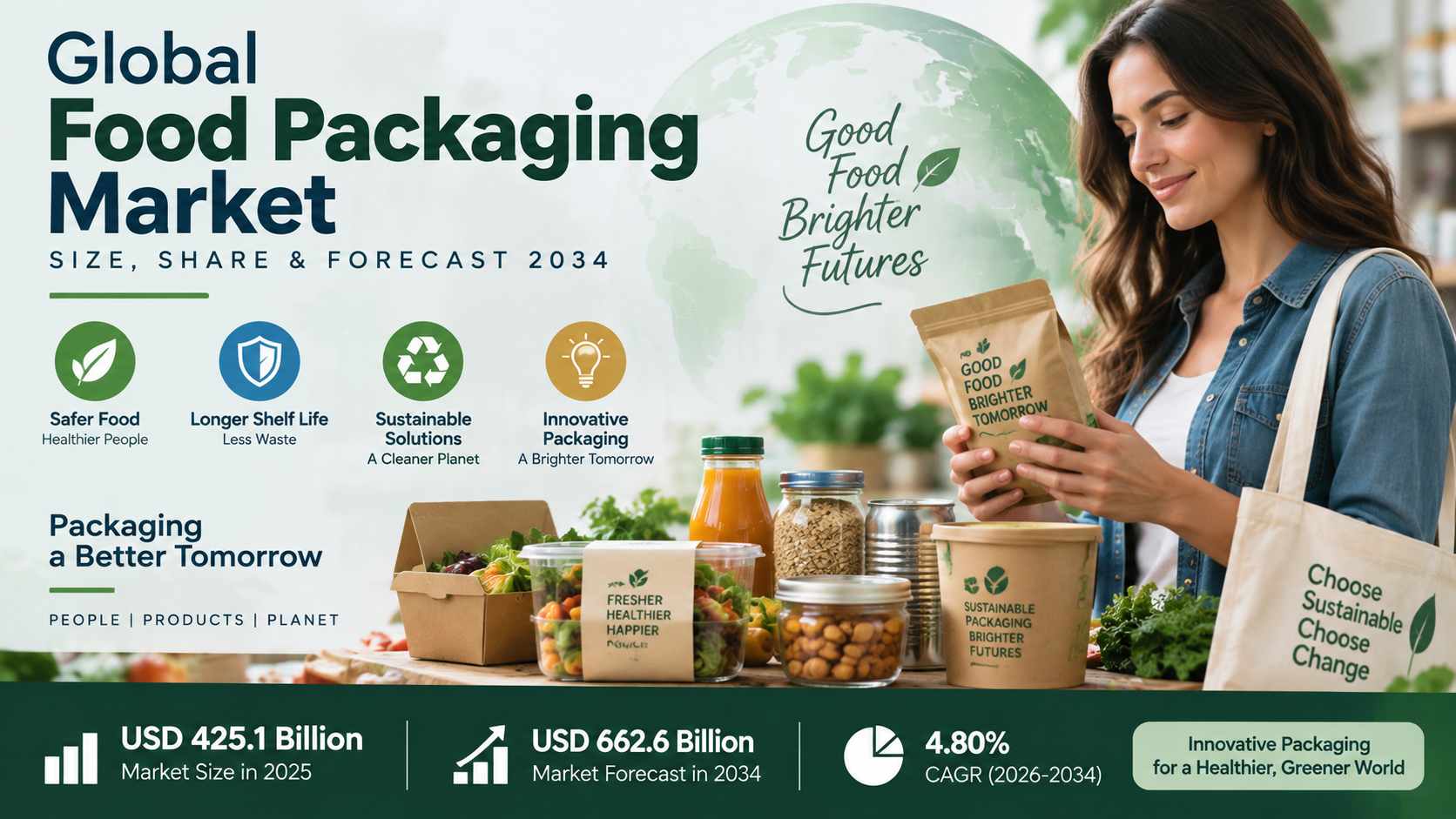
According to a research report by IMARC Group, the global food packaging market size was valued at USD 425.1 Billion in 2025. Looking forward, the market is projected to reach USD 662.6 Billion by 2034, growing at a CAGR of 4.80% during 2026-2034. North America currently dominates the regional landscape, accounting for a market share of over 31.0% in 2025. Growth in the market is primarily driven by growing concerns over environmental issues and the negative impacts of plastic waste, increasing demand for convenience foods, and continuous advancements in packaging technology aimed at extending shelf life and improving food safety.
-
Market Size & Growth: The global food packaging market share was valued at USD 425.1 Billion in 2025 and is projected to reach USD 662.6 Billion by 2034, registering a CAGR of 4.80% during 2026–2034.
-
Regional Leadership: North America represents the largest regional market, accounting for a 31.0% share in 2025, supported by strong demand for processed and convenience foods and continued advancements in packaging technology.
-
By Packaging Type: The market is segmented into flexible packaging, paper and paperboard packaging, rigid plastic packaging, glass packaging, metal packaging, and others, with flexible packaging holding the largest share.
-
By Application: The market covers bakery, confectionery, pasta and noodles, dairy products, sauces, dressings and condiments, snacks and side dishes, convenience foods, meat, fish and poultry, fruits and vegetables, and others, with bakery, confectionery, pasta and noodles representing the largest segment.
-
Key Market Drivers: Growing demand for convenience foods, increasing sustainability concerns, advancements in packaging technologies, and rising emphasis on food safety and extended shelf life.
-
Key Market Trends: Packaging innovation in design and aesthetics, technological advancements including QR codes and RFID, growing adoption of active and intelligent packaging, and increasing demand for biodegradable, recyclable, and compostable materials.
-
Key Market Challenges: Addressing environmental concerns associated with packaging waste while maintaining product protection, affordability, functionality, and compliance with evolving regulations.
-
Key Market Opportunities: Development of sustainable packaging materials, smart packaging technologies, advanced barrier solutions, and packaging innovations for emerging markets.
Request for a Sample Report for Detailed Evaluation: https://www.imarcgroup.com/food-packaging-market/requestsample
What Is Driving Food Packaging Market Growth in 2026?
Growing Demand for Convenience Foods
The increasing demand for convenience foods, ready-to-eat meals, snacks, and other packaged food products represents one of the key factors positively influencing the food packaging market. Changing lifestyles, rapid urbanization, and evolving consumption patterns are encouraging consumers to seek convenient food options that can be stored, transported, and consumed easily.
Packaging plays an important role in preserving food quality, extending shelf life, and ensuring safe distribution. Flexible pouches, cartons, rigid containers, vacuum-sealed formats, and other packaging solutions are increasingly being used to meet the diverse requirements of food manufacturers and consumers.
Sustainability and Environmental Concerns
Growing awareness regarding environmental issues and the negative impacts of plastic waste is accelerating demand for sustainable food packaging solutions. Consumers, governments, and businesses are increasingly encouraging the use of biodegradable, recyclable, compostable, and reusable packaging materials.
Manufacturers are responding by developing packaging designs that reduce resource consumption, improve recyclability, and lower the environmental impact associated with packaging waste. This sustainability-focused shift is also encouraging investments in alternative materials and innovative packaging technologies.
Technological Innovation in Packaging
Technological advancements are transforming the food packaging industry by improving product protection, traceability, freshness, and consumer convenience. Technologies such as quick response (QR) codes, radio-frequency identification (RFID) tags, freshness indicators, antimicrobial agents, and oxygen scavengers are increasingly being incorporated into packaging solutions.
These technologies provide information regarding product quality, source, and expiration dates while helping preserve food freshness and extend shelf life. Advances in materials science are also contributing to the development of lightweight, flexible, and durable packaging with improved barrier properties.
Packaging Innovation in Design and Aesthetics
Packaging design and aesthetics are becoming increasingly important factors in attracting consumers and strengthening brand identity. Creative packaging designs can differentiate products in competitive retail environments while communicating brand values and improving the overall consumer experience.
Ergonomic designs, informative labeling, interactive features, and innovative printing technologies are encouraging manufacturers to invest in packaging that combines functionality with visual appeal. Such innovations are supporting market growth as packaging increasingly serves both protective and marketing functions.
Rising Focus on Food Safety and Shelf Life
Food packaging plays a crucial role in maintaining product quality and safety by protecting food from contamination, moisture, oxygen, light, and other external factors. Increasing consumer expectations regarding freshness and food safety are encouraging manufacturers to adopt high-barrier and advanced packaging solutions.
Active and intelligent packaging technologies are further supporting these objectives through features such as freshness indicators, tamper-proof seals, improved traceability, and technologies designed to extend product shelf life.
Food Packaging Market Segmentation Analysis
By Packaging Type
-
Flexible Packaging
-
Paper and Paperboard Packaging
-
Rigid Plastic Packaging
-
Glass Packaging
-
Metal Packaging
-
Others
Flexible packaging leads the market by packaging type, accounting for a 49.5% share according to the supplied market outlook. Its versatility, affordability, lightweight nature, and performance are supporting widespread adoption across the food industry.
Flexible packaging includes bags, pouches, wraps, and films that can accommodate different shapes and sizes while providing protection against contamination and helping extend product shelf life. Its lightweight characteristics can also reduce transportation costs and resource consumption.
The increasing popularity of ready-to-eat meals and single-portion products is further supporting demand for flexible packaging. Advances in materials and printing technologies are improving packaging performance, appearance, and sustainability characteristics, allowing manufacturers to address changing consumer preferences.
In 2024, Domino Printing Sciences introduced a new TIJ solution for food packaging applications designed to improve overprinting efficiency and reduce consumable consumption and waste compared with traditional TTO solutions.
By Application
-
Bakery, Confectionery, Pasta, and Noodles
-
Dairy Products
-
Sauces, Dressings, and Condiments
-
Snacks and Side Dishes
-
Convenience Foods
-
Meat, Fish, and Poultry
-
Fruits and Vegetables
-
Others
Bakery, confectionery, pasta, and noodles represent the largest application segment, accounting for a 24.4% share. Strong consumer demand for these products, combined with increasing preferences for convenient and appealing packaging, is supporting segment growth.
Packaging formats such as flexible pouches, wrappers, and cartons provide protection against moisture, light, and air, helping preserve food quality and taste. Increasing demand for premium and handcrafted bakery and confectionery products is also encouraging manufacturers to adopt creative and visually appealing packaging designs.
In December 2023, Mars China launched SNICKERS® low-GI dark chocolate cereal bars in recyclable, mono-material, flexible packaging, supporting its sustainability objectives.
By Region
-
North America
-
Europe
-
Asia Pacific
-
Latin America
-
Middle East and Africa
North America leads the global food packaging market, accounting for 31.0% of the market share in 2025. The region's leadership is supported by strong demand for processed and convenience foods and continuous advancements in packaging technologies.
The developed food and beverage industry across North America requires effective and technologically advanced packaging solutions to meet changing consumer requirements. The growing popularity of convenience foods, pre-packaged meals, and individual servings is supporting demand for flexible packaging, rigid plastic packaging, and environmentally friendly materials.
Europe is witnessing growing demand for sustainable packaging solutions, supported by stringent regulatory policies related to sustainability and waste reduction. Increasing consumer interest in organic and health-conscious food products is also encouraging demand for protective and innovative packaging.
Asia Pacific is experiencing strong market growth due to rapid urbanization, rising disposable incomes, and changing consumer lifestyles. Increasing demand for convenience and ready-to-eat foods, particularly in China and India, is supporting packaging demand. Growing awareness regarding food safety, shelf life, and environmental sustainability is further contributing to regional expansion.
Latin America's food packaging market is being supported by population growth, urbanization, and increasing demand for processed, packaged, convenience, and ready-to-eat foods. Sustainability is also becoming increasingly important as consumers and businesses seek environmentally friendly packaging solutions.
The Middle East and Africa market is being driven by rapid urbanization, economic growth, rising disposable incomes, and changing consumer preferences toward convenient and packaged foods. Growth in online and modern retail channels is further expanding demand, while sustainability initiatives are encouraging the adoption of environmentally friendly packaging.
Key Regional Insight: North America's Strategic Position
North America's leading position in the global food packaging market is supported by its well-developed food and beverage industry, strong consumer demand for convenience foods, and continued investment in advanced packaging technologies.
The region is also witnessing growing demand for recyclable, biodegradable, and compostable materials as consumers and businesses place greater emphasis on environmental sustainability. Advances in smart packaging and barrier technologies are further improving food safety, shelf life, and consumer experiences.
In 2023, Amcor launched curbside-recyclable AmFiber Performance Paper packaging in North America for food applications, offering high-barrier protection while being compatible with existing flexible packaging equipment.
Regional Food Packaging Market Analysis
United States Food Packaging Market
The United States represents a major regional market for food packaging, supported by strong demand for convenience, quality, safety, and sustainability. The market encompasses a wide range of packaging materials, including plastic, paper, glass, and metal.
Demand for packaged snacks, frozen foods, and ready-to-eat meals continues to support market growth. Sustainability has also gained significant attention, with consumers and businesses increasingly seeking recyclable, biodegradable, and compostable packaging materials.
Advanced packaging technologies are being adopted to improve shelf life, food safety, durability, and overall consumer experience. Government initiatives related to waste reduction are further encouraging businesses to adopt environmentally responsible packaging practices.
Europe Food Packaging Market
The European food packaging market is supported by the growth of the food and beverage industry and demand for specialty packaging solutions. Rigid and flexible packaging formats are increasingly being used to address consumer requirements related to convenience and portability.
Vacuum-sealed and modified atmosphere packaging solutions help preserve the freshness of perishable products while maintaining flavor and nutritional properties. Resealable packaging is also gaining popularity among consumers seeking convenient products for on-the-go consumption.
High-barrier materials, portion-control packaging, premium designs, food-safe inks, and traceability technologies are contributing to continued innovation in the European market.
Asia Pacific Food Packaging Market
The Asia Pacific food packaging market is being supported by rapid urbanization, increasing disposable incomes, and changing consumer lifestyles. The growth of online food ordering and delivery is further increasing demand for flexible, safe, heat-retaining, spill-proof, and tamper-evident packaging.
The supplied market information notes that India's online food ordering and delivery market was valued at USD 28.3 Billion in 2022 and was expected to reach approximately USD 117 Billion by 2028 at a CAGR of 27%. The growth of this sector is supporting demand for packaging that maintains food quality during transportation.
Lightweight, stackable, temperature-resistant, and customized packaging formats are increasingly being adopted to improve storage, transportation, branding, and consumer experience.
Latin America Food Packaging Market
The Latin American food packaging market is benefiting from urbanization, population growth, and an expanding workforce. Increasing consumption of ready-to-eat meals, snack products, and pre-cut fresh produce is creating demand for convenient and functional packaging.
Compact microwavable containers, easy-opening formats, single-serving packages, and clear labeling are increasingly being used to address the requirements of busy and health-conscious consumers. Packaging solutions that combine portability, durability, extended shelf life, and attractive design are also gaining importance.
Middle East and Africa Food Packaging Market
The Middle East and Africa food packaging market is benefiting from tourism growth, economic development, urbanization, and changing consumer behavior. Rising demand for packaged, ready-to-eat, and processed foods is supporting the adoption of convenient packaging formats.
The expansion of tourism is also creating demand for portable and lightweight packaging that can accommodate meals during travel. Leak-proof, heat-sealed, compact, and multi-compartment packaging solutions are being adopted to improve convenience and protect food during transportation.
Sustainable materials and reusable packaging are also gaining relevance as governments, businesses, and consumers increasingly focus on reducing plastic waste and improving environmental performance.
Key Food Packaging Market Players Include:
-
Amcor PLC
-
Crown Holdings Incorporated
-
Owens-Illinois Inc.
-
Tetra Pak Ltd.
-
American Packaging Corporation
-
Ball Corporation
The competitive landscape of the food packaging market is characterized by increasing investments in innovation, sustainability, and technological capabilities. Companies are developing biodegradable, recyclable, and compostable materials while also introducing smart packaging solutions with freshness indicators, traceability technologies, tamper protection, and improved convenience.
Partnerships between packaging manufacturers and food producers are also supporting the development of customized packaging solutions that combine functionality, premium design, and environmental considerations. Innovations involving plant-based plastics and edible packaging are further contributing to the evolution of the industry.
Recent Developments:
-
May 2025: Diamond Edge Ventures, the corporate venture arm of Mitsubishi Chemical Group, participated in an oversubscribed seed funding round for Canadian startup Fresher Sustainable Technologies to support the scale-up of its active food packaging technology. The company's FreshrPack™ technology integrates natural antimicrobial agents onto packaging films and is designed for compostable, recyclable, and moisture-resistant applications.
-
April 2025: India's Ministry of Health and Family Welfare, in coordination with FSSAI, launched an initiative promoting sustainable food packaging, including guidelines and labeling intended to identify eco-friendly materials. The initiative included the finalized use of recycled PET (rPET) in food packaging and emphasized industry collaboration, regulatory alignment, and innovation.
-
January 2025: Kraft Heinz, in collaboration with the Rethinking Materials summit, launched its Global Packaging Innovation Challenge to seek sustainable flexible packaging solutions that are recyclable, compostable, durable, and user-friendly. The initiative is open to startups, universities, and businesses worldwide.
-
January 2025: INEOS Styrolution completed a demonstration project involving mechanically recycled polystyrene for yogurt cups. The project incorporated advanced sorting, hot washing, and pelletizing processes and involved collaboration across the value chain.
-
December 2024: Start-ups in Chennai developed food packaging alternatives using materials such as bagasse, cornstarch, and areca leaf products. The initiative reflects increasing demand for biodegradable cutlery and containers as businesses and brands place greater emphasis on sustainable packaging.
-
May 2024: Tetra Pak Ltd. and the University of Georgia opened North America's first Tetra Recart® trial facility at the UGA Food Product Innovation and Commercialization Center. The facility enables food companies to test and develop packaging solutions as alternatives to conventional canning processes.
-
April 2024: American Packaging Corporation launched a recyclable packaging design for pet food, aiming to replace non-recyclable laminates with PE-based materials while maintaining different package sizes and performance requirements.
-
February 2024: Amcor partnered with Stonyfield Organic and Cheer Pack North America to launch an all-polyethylene (PE) spouted pouch for YoBaby yogurt. The packaging uses AmPrima Plus film and Vizi caps and is designed to improve recyclability while maintaining packaging performance.
Market Drivers, Challenges & Opportunities
Major Market Drivers:
-
Growing Demand for Convenience Foods: Rising consumption of ready-to-eat meals, snacks, and other convenience foods is increasing the need for functional and attractive packaging.
-
Sustainability Concerns: Growing awareness regarding plastic waste and environmental issues is accelerating demand for recyclable, biodegradable, compostable, and reusable packaging.
-
Packaging Technology Advancements: Smart packaging, active packaging, advanced barrier coatings, RFID, QR codes, and freshness indicators are improving product safety, traceability, and shelf life.
-
Food Safety Requirements: Increasing emphasis on food safety and product quality is encouraging manufacturers to adopt packaging solutions that protect food from contamination and environmental exposure.
Key Challenges:
-
Environmental Impact of Packaging Waste: Manufacturers face increasing pressure to reduce packaging waste and dependence on conventional plastics while maintaining product protection and performance.
-
Evolving Regulatory Requirements: Changing food safety, sustainability, recycling, and waste-management regulations require packaging manufacturers to continuously adapt materials and production processes.
-
Balancing Sustainability and Performance: Packaging manufacturers need to develop environmentally responsible materials without compromising durability, shelf life, food safety, and cost-effectiveness.
Emerging Opportunities:
-
Sustainable Packaging Materials: Growing demand for recyclable, biodegradable, compostable, and reusable packaging is creating opportunities for material innovation.
-
Smart and Intelligent Packaging: Technologies such as freshness indicators, QR codes, RFID tags, and traceability solutions are opening new avenues for product differentiation and consumer engagement.
-
Advanced Barrier Technologies: Innovations that improve protection against oxygen, moisture, and other external factors are creating opportunities to extend food shelf life and reduce waste.
-
Emerging Markets: Rapid urbanization, rising disposable incomes, and changing consumption patterns across Asia Pacific and Latin America are creating additional demand for modern food packaging solutions.
Food Packaging Market FAQs
1. What is the current size of the food packaging market?
The global food packaging market was valued at USD 425.1 Billion in 2025 and is projected to reach USD 662.6 Billion by 2034, growing at a CAGR of 4.80% during 2026-2034.
2. What is driving the growth of the food packaging market?
The market is driven by increasing demand for convenience foods, growing environmental concerns, rising demand for sustainable packaging, technological advancements, and increasing emphasis on food safety and extended shelf life.
3. Which region dominates the food packaging market?
North America leads the global food packaging market, accounting for 31.0% of the market share in 2025, supported by strong demand for processed and convenience foods and continued advancements in packaging technology.
4. Which segment holds the largest share in the food packaging market?
Flexible packaging represents the largest packaging type segment, accounting for 49.5% of the market. By application, bakery, confectionery, pasta, and noodles represent the largest segment, with a 24.4% share.
5. What are the key trends in the food packaging market?
Key trends include innovations in packaging design and aesthetics, increasing adoption of smart and intelligent packaging, growing use of recyclable and biodegradable materials, advancements in barrier technologies, and rising demand for packaging that improves food safety and shelf life.
Conclusion: Food Packaging Market Outlook to 2034
The global food packaging market is set for steady growth through 2034, supported by increasing demand for convenience foods, growing emphasis on food safety and extended shelf life, technological advancements, and rising environmental concerns surrounding packaging waste.
While flexible packaging currently represents the largest packaging type and bakery, confectionery, pasta, and noodles account for the leading application segment, the market is increasingly evolving toward sustainable, smart, and technologically advanced packaging solutions. Manufacturers are investing in recyclable, biodegradable, compostable, and reusable materials while exploring active and intelligent packaging technologies.
With North America maintaining its position as the leading regional market and Asia Pacific and Latin America offering significant opportunities due to urbanization, rising disposable incomes, and changing consumption patterns, the outlook through 2034 remains positive. Companies investing in sustainable materials, advanced barrier technologies, smart packaging, and innovative designs will continue to play an important role as the food packaging industry evolves alongside changing consumer, regulatory, and environmental requirements.
About the Author:
IMARC Group is a leading global market research company providing data-driven insights and expert consulting services to businesses seeking to achieve their strategic objectives. With a multi-disciplinary team of industry experts, IMARC delivers thorough, reliable market intelligence across sectors including Energy and Mining, Construction and Manufacturing, Automotive, Chemicals and Materials, and more.
Media & Sales Contact:
IMARC Group
United States: +1-201-971-6302
India: +91-120-433-0800
United Kingdom: +44-753-714-6104

 English
 Arabic
 French
 Spanish
 Deutsch
 Turkish
 Dutch
Dutch
 Italiano
 Russian
 Romaian
 Portuguese (Brazil)
 Greek
Greek
 Bengali