


Used Oil Re-Refining Plant Project Implementation in India
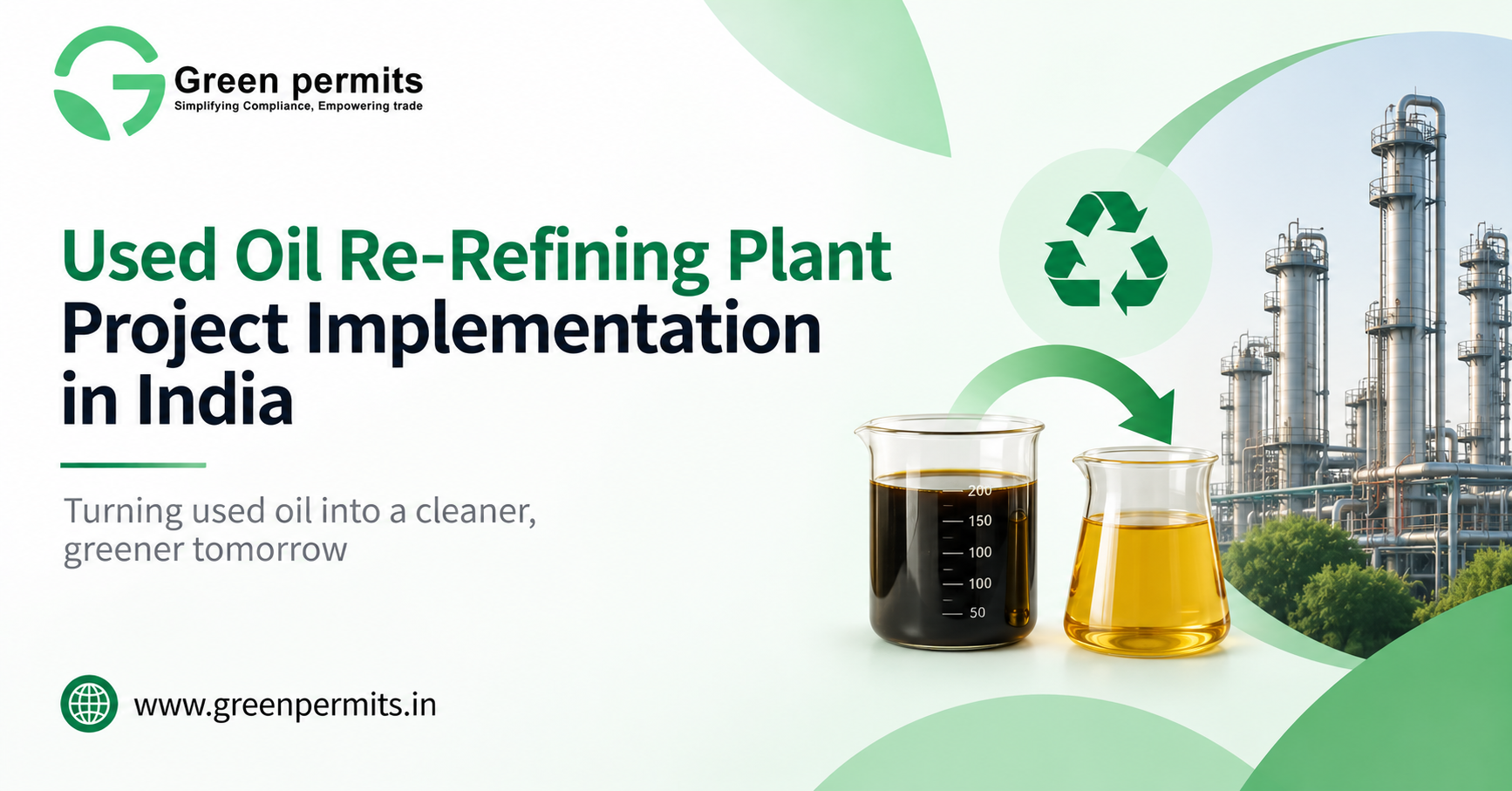
Setting up a Used Oil Re-Refining Plant in India requires careful planning of feedstock supply, technology, environmental approvals, machinery, product quality, working capital and buyer demand before construction begins.
Used lubricating oil generated from automobiles, industrial machinery, transformers, workshops and manufacturing facilities can still contain valuable base-oil fractions. Through re-refining, contaminants, water, sludge, degraded additives and other impurities are removed so that useful oil fractions can be recovered and processed further.
For investors, the project should not begin with machinery purchase. The correct starting point is to understand how much used oil can be secured, what quality it has, what recovery technology is suitable and who will buy the recovered product.
Green Permits Consulting supports investors with used oil market studies, feedstock assessment, DPR preparation, plant-capacity planning, technology selection, environmental approvals and project implementation support.
What is a Used Oil Re-Refining Plant?
A used oil re-refining plant processes waste lubricating oil so that recoverable oil fractions can be separated from water, sludge, metals, degraded additives and other contaminants.
Depending on the technology, the process may involve:
Used Oil Collection → Storage → Dehydration → Pre-Treatment → Vacuum Distillation → Purification / Finishing → Recovered Base Oil
The plant may also generate fuel fractions, sludge and other residues that require proper handling.
The exact process depends on incoming oil quality and the desired finished product.
Feedstock Study Should Come First
The success of the plant depends heavily on the availability of used oil.
Potential feedstock sources include automobile workshops, fleet operators, transport companies, factories, lubricant users, industrial maintenance facilities and authorised collection networks.
A project designed for 50 tonnes per day will struggle if only 20 to 25 tonnes can be collected consistently.
The correct sequence should be:
Feedstock Availability → Quality → Collection Cost → Plant Capacity → Technology → Product Market
This reduces the risk of installing an oversized plant.
Used Oil Quality Matters
Not all used oil has the same commercial value.
Some streams may contain relatively high recoverable lubricating-oil content, while others can contain water, fuel contamination, sludge or other unwanted material.
This affects both recovery yield and processing cost.
A market study should therefore analyse actual samples instead of using one standard recovery assumption.
The financial model should calculate:
Used Oil Input × Actual Recovery Yield = Saleable Recovered Product
An unrealistic recovery percentage can significantly overstate project revenue.
Selecting the Right Re-Refining Technology
Technology selection depends on the feedstock and the required final product quality.
A modern used oil re-refining project may use combinations of dehydration, vacuum distillation, thin-film or wiped-film evaporation, solvent treatment, clay polishing, hydrotreating or other finishing processes.
The technology should be selected on the basis of product quality, recovery efficiency, energy consumption, residue generation, operating cost and maintenance requirement.
A cheaper technology may reduce initial CAPEX but may also produce lower-value output.
The project should therefore compare lifecycle economics rather than machinery price alone.
Site Selection for the Plant
The project site should be suitable for industrial and waste-processing activities and have adequate space for used-oil storage, production equipment, finished product tanks, residue storage, utilities and pollution-control systems.
Location should also consider the distance from major used-oil generators.
Transporting used oil over long distances can materially increase procurement cost.
An ideal location should balance:
Feedstock Sources + Transport Cost + Industrial Infrastructure + Buyer Access
Road connectivity is particularly important because both incoming used oil and finished products are transported in bulk.
Used Oil Storage and Handling
Used oil should be stored in suitable tanks with proper containment and identification.
Incoming material should ideally be tested before unloading so that excessively contaminated batches can be identified.
Separate storage may be needed for different grades or qualities of used oil.
Good storage management improves process consistency and also helps maintain regulatory traceability.
Spill-control arrangements and safe transfer systems should be included during plant layout planning.
Major Machinery Required
The machinery configuration depends on the selected technology and capacity.
A typical plant may require receiving tanks, dehydration systems, filtration equipment, vacuum distillation units, evaporators, condensers, purification systems, storage tanks, pumps, heat exchangers and laboratory equipment.
Pollution-control and safety systems are equally important.
The machinery supplier should clearly specify expected recovery, energy consumption, capacity, product quality and residue generation.
A machinery quotation without these performance assumptions gives an incomplete picture of the project.
Plant Capacity Planning
Plant capacity should be linked to the amount of feedstock that can be secured every month.
For example, if the local sourcing study shows reliable availability of 6,000 tonnes per year, building a 15,000-tonne-per-year facility may create low utilisation.
A better strategy may be to build a smaller first phase and provide land and utilities for future expansion.
This can reduce initial investment while allowing the business to grow as the collection network develops.
Environmental Approvals
A used oil re-refining facility requires environmental compliance planning before construction.
Depending on the location and plant configuration, the project may need Consent to Establish, Consent to Operate, Hazardous Waste Authorisation and other applicable industrial or fire-safety approvals.
Used oil is regulated under India's hazardous-waste framework, and recycling or re-refining activities need to follow the applicable authorisation and registration requirements.
The plant should also establish proper handling routes for sludge, residues and other hazardous by-products.
Environmental systems should be included in the original project CAPEX rather than added after machinery installation.
Used Oil EPR Framework
India's Used Oil EPR framework creates additional formal demand for compliant recycling and re-refining.
Under the regulatory system, eligible registered recyclers can generate EPR certificates based on prescribed recycling activity, while producers fulfil their obligations using eligible certificates.
For a re-refining plant, this can create an additional commercial opportunity.
However, EPR certificate revenue should not be treated as guaranteed income.
The project's primary economics should remain based on actual used-oil sourcing, recovery yield and sale of recovered products.
Recovered Product and Buyer Market
Before finalising the project, the investor should identify what product the plant intends to sell.
Depending on the technology and quality, recovered outputs may include re-refined base oil or other usable oil fractions.
Potential buyers can include lubricant manufacturers, industrial oil users and other eligible downstream businesses.
The project should understand buyer requirements for viscosity, flash point, colour, sulphur, moisture and other quality parameters.
The right project sequence is:
Buyer Requirement → Product Specification → Technology → Plant Design
This prevents a situation where the plant produces material that does not meet the intended buyer's specification.
Used Oil Re-Refining Plant Setup Cost
There is no fixed cost for every re-refining plant.
Investment depends on plant capacity, technology, automation, storage tanks, distillation system, finishing equipment, utilities, pollution controls and laboratory requirements.
The complete project cost should consider:
Land + Civil Work + Machinery + Storage + Utilities + Pollution Controls + Laboratory + Working Capital
Working capital is important because the business may need to purchase used oil before finished products are sold.
Project Implementation Timeline
A successful project should be implemented in planned stages.
The first stage should cover market study, feedstock assessment and DPR preparation. After that, the promoter can finalise the site, obtain required approvals, select the technology and machinery supplier and begin civil construction.
Once machinery is installed, the plant proceeds to commissioning, trial production and product-quality validation.
Commercial operations should begin only after the required operating approvals are in place.
A practical sequence is:
Market Study → DPR → Site → Approvals → Machinery → Construction → Installation → Trial Run → CTO / Registration → Commercial Production
DPR for Used Oil Re-Refining Plant
A Detailed Project Report - DPR connects technical design with financial feasibility.
The DPR should cover feedstock availability, capacity, process technology, machinery, material balance, land, utilities, manpower, approvals, project cost and working capital.
The financial section should evaluate revenue, operating expenses, profitability, cash flow, break-even and debt servicing.
Sensitivity analysis should also test what happens if used-oil purchase prices rise, recovery yield falls or recovered-product prices decline.
This helps investors understand the project's risk before taking debt or committing equity.
Common Project Implementation Mistakes
One common mistake is purchasing machinery before confirming used-oil availability.
Another is assuming a high recovery rate without testing representative feedstock.
Projects can also underestimate working capital, storage requirements, pollution-control cost or residue disposal.
The stronger approach is:
Feedstock Study → Buyer Study → DPR → Approvals → Technology → Machinery → Commissioning
This keeps the commercial, technical and regulatory sides of the project aligned.
How Green Permits Helps with Used Oil Re-Refining Projects
Green Permits Consulting supports investors and recyclers with used oil feedstock studies, feasibility reports, DPR preparation, technology assessment, plant-capacity planning, CTE/CTO, Hazardous Waste compliance, project cost analysis and project implementation support.
The objective is to evaluate the complete project before major capital is committed.
Learn More About Used Oil Re-Refining Plant Project Implementation
If you are planning a used oil re-refining plant, the project should be evaluated for feedstock availability, recovery technology, product buyers, plant capacity, approvals and financial viability before machinery is finalised.
Read more about recycling plant setup and DPR consulting services here:
👉 https://www.greenpermits.in/09/used-oil-re-refining-project-roadmap-in-india/
📞 Get Expert Assistance for Used Oil Re-Refining Plant Setup
If you need help with Used Oil Re-Refining Plant Project Implementation, feasibility study, DPR preparation, feedstock assessment, machinery planning or environmental approvals, Green Permits Consulting can assist you.
🌐 Website: www.greenpermits.in
📞 Phone: +91 78350 06182
📧 Email: wecare@greenpermits.in

 English
 Arabic
 French
 Spanish
 Portuguese
 Deutsch
 Dutch
Dutch
 Italiano
 Russian
 Romaian
 Portuguese (Brazil)
 Greek
Greek
 Bengali