


Internet of Things (IOT) in Healthcare Market Size, Share, Industry Analysis and Forecast 2026-2034
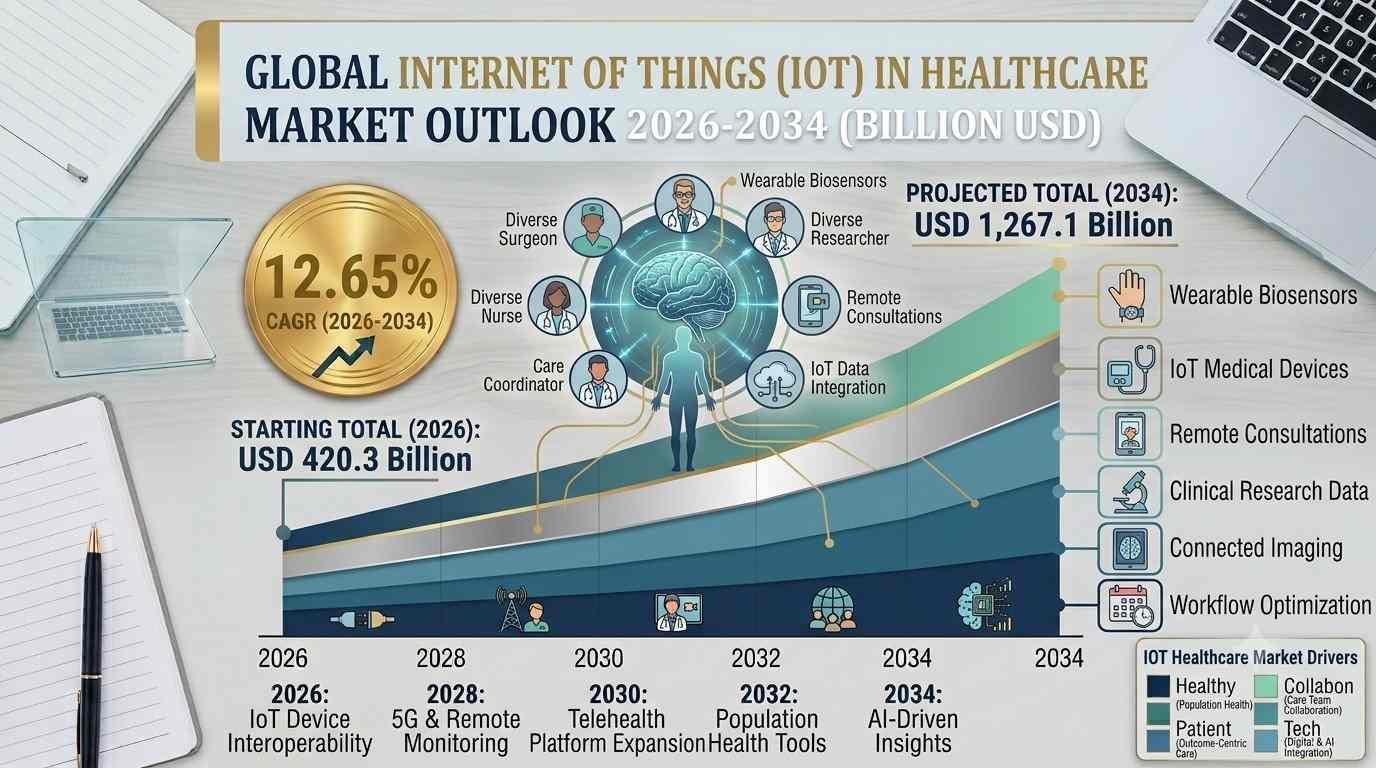
According to IMARC Group, the global internet of things (IOT) in healthcare market size reached USD 420.3 Billion in 2025 and is projected to reach USD 1,267.1 Billion by 2034, expanding at a CAGR of 12.65% during 2026-2034. This strong internet of things (IOT) in healthcare market growth reflects rising adoption of connected medical devices, growing demand for real-time health monitoring, advancements in sensor technology and data analytics, an aging population's need for preventive and personalized care, and government initiatives promoting digital healthcare infrastructure.
Internet of Things (IOT) in Healthcare Industry Overview
IoT in healthcare refers to the network of connected medical devices, wearable sensors, hospital systems, and software applications that collect, transmit, and analyze health-related data in real time. By linking physical devices to cloud-based analytics platforms, healthcare providers gain continuous visibility into patient vitals, equipment status, and operational workflows, enabling faster clinical decisions, proactive interventions, and more efficient resource utilization than traditional, episodic care models can support.
IoT-enabled healthcare solutions are deployed across a broad continuum of use cases:
- Telemedicine: Remote consultations and virtual care delivery supported by connected diagnostic and monitoring devices
- Medication management: Smart pill dispensers, adherence apps, and electronic prescribing systems that reduce medication errors
- Clinical operations: Asset tracking, inventory management, and workflow automation across hospital facilities
- Inpatient monitoring: Wearable sensors and smart beds enabling continuous vital-sign tracking and early deterioration detection
- Connected imaging: Cloud-based image storage and AI-assisted interpretation supporting collaborative diagnosis
Global Internet of Things (IOT) in Healthcare Market Size & Key Statistics
Below are the key Internet of Things (IOT) in Healthcare Market statistics drawn from IMARC Group's comprehensive market analysis:
Base Year - 2025
Historical Period - 2020-2025
Forecast Period - 2026-2034
Internet of Things (IOT) in Healthcare Market Size in 2025 - USD 420.3 Billion
Market Forecast in 2034 - USD 1,267.1 Billion
Market Growth Rate (2026-2034) - 12.65% CAGR
Largest Region - North America
Leading Component Segment - Services
Leading Connectivity Technology - Cellular
Leading Application - Telemedicine
Leading End-Use Segment - Hospitals and Clinics
Request for a Sample Report for Detailed Internet of Things (IOT) in Healthcare Market Share Evaluation: https://www.imarcgroup.com/internet-of-things-in-healthcare-market/requestsample
Key Market Drivers & Internet of Things (IOT) in Healthcare Market Trends in 2026
Several powerful forces are shaping internet of things (IOT) in healthcare market trends and fuelling sustained growth expectations across global digital health markets:
1. Increasing Adoption of IoT Devices by Healthcare Providers
Healthcare providers are relying more heavily on IoT devices and platforms to improve patient care quality and optimize operational processes. Industrial IoT and medical device security collaborations between regional cybersecurity vendors are expanding to support connected healthcare deployments in emerging digital-health markets. IoT solutions also help healthcare organizations optimize inventory control, asset and facility management, reducing costs and increasing resource efficiency.
2. Growing Demand for Real-Time Health Monitoring
Demand for remote, real-time health monitoring has risen sharply in recent years as patients increasingly seek to track their health status and detect early signs of illness. IoT devices enable 24/7 monitoring of vital signs such as heart rate, blood pressure, and blood glucose, supporting chronic disease management and timely intervention. This is especially valuable in remote patient monitoring programs that help avoid unnecessary hospital readmissions and improve outcomes.
3. Advancements in Sensor Technology and Data Analytics
Continuous improvement in sensor miniaturization and data-analytics capability is enabling next-generation IoT healthcare solutions. Sensors embedded in wearables, implants, and home-monitoring systems capture large volumes of physiological data, which advanced analytics algorithms process in real time to detect trends, outliers, and predictive patterns, supporting personalized, evidence-based clinical decisions.
4. Expansion of Telemedicine and Smart Hospital Infrastructure
The industry is increasingly relying on IoT to power telemedicine, delivering real-time remote consultations and care. IoT devices are also being integrated into patient management systems for personalized attention, while the emergence of smart hospitals — which use IoT to manage operations, patient care, and energy — is a defining structural trend reshaping facility design and investment.
5. Integration of Artificial Intelligence into IoT Platforms
Combining AI with IoT infrastructure is improving diagnostic accuracy and predictive analytics across connected healthcare applications. The growing use of internet-connected devices for mental health management, including tools that monitor psychological states and recommend interventions, is a further driver of Internet of Things (IOT) in Healthcare Market Growth.
6. Aging Population and Rising Chronic Disease Burden
The IoT in healthcare business is fundamentally driven by the need to optimize patient outcomes while reducing costs. The aging population's growing demand for personalized and preventive healthcare solutions, combined with the rising prevalence of chronic diseases requiring round-the-clock monitoring, is expanding the addressable base for connected-care technologies.
7. Government Investment in Digital Health Infrastructure
Government and health-organization investment in IoT is boosting smart health infrastructure worldwide, creating a positive Internet of Things (IOT) in Healthcare Market outlook. Technological advancement in sensors and machine learning has made connected devices smarter and more reliable, further stimulating adoption across public and private healthcare systems.
Key Market Segmentation
By Component
Services — Largest Segment: Services, including system integration, consulting, training and education, and support and maintenance, hold the majority of the total Internet of Things (IOT) in Healthcare Market Share. As adoption of connected medical devices and software expands, healthcare organizations increasingly require specialized expertise to navigate regulatory requirements, optimize system integration, and maximize return on IT investment.
Medical Devices: This segment spans wearable external devices, implanted medical devices, and stationary medical devices, driven by rising chronic disease prevalence, an aging population, and growing focus on personalized medicine and minimally invasive procedures.
System and Software: Covering remote device management, network bandwidth management, data analytics, application security, and network security, this segment is propelled by rising investment in EHR, medical imaging software, and telemedicine platforms that improve interoperability and patient engagement.
By Connectivity Technology
Cellular — Largest Segment: Cellular technologies such as LTE-M and NB-IoT currently exhibit clear dominance, offering wide coverage, robust security, and support for high-bandwidth applications suited to connected vehicles, smart cities, and industrial healthcare automation.
Wi-Fi: Preferred for high-speed, reliable wireless connectivity in hospitals, offices, and smart-facility deployments, further boosted by Wi-Fi 6 and Wi-Fi 6E advancements.
Bluetooth Low Energy (BLE): Favoured for energy-efficient, low-cost wireless communication in wearables, smart sensors, and asset tracking devices.
ZigBee, Near Field Communication (NFC), and Satellite: ZigBee supports low-power mesh networking for facility automation; NFC enables secure, contactless authentication and mobile payments; and satellite connectivity extends coverage to remote and isolated healthcare settings beyond terrestrial network reach.
By Application
Telemedicine — Largest Segment: Telemedicine currently accounts for the majority of the global Internet of Things (IOT) in Healthcare Market Share, driven by demand for convenient remote access to care, particularly in rural and underserved areas, and accelerated by the post-pandemic mainstreaming of virtual healthcare delivery.
Medication Management: Smart pill dispensers, adherence apps, and e-prescribing systems address non-adherence and reduce medication errors amid rising chronic disease prevalence.
Clinical Operations: Asset tracking, inventory management, and workflow automation tools streamline hospital supply chains and improve staff efficiency.
Inpatient Monitoring: Wearable sensors, smart beds, and remote monitoring systems help detect early signs of patient deterioration and reduce complication risk.
Connected Imaging and Others: Digital imaging modalities, cloud-based storage, and AI algorithms enhance imaging workflow efficiency and enable remote, collaborative interpretation.
By End User
Hospitals and Clinics — Largest Segment: Hospitals and clinics hold the largest end-use share of the Internet of Things (IOT) in Healthcare Market, leveraging connected devices for remote patient monitoring, real-time health tracking, and EHR integration that supports care coordination and improved patient outcomes.
Clinical Research Organizations (CROs): CROs use wearables and remote monitoring systems to streamline clinical trials, improve data accuracy, and enable remote patient recruitment and engagement.
Research and Diagnostic Laboratories: Laboratories deploy IoT-enabled instrument connectivity and predictive maintenance to optimize equipment performance and minimize downtime.
Others: Includes consumer-facing wearable devices offering personalized health-parameter monitoring beyond formal clinical settings.
Regional Internet of Things (IOT) in Healthcare Market Analysis
North America — Largest
United States & Canada; superior healthcare infrastructure, presence of leading IoT healthcare enterprises, higher healthcare spending, and a regulatory climate conducive to advanced-system adoption
Europe: Germany, France, UK, Italy, Spain, Russia; government programmes promoting digital health, rising investment in IoT health innovation, strong interoperability and data-security standards
Asia-Pacific: China, Japan, India, South Korea, Australia, Indonesia; rapid healthcare infrastructure expansion, rising technology adoption, growing awareness of IoT healthcare management
Latin America: Brazil, Mexico; addressing healthcare disparities and improving access to quality care through IoT-enabled solutions and government digital-health strategies
Middle East & Africa: Rising investments in healthcare infrastructure development, growing awareness of IoT benefits, and initiatives to enhance healthcare delivery in remote areas
North America leads the global Internet of Things (IOT) in Healthcare Market Share, underpinned by superior healthcare infrastructure, a dense base of leading IoT healthcare enterprises, and significantly higher healthcare spending. As per the Internet of Things (IOT) in Healthcare Market analysis, Asia-Pacific represents the fastest-growing region, driven by rapid urbanization, rising healthcare spending, growing demand for remote patient monitoring, and expanding smartphone and telecommunications infrastructure.
Connect for Detailed Internet of Things (IOT) in Healthcare Market Share Segmentation Analysis — Speak to an Analyst: https://www.imarcgroup.com/request?type=report&id=6143&flag=C
Leading Players in the Global Internet of Things (IOT) in Healthcare Industry
The global IoT in healthcare market features a mix of medical device manufacturers, consumer technology giants, and specialized connected-health vendors. Key companies covered in the IMARC Group report include:
- AliveCor, Inc.
- Apple Inc.
- Baxter International Inc.
- Cisco Systems, Inc.
- Comarch SA
- HQSoftware
- iHealth Labs Inc.
- Koninklijke Philips N.V.
- Medtronic plc
- Microsoft Corporation
- Qualcomm Technologies, Inc.
About Us
IMARC Group is a leading global market research company providing data-driven insights and expert consulting services to businesses seeking to achieve their strategic objectives. With a multi-disciplinary team of industry experts, IMARC delivers thorough, reliable market intelligence across sectors including Healthcare, Technology, Chemicals, Energy, Food & Beverages, and more.
Contact Us
IMARC Group
United States: +1-201-971-6302
India: +91-120-433-0800
United Kingdom: +44-753-714-6104

 English
 Arabic
 French
 Spanish
 Portuguese
 Deutsch
 Turkish
 Italiano
 Russian
 Romaian
 Portuguese (Brazil)
 Greek
Greek
 Bengali