


Press Mud Bio-CNG Plant Subsidy & Project Finance in India
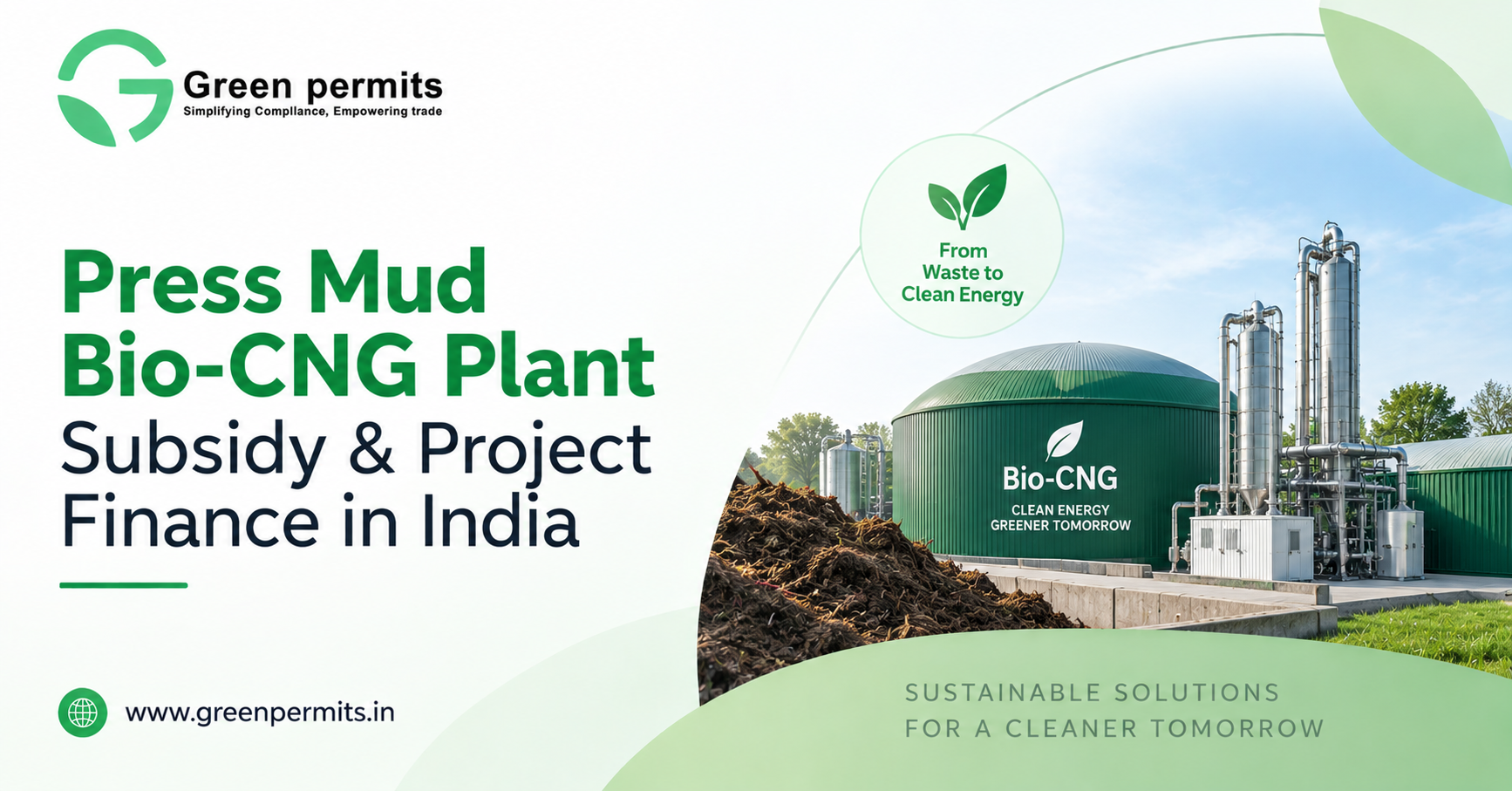
Setting up a Press Mud Bio-CNG Plant in India can be an attractive opportunity for sugar mills, renewable-energy developers, investors and entrepreneurs looking to convert sugar-industry waste into compressed biogas.
Press mud is generated during sugar processing and contains biodegradable organic matter that can be used as feedstock for anaerobic digestion. However, the commercial success of a Bio-CNG project depends on more than machinery. Investors need to evaluate press mud availability, seasonal storage, gas yield, plant capacity, subsidy eligibility, Bio-CNG offtake, CAPEX, working capital and project finance before construction begins.
Green Permits Consulting supports investors with Press Mud Bio-CNG feasibility studies, DPR preparation, feedstock assessment, subsidy analysis, machinery planning and project finance documentation.
Why Press Mud is Used for Bio-CNG Production
Press mud is a by-product generated by sugar mills during clarification of sugarcane juice. Instead of treating it only as a low-value residue, it can be converted into biogas through anaerobic digestion.
The basic process is:
Press Mud → Feed Preparation → Anaerobic Digestion → Raw Biogas → Purification → Compression → Bio-CNG
The digestion process also generates digestate, which may have potential agricultural use after suitable processing and quality assessment.
For sugar-producing regions, the availability of press mud near the plant can significantly improve Bio-CNG project economics by reducing feedstock transportation costs.
Feedstock Availability Comes Before Plant Capacity
The first question should not be "Which machinery should we buy?"
It should be:
How much press mud can we secure every year?
Press mud production is linked to sugarcane crushing, which means availability can be seasonal. A Bio-CNG plant, however, normally needs relatively consistent feed throughout the year.
The project therefore needs to evaluate annual press mud generation, crushing season, supplier locations, transport distance and storage strategy.
For example, a plant designed for 100 tonnes of feedstock per day may struggle if only 60 to 70 tonnes can be supplied consistently.
Plant capacity should therefore follow realistic feedstock availability.
Press Mud Storage is an Important Project Issue
Seasonality is one of the biggest differences between press mud projects and plants using continuously available feedstock.
Large quantities may become available during the sugar-crushing season, while supply can reduce significantly outside that period.
The project may therefore need a suitable storage and preservation strategy.
Storage planning affects land requirement, working capital, feedstock quality and operating continuity.
A DPR should evaluate whether the project will use only press mud or combine it with other suitable feedstocks during periods of lower availability.
Bio-CNG Production from Press Mud
The actual gas yield from press mud depends on its moisture, organic content, storage condition and digestion performance.
There is no single conversion factor that should be applied to every project.
Before financial projections are prepared, representative feedstock should ideally be analysed and realistic biogas and methane-yield assumptions established.
The financial model should calculate:
Daily Feedstock × Actual Gas Yield × Methane Recovery = Saleable Bio-CNG
Using an overly optimistic gas yield can make the project appear much more profitable than it may be in actual operation.
Machinery Required for a Press Mud Bio-CNG Plant
A press mud Bio-CNG facility generally requires feedstock preparation, feeding systems, digesters, pumps, agitators, gas holders, H2S removal, gas purification, drying, compressors and storage systems.
Digestate management is also an important part of the plant.
Technology should be selected according to feedstock characteristics and expected gas production rather than purchasing a standard Bio-CNG package.
The machinery supplier should clearly specify gas-yield assumptions, methane recovery, electricity consumption and equipment included within the proposed scope.
Press Mud Bio-CNG Plant Setup Cost
There is no fixed setup cost for every Press Mud Bio-CNG plant.
Investment depends on feedstock capacity, digestion technology, land, civil construction, purification technology, gas compression, storage, utilities and automation.
The total project investment should consider:
Land + Civil Work + Feedstock Storage + Digesters + Purification + Compression + Utilities + Environmental Systems + Working Capital
Working capital can be particularly important for press mud projects because large volumes of feedstock may need to be purchased or secured during the crushing season.
Government Subsidy for Bio-CNG Plants
Bio-CNG and compressed biogas projects may be eligible for support under applicable central or state renewable-energy, waste-to-energy, industrial or clean-energy programmes.
However, investors should not assume that every Bio-CNG project automatically receives a fixed subsidy.
Eligibility can depend on the current scheme, plant technology, project capacity, commissioning conditions, location and other criteria.
State governments may also provide industrial incentives related to land, electricity, capital investment or other project costs depending on the applicable policy.
The project should therefore use:
Confirmed Subsidy Eligibility
rather than an assumed subsidy while preparing the final financial model.
A commercially strong project should remain understandable even if an expected incentive is delayed.
SATAT and Bio-CNG Offtake
Bio-CNG projects can also evaluate opportunities linked to India's compressed biogas ecosystem and potential offtake arrangements with gas marketing companies or industrial buyers.
For project finance, the important factor is not simply whether a buyer exists nationally.
The promoter should determine the expected quantity, quality specification, delivery model, distance from the plant and commercial terms.
A plant with a clearly identified buyer generally provides a stronger investment case than one planning to search for customers after commissioning.
Project Finance for Press Mud Bio-CNG Plant
A Press Mud Bio-CNG plant can typically be financed through a combination of promoter equity, term loan, working-capital facilities and eligible incentives.
Lenders generally want to understand whether the project has reliable feedstock and a realistic market for Bio-CNG.
The financing case becomes stronger when the promoter can demonstrate relationships with sugar mills, feedstock supply agreements and potential gas offtake arrangements.
For lenders, the project chain should look like:
Feedstock Security → Predictable Gas Production → Confirmed Buyer → Revenue → Debt Repayment
This is why feedstock and offtake agreements can be just as important as machinery quotations.
What Banks Look for in a Bio-CNG Project
Banks and financial institutions typically evaluate the promoter, project cost, feedstock supply, technology, machinery supplier, gas production assumptions, buyer arrangement and expected cash flow.
They will also examine whether the project can service its debt under realistic operating conditions.
A financial model should therefore use gradual plant stabilisation instead of assuming maximum production immediately after commissioning.
Sensitivity analysis should also consider lower gas yield, higher feedstock cost, lower plant utilisation and changes in operating expenses.
Revenue from Bio-CNG and Digestate
The primary revenue source is usually the sale of Bio-CNG.
Digestate or processed organic manure may provide an additional revenue stream depending on its quality, processing and local demand.
However, manure income should be estimated conservatively.
The project's core financial viability should not depend on unrealistic assumptions about digestate selling price.
A stronger financial model focuses first on:
Bio-CNG Production × Realistic Selling Price = Core Operating Revenue
and then adds other genuine revenue streams separately.
Environmental and Regulatory Approvals
A Press Mud Bio-CNG plant should assess environmental and industrial approvals before construction.
Depending on the location and project configuration, requirements may include Consent to Establish, Consent to Operate, fire-safety approvals, factory-related permissions and other local or project-specific approvals.
Gas compression and storage arrangements should also be reviewed according to the actual facility configuration.
These requirements should form part of the DPR and plant layout from the beginning.
DPR for Press Mud Bio-CNG Plant
A Detailed Project Report - DPR helps determine whether the project is technically and financially viable before major investment.
The DPR can assess press mud availability, storage, plant capacity, gas yield, machinery, land, utilities, approvals, project cost and working capital.
The financial section can include revenue projections, operating cost, profitability, cash flow, break-even and debt servicing.
For bank finance, the DPR should be supported by realistic feedstock and offtake assumptions rather than only theoretical Bio-CNG production.
Common Mistakes in Press Mud Bio-CNG Projects
One common mistake is designing the plant from machinery capacity instead of actual press mud availability.
Another is ignoring feedstock seasonality and assuming year-round supply without a storage plan.
Projects may also overestimate gas yield, assume subsidy approval before confirmation or underestimate working capital.
A better development sequence is:
Press Mud Study → Storage Plan → Gas Yield → Buyer → Plant Capacity → DPR → Subsidy Assessment → Project Finance → Plant Setup
How Green Permits Helps with Press Mud Bio-CNG Projects
Green Permits Consulting supports sugar mills, renewable-energy developers and investors with Press Mud Bio-CNG feasibility studies, feedstock assessment, DPR preparation, subsidy analysis, machinery planning, CAPEX and OPEX modelling, project finance documentation and environmental approval planning.
The objective is to connect feedstock, plant capacity and project finance before major capital is committed.
Learn More About Press Mud Bio-CNG Plant Subsidy & Project Finance
If you are planning a Press Mud Bio-CNG plant, the project should be evaluated for feedstock availability, seasonal storage, gas yield, plant capacity, subsidy eligibility, offtake and financing before machinery is finalised.
Read more about Bio-CNG DPR and project feasibility services here:
👉 https://www.greenpermits.in/09/press-mud-bio-cng-subsidy-finance-in-india/
📞 Get Expert Assistance for Press Mud Bio-CNG Plant
If you need help with Press Mud Bio-CNG Plant subsidy assessment, feasibility study, DPR preparation, feedstock analysis, machinery planning or project finance, Green Permits Consulting can assist you.
🌐 Website: www.greenpermits.in
📞 Phone: +91 78350 06182
📧 Email: wecare@greenpermits.in

 English
 Arabic
 French
 Spanish
 Portuguese
 Deutsch
 Turkish
 Dutch
Dutch
 Italiano
 Russian
 Romaian
 Greek
Greek
 Bengali