


What Are the Top Emerging Technologies in Data Science and Why Do They Matter?
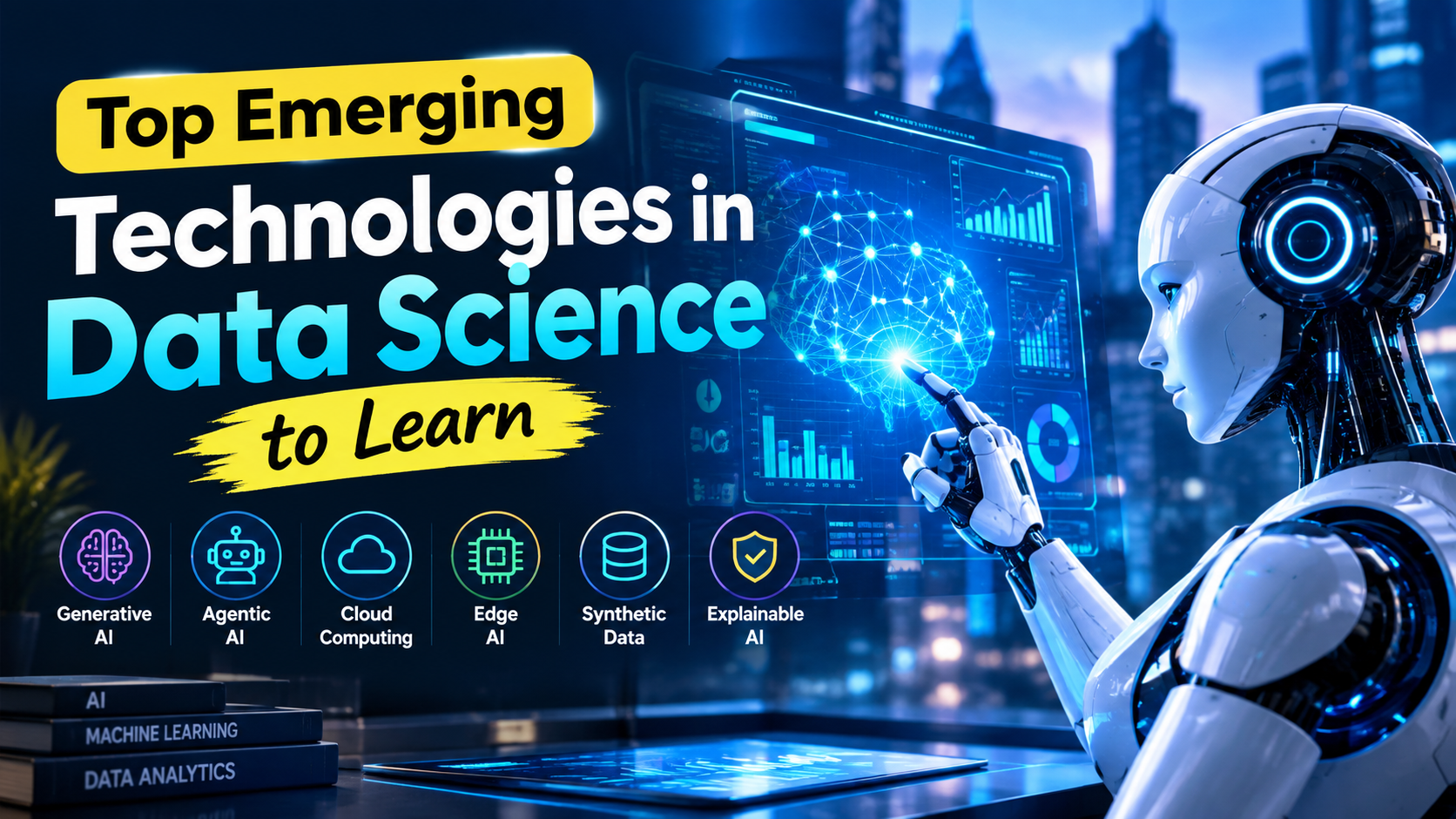
The world of data science is evolving more quickly than ever. Just a few years ago, data science revolved mostly around dumping data, generating reports and developing machine learning models. The field has come a long way since then. Technologies like artificial intelligence, generative AI, automation, edge computing and cloud platforms, and advanced analytics are transforming the way businesses collect, process and leverage data.
With the rapid proliferation of these technologies comes an evolution of the role of a data scientist. Datasets will be bigger, AI models more intelligent, and systems even more automated — now professionals are expected to work with them all in real time. It is important for students and professionals planning a career in this field to know the top emerging technologies in data science, as this will assist them in knowing the changing job market. If you're planning a career in data science, understanding the top emerging technologies in data science to learn can help you stay updated with the skills shaping the future of this rapidly evolving field.
How Is The New IT World Based On Data-Driven Emerging Technologies?
Emerging technologies in the field of data science refer to new or rapidly developing tools, methods, and technologies that enhance how we collect, analyse, interpret, and use data for decision-making.
They can help organisations uncover hidden patterns, forecast what may happen next, automate repetitive processes, and make quicker decisions. They are applied in areas including:
-
finance
-
healthcare
-
retail
-
human performance and education
-
manufacturing
-
cybersecurity
-
transportation
-
etc.
Key technologies include: -
generative AI
-
agentic AI
-
automated machine learning
-
edge AI
-
cloud computing
-
synthetic data
-
explainable AI (XAI)
-
advanced data engineering.
Generative AI
Generative AI has emerged as one of the major advancements related to data science. Generative models can generate content solutions: this means that rather than simply analysing information from the past or predicting what might occur, these types of AI systems create something new (i.e., they write an email, design an image/generate code/summarise their findings as a PDF, and other digital formats).
Generative AI can assist data-focused professionals with a lot of their daily work. It has the potential to:
-
write code
-
explain datasets
-
write SQL queries
-
summarise analytical results
-
help with documentation.
Here, however, data professionals need to understand its limitations too. AI outputs may contain errors, biased information, or unverified assumptions. Thus, human review and data validation become really critical.
Creating guidance for managing risks around generative AI is one instance — this new approach to responsible use demonstrates how emerging technologies are becoming a critical part of data work.
Agentic AI
Agentic AI is the next step beyond most traditional kinds of AI assistants. These AI agents can understand goals, break bigger tasks into smaller slices, use tools, and take actions with little human supervision.
Changes in data science workflows
This technology could change our working method in data science. Rather than having to switch from one database to another, from one coding environment to a second, a third dashboard, and four reports, an AI agent can coordinate all the different parts of this workflow.
For instance, an agent might:
-
receive a business query
-
find relevant data
-
conduct the analysis
-
detect patterns
-
compose a draft report about it.
With the growing automation of these systems, data scientists need to start caring about monitoring, testing, security, and governance more than just the model. The discussions around technology that focus on `agentic AI' emerge as one top emerging area.
Automated Machine Learning
A very important technology in modern data science is automated machine learning, or AutoML for short.
This can involve many manual steps in traditional machine learning, i.e., selecting algorithms, preparing features, testing models, and tuning parameters. Many of these processes are automated with AutoML.
Does this mean that data scientists are a thing of the past? AutoML frees experts to spend less of their time worrying about under-the-hood things, allowing them to instead spend more time working on understanding business problems, validating data quality, reading results, and, in general, interacting with an overall better solution.
AutoML is very beneficial for organisations looking to adopt machine learning but not having large teams of highly specialised machine learning engineers.
Edge AI and Edge Computing
Conventional data processing typically transmits the information to centralised core clouds. Edge computing works by processing the data as close as possible to where it gets generated.
When models run on devices or in nearby systems, organisations can quickly analyse data without needing to send everything far away to the cloud server.
Such use cases are common in:
-
smart cameras
-
connected vehicles
-
industrial machines
-
healthcare devices
-
IoT applications.
It will accelerate near real-time decision-making but has the opposite effects on bandwidth and privacy requirements. They also shed light on the link between Edge AI, TinyML, and federated learning.
Synthetic Data
While a good base of data is critical for training reliable models, gaining access to this real-world information can become quite challenging. Privacy restrictions, limited datasets, and sensitive information can be limitations.
One potential solution is synthetic data. Synthetic data is faux made-up data that tries to replicate key aspects of real data.
To illustrate, a company can generate synthetic customer records to test a machine learning system without revealing any real customer information.
The use of synthetic data is useful in the context of:
-
training
-
testing
-
simulations
-
privacy-sensitive applications.
Fake data might not even resemble the real world fairly well; it needs serious testing, though.
Explainable and Responsible AI
Merely producing an accurate prediction is not enough, as AI plays a deeper role in consequential decisions. A Growing Interest in Explainability: People want to know why an AI did what it did, i.e., reached a certain output – they want some explanation on the reasoning behind that output for better clarity.
Which is where explainable AI comes into play.
The explainable part of AI is to break down model decisions to their minimal and basic explanations. This is particularly useful in domains like:
-
banking
-
healthcare
-
insurance
-
hiring
-
public services.
Responsible AI equally encompasses concerns such as: -
fairness
-
privacy
-
security
-
transparency
-
reliability.
Now the Secretary of Commerce has issued a Request for Information on NIST's proposed AI Risk Management Framework, which incorporates many traits covering validity, reliability, safety, security, accountability, transparency and explainability, privacy and fairness.
These principles will be equally as important to future data scientists as programming and statistics.
Cloud Data Science
As organisations have started generating huge data, cloud computing is now an integral part of current-day data science.
Cloud platforms let companies store large datasets and compute resources on demand. Data scientists can develop models, execute experiments, ingest data and collaborate with less need for local hardware.
In addition, cloud-based data science can scale up. A simple project needs limited computing power while a larger machine learning workload may need significantly more. Cloud infrastructure allows organisations to scale resources based on demand.
Hence, the blend of cloud computing with data engineering, machine learning, and AI is likely to stay relevant for modern-day data teams
Real-Time Data Analytics
Data-at-scale businesses also want answers almost on demand, without having to wait for daily or weekly reports.
Real-time analytics enables organisations to process and analyse data upon creation. It can help to:
-
detect fraud
-
recommendation systems
-
stock monitoring
-
cyber security
-
customer behaviour analysis
-
find industrial operations.
For instance, a financial company is able to keep track of its transactions and detect suspicious behaviour in near real-time. Likewise, an online shopping platform can look at and adapt to customer behaviour on the fly.
If the world of business is now more driven by data, then being able to manipulate both streaming and real-time information will be invaluable in the years to come.
Good data is indeed the lifeblood of data science. An advanced machine learning model can deliver unreliable results if the data is incomplete, duplicated, outdated, or improperly organised. This is the reason why modern data engineering technologies are getting more critical.
One of the strategies under data fabric, which allows organisations to connect as well as manage data across various systems and solutions. It is capable of enabling improved access, integration, governance, and management of information.
For data scientists, this implies that traditional statistics and machine learning skills are becoming less useful than knowledge of:
-
databases
-
APIs
-
data pipelines
-
cloud platforms
-
data quality.
Multimodal AI
Various conventional AI techniques place emphasis on a single kind of knowledge, equivalent to textual content or pictures. Multimodal AI is developed to process different types of data.
A multimodal system can jointly process:
-
text
-
images
-
audio
-
video
-
other types of data.
This opens doors for data science creation. As an example, a healthcare system could combine clinical text, images, and other forms of patient information to aid in the analysis. What is one use case for a retail system that involves customer reviews, product images, and the associated purchase behaviour?
The technology is still nascent, but its potential to integrate various modes of information is promising.
Here Are The Technologies That Every Data Science Student Should Learn
These technologies are important tools that can help students to appreciate how contemporary data teams function. But learners should not aim to cover every area in one go.
Strong fundamentals still matter. Statistics, Python, SQL, machine learning & data visualisation & problem-solving form the base over which you can create advanced technologies.
Once these fundamentals have been established, learners can gradually discover:
-
generative AI, which is gaining momentum today
-
cloud computing
-
MLOps
-
AutoML. Finally, responsible AI, in which the ethical application of machine learning will play a critical role in the future.
You should not chase every new technology as your holy grail. She learners need to learn what problem is solved by every technology and how it should be used correctly.
The Future of Data Science
Future of Data Science
With better automation using modern tools, get ready for faster data processing at scale, intelligent systems, and a seamless link between AI and business.
Human skills will be equally important at the same time. Business problems will always need to be audited, bad results kept in check, reports filtered out, and interpreted by humans.
With the increasing capability of AI systems, governance and risk management will also be important parts of the data science lifecycle. As per NIST, AI risk management is a continuous process that answers how to be responsible for the development, deployment, use, testing, and evaluation of artificial intelligence systems.
In other words, the future data scientist will be less about rote technical work and more about:
-
creating robust solutions
-
validating findings
-
complex problem-solving
-
working with intelligent systems.
Conclusion
In less than a decade, the top emerging technologies in data science are revolutionising the way organisations interact with data. These new technologies should help businesses and people, including:
-
generative AI
-
agentic AI
-
AutoML
-
Edge AI
-
synthetic data
-
explainable AI
-
fresh out of AAI publishes Large into autonomously from feeds +1A computing
-
REAL-TIME ANALYTICS
However, learning every new technology is not the solution. Instead, the smarter way is to lay a strong base first, followed by understanding how upcoming tools can solve real-world problems. A data science course for career growth can help learners build practical skills in statistics, Python, machine learning, data analysis, and other areas needed to work with real-world data.The field of data science will grow, and those who can bring together their technical knowledge with critical thinking, responsible AI practices, and business acumen are in a better position for what is next.

 English
 Arabic
 French
 Spanish
 Portuguese
 Deutsch
 Turkish
 Italiano
 Russian
 Romaian
 Portuguese (Brazil)
 Greek
Greek
 Bengali