


E-Waste Recycling Plant Licences & Approvals in India
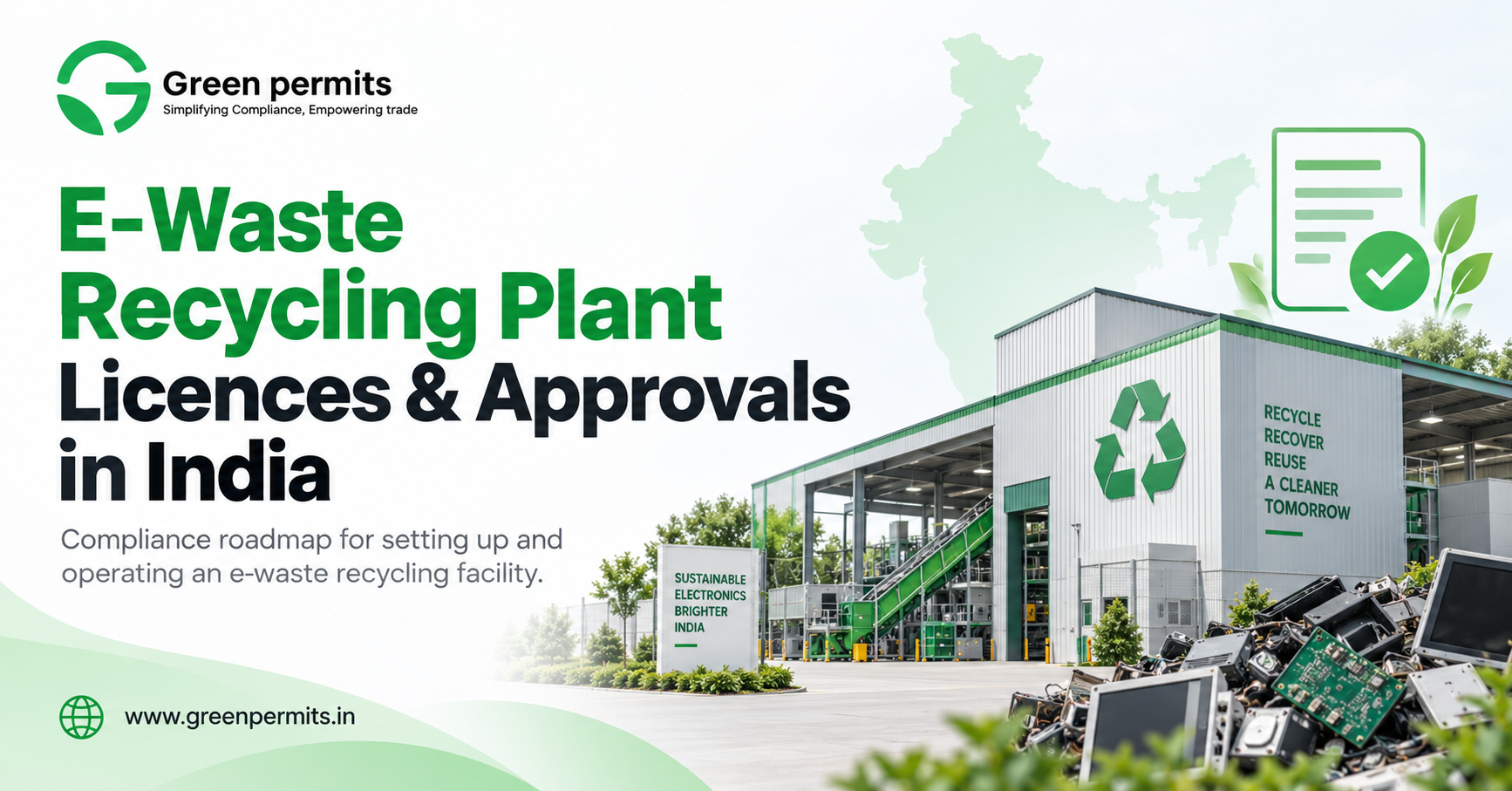
Setting up an E-Waste Recycling Plant in India requires more than purchasing shredders, dismantling equipment and metal-separation machinery. Before commercial recycling begins, the project needs the correct environmental consents, waste authorisation and registration under the E-Waste (Management) Rules, 2022.
The Rules became effective from 1 April 2023, and recyclers are one of the entities required to register under the EPR framework. CPCB's recycler SOP also makes it clear that the recycling facility needs valid environmental approvals before recycler registration is completed.
Green Permits Consulting supports entrepreneurs and recyclers with site assessment, DPR preparation, CTE, CTO, Hazardous Waste Authorisation, CPCB E-Waste Recycler Registration and complete recycling plant compliance planning.
What Approvals Are Required for an E-Waste Recycling Plant?
For most e-waste recycling projects, the key regulatory approvals are connected.
The normal project sequence is:
Site Selection → Consent to Establish → Plant Installation → Consent to Operate → Hazardous Waste Authorisation → CPCB Recycler Registration → Commercial Recycling
Additional approvals such as Fire NOC, Factory Licence or local permissions may also need to be assessed depending on the location, machinery and project configuration.
The important point is that a recycler should not treat CPCB registration as the first approval. The underlying plant and environmental permissions need to be planned before the portal application.
Consent to Establish - CTE
Before installing an applicable e-waste recycling facility, the promoter generally needs to obtain Consent to Establish - CTE from the concerned State Pollution Control Board or Pollution Control Committee.
The CTE application normally describes the proposed capacity, recycling process, machinery, water requirement, wastewater generation, air pollution sources, waste handling and pollution-control arrangements.
The site layout should also identify areas for receiving e-waste, storage, dismantling, recycling machinery, recovered materials and rejects.
The plant should be designed according to the process that will actually be carried out, because this information later becomes important for CTO and CPCB registration.
Consent to Operate - CTO
After the plant is installed and the required environmental systems are in place, the recycler generally needs Consent to Operate - CTO before regular operations.
CPCB's October 2024 recycler SOP specifically asks recyclers to submit copies of both CTE and CTO with their registration application. It also states that the annual recycling capacity declared on the portal should be as per the CTO.
This makes capacity planning important.
If the CTO permits 5,000 tonnes per year, the recycler should not assume it can simply declare 10,000 tonnes of recycling capacity on the E-Waste portal.
The machinery, CTO capacity and CPCB registration should remain aligned.
Hazardous Waste Authorisation
An e-waste recycling plant may generate or handle waste streams that need to be managed under the Hazardous and Other Wastes (Management and Transboundary Movement) Rules, 2016.
The current CPCB recycler SOP requires the applicant to provide a copy of the applicable Hazardous Waste Authorisation issued by the concerned SPCB/PCC as part of the recycler registration documents.
The project should therefore identify residues, hazardous fractions and downstream disposal routes during the planning stage.
Hazardous or non-recyclable material should be sent only through an appropriate authorised route.
CPCB E-Waste Recycler Registration
After establishing the facility and obtaining the required supporting approvals, the recycler needs registration on the CPCB E-Waste EPR portal.
Under the E-Waste framework, recyclers are required to register before carrying out covered recycling activities. CPCB's SOP states that an entity falling under more than one category, such as manufacturer, producer, refurbisher or recycler, needs separate registration for the applicable categories.
The recycler application includes details of the company, recycling facility, process, capacity, installed equipment and materials recovered from recycling.
The registration is issued digitally through the portal and, under the SOP, is valid for five years from the date of issue.
What Does CPCB Check During Recycler Registration?
CPCB does not look only at company documents.
The recycler has to provide information showing that an actual recycling facility exists and is capable of carrying out the proposed process.
The SOP requires information relating to the e-waste categories proposed for recycling, annual capacity, recovered end products, installed machinery, process flow and material balance. Geotagged photographs and a geotagged video of the facility are also required.
This is why purchasing a few machines and applying immediately may not be enough.
The plant should have a clear process showing how incoming e-waste is converted into identifiable recovered materials.
Recycling Process and Material Balance
A well-planned e-waste facility should clearly define what happens to every major material stream.
A typical mechanical recycling process may look like:
E-Waste Receiving → Sorting → Dismantling → Shredding → Physical Separation → Metal / Plastic Recovery → Residue Management
The actual process depends on the equipment and type of e-waste being processed.
The recycler should also understand its material balance.
For example, if 1,000 kg of e-waste enters the process, the project should be able to explain the approximate quantities converted into recovered metals, plastics and other output streams, along with residues or losses.
CPCB asks recyclers to provide recovered end-product details and other recycling outputs so that the material balance can be evaluated.
Plant Machinery Should Match the Approved Process
The machinery list should be prepared according to the actual recycling activity.
Depending on the project, equipment may include dismantling benches, shredders, magnetic separators, eddy-current separators, cable-processing equipment, dust-control systems and other physical separation machinery.
Advanced metal-recovery processes require a completely different level of technology and environmental control.
The project should therefore avoid presenting a process in the DPR or application that the installed machinery cannot actually perform.
Fire and Occupational Safety
E-waste recycling plants handle electrical equipment, plastics, metal fractions and, in some cases, products containing batteries.
Fire and occupational safety should therefore be considered from the beginning.
CPCB's recycler registration SOP requires a self-declaration confirming that adequate occupational safety, health and fire-safety measures have been taken at the recycling facility.
Depending on the facility and local regulations, separate fire or factory-related approvals may also need to be evaluated.
Lithium-ion batteries should be identified and handled separately because they can create thermal and fire risks and are governed under the battery-waste framework.
Inspection of the Recycling Facility
Recycler registration is not only a document-based exercise.
The CPCB SOP provides for verification of the recycling facility after registration through physical inspection or video-conferencing mode to confirm the information submitted by the recycler.
The actual plant should therefore match the application.
Differences in machinery, capacity, address or recycling process can lead to compliance issues.
CPCB can also verify recycler compliance through inspections and periodic audits.
Address and Documents Must Match
A surprisingly common problem is inconsistency between company records.
CPCB's SOP specifically states that the recycling-facility address in supporting documents such as CTE, CTO, Hazardous Waste Authorisation and GST records should correspond with the facility address used for registration.
This should be checked before submitting the portal application.
Correcting multiple approvals after the application has already been filed can delay registration.
EPR Certificates for E-Waste Recyclers
Registered recyclers can participate in the EPR framework and may generate eligible EPR certificates based on recycling carried out under the prescribed CPCB mechanism.
However, EPR certificate revenue should not be treated as guaranteed income.
The project's main economics should still be based on genuine feedstock availability, recovery efficiency, recovered-material value and operating cost.
A commercially sustainable recycling business should work as a recycling plant first, with EPR certificates providing an additional regulatory revenue opportunity where applicable.
Common Mistakes While Setting Up an E-Waste Recycling Plant
One of the biggest mistakes is purchasing machinery or land before checking environmental approval requirements.
Promoters also face problems when the machinery capacity does not match the CTO, the plant process does not support the claimed recovered products or the facility address differs across regulatory documents.
Another common mistake is treating CPCB Recycler Registration as the only approval.
The better sequence is:
Project Feasibility → Site → CTE → Installation → CTO & Authorisation → CPCB Registration → Operations
This creates a much cleaner approval pathway.
DPR for E-Waste Recycling Plant
Before investing, a Detailed Project Report - DPR can help determine plant capacity, feedstock availability, recycling technology, machinery, recovered products, land requirement and total project cost.
The DPR should also examine CAPEX, operating expenses, working capital, material recovery, sales revenue and regulatory approvals.
For investors seeking bank finance, the DPR can additionally include cash flow, profitability, break-even and debt-servicing analysis.
A good DPR connects the commercial model with the regulatory process instead of treating approvals as an afterthought.
How Green Permits Helps with E-Waste Recycling Plant Licences & Approvals
Green Permits Consulting supports entrepreneurs and recyclers with e-waste plant feasibility studies, DPR preparation, site and capacity planning, CTE, CTO, Hazardous Waste Authorisation, CPCB E-Waste Recycler Registration and environmental compliance support.
We also help align the plant's process, machinery, approved capacity and recovered products before the registration application is submitted.
Learn More About E-Waste Recycling Plant Setup
If you are planning an e-waste recycling plant in India, approvals should be planned before machinery installation so that the plant capacity, recycling process, CTE/CTO, Hazardous Waste Authorisation and CPCB registration remain aligned.
Read more about recycling plant setup and environmental approval services here:
👉 https://www.greenpermits.in/09/e-waste-recycling-licences-cte-cto-cpcb-checklist/
📞 Get Expert Assistance for E-Waste Recycling Plant Licences & Approvals
If you need help with E-Waste Recycling Plant Licences & Approvals, CTE/CTO, Hazardous Waste Authorisation, CPCB Recycler Registration, DPR preparation or plant setup, Green Permits Consulting can assist you.
🌐 Website: www.greenpermits.in
📞 Phone: +91 78350 06182
📧 Email: wecare@greenpermits.in

 English
 Arabic
 French
 Spanish
 Portuguese
 Turkish
 Dutch
Dutch
 Italiano
 Russian
 Romaian
 Portuguese (Brazil)
 Greek
Greek
 Bengali