


Air Traffic Management Market Size, Share, Growth Trends & Forecast 2026-2034
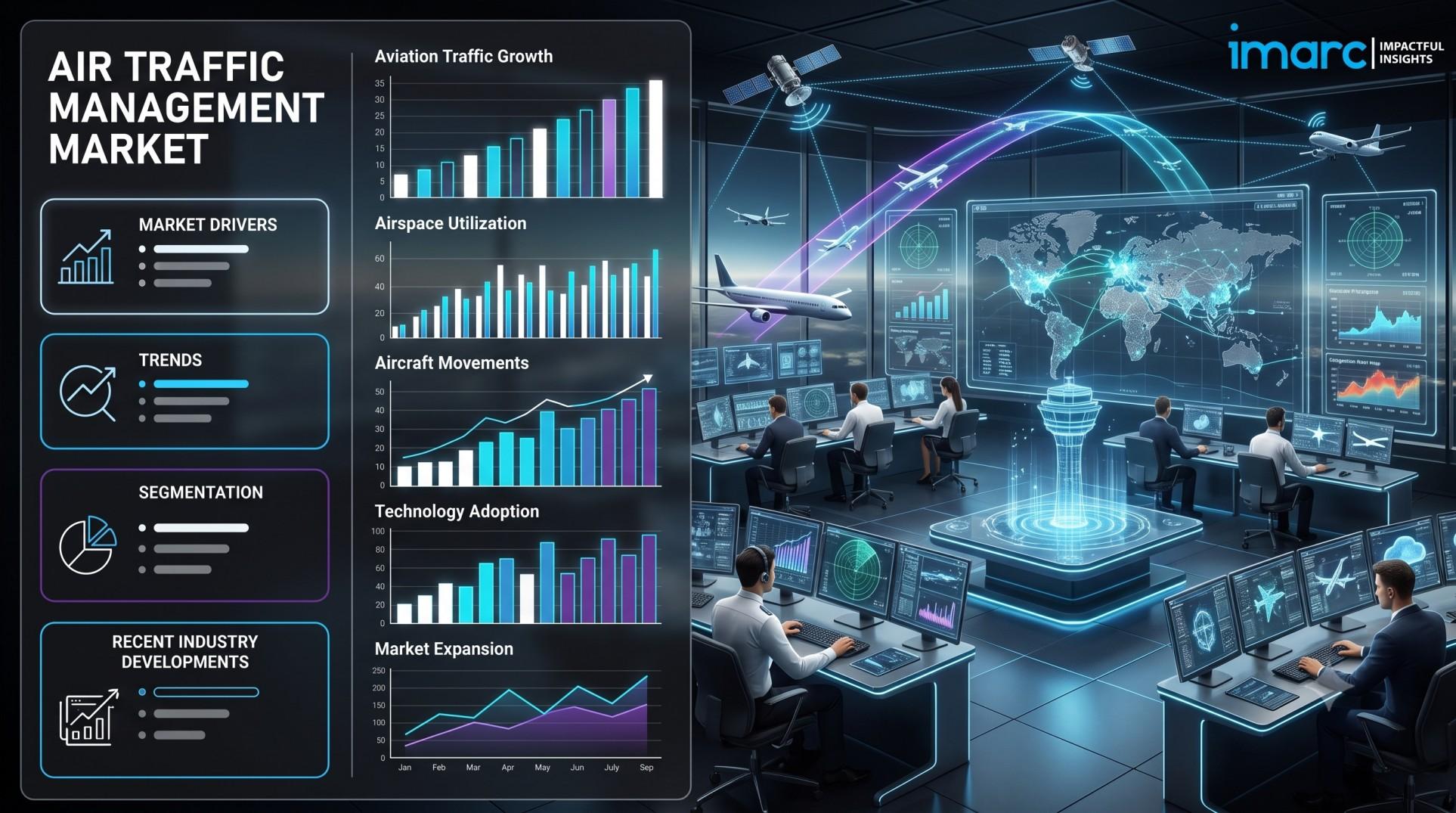
IMARC Group, a leading global market research and management consulting firm, has published its latest market intelligence report on the Air Traffic Management Market. The global air traffic management market size was valued at USD 19.6 Billion in 2025. Looking forward, IMARC Group estimates the market to reach USD 39.5 Billion by 2034, exhibiting a CAGR of 7.88% from 2026-2034. Growth is being driven by rising global air passenger and cargo volumes, aging ground infrastructure that governments are racing to replace, growing integration of drones and eVTOLs into controlled airspace, and the adoption of AI and automation to manage increasingly congested skies.
The market's trajectory reflects a broader shift in how nations think about airspace as critical infrastructure rather than a fixed asset to be maintained indefinitely. Decades old radar, communication, and flight data systems are being retired in favor of digital, satellite based, and AI assisted platforms that can handle far higher traffic densities without compromising safety. At the same time, the arrival of unmanned aircraft, air taxis, and beyond visual line of sight drone operations is forcing regulators to redesign airspace itself, layering new unmanned traffic management systems on top of traditional air traffic control. This convergence of legacy system replacement and next generation airspace design is expected to keep investment flowing into the sector from both government modernization budgets and private aviation technology vendors.
Air Traffic Management Market at a Glance
- Market Size 2025: USD 19.6 Billion
- Market Forecast 2034: USD 39.5 Billion
- Growth Rate 2026-2034: CAGR of 7.88%
- Leading Domain: Air Traffic Control, holding the largest share at 35.7 percent
- Leading Component: Hardware, accounting for 59.7 percent share
- Leading Application: Communication, capturing 33.2 percent share
- Leading End User: Commercial aviation, holding 70.6 percent share
- Dominant Region: Asia Pacific, with a 33.7 percent share
How AI is Reshaping the Future of the Air Traffic Management Market
- AI powered systems doubling airport capacity: Thales was awarded a contract to supply the core system for Singapore's NexGen ATMS program, an AI powered platform expected to double the airport's aircraft movement capacity while improving safety margins.
- Automated surveillance replacing manual monitoring: The FAA's ongoing National Airspace System overhaul is prioritizing surveillance automation and AI assisted decision support tools to help controllers manage rising traffic volumes with legacy staffing levels.
- Simulation driven airspace design for drones and air taxis: The UAE's Technology Innovation Institute and GCAA are using advanced simulation models, developed with Caltech, to design safe air corridors and separation standards for autonomous flying taxis and delivery drones ahead of commercial rollout.
Grab a sample PDF of this report: https://www.imarcgroup.com/air-traffic-management-market/requestsample
Air Traffic Management Market Trends and Drivers
Rising global air travel demand remains the primary growth driver for this market. IATA's latest full year performance data shows worldwide passenger traffic, measured in revenue passenger kilometers, grew by over 10 percent year on year, while capacity expanded close to 9 percent and the global load factor climbed to a record high above 83 percent. This surge in both passenger and cargo movement is straining airspace that was largely designed decades ago, pushing airports and regulators to invest in systems that can safely coordinate a much higher volume of flights without increasing delays or fuel burn.
A second driver is the global convergence around digital, interoperable airspace management. International coordination through frameworks such as the Single European Sky is pushing member states toward harmonized, satellite based navigation and automated dependent surveillance, since fragmented national systems can no longer keep pace with cross border traffic growth. This same logic of interoperability is shaping national programs worldwide, from the United States to Asia Pacific, setting the stage for the wave of dedicated government funding programs described below.
The third driver is the accelerating integration of unmanned aircraft into controlled airspace. As drones move from isolated commercial use cases into shared airspace with piloted aircraft, regulators are being forced to build entirely new unmanned traffic management layers, creating a fast growing sub-segment of demand for specialized ATM technology that did not exist at scale a decade ago.
Ask an analyst for customized report: https://www.imarcgroup.com/request?type=report&id=4656&flag=E
Global Regulatory, Trade, and Sustainability Landscape Shaping Demand
- ICAO Global Air Navigation Plan: Sets the international interoperability baseline that national modernization programs, from the FAA's airspace overhaul to Europe's SESAR initiative, are designed to align with.
- Single European Sky Regulation: Continues to drive harmonization of Europe's fragmented airspace, with SESAR deployment already delivering an estimated EUR 7.5 Billion in cumulative benefits and projected to reach EUR 34.2 Billion under longer term competitiveness forecasts.
- FAA National Airspace System Modernization Mandate: Sets binding safety and cybersecurity performance benchmarks that are pushing legacy radar, radio, and flight data systems toward full digital replacement across the United States.
- Emerging U-space and Unmanned Traffic Management Frameworks: Regulators including the UAE's GCAA and European aviation authorities are formalizing certification pathways that allow drone and eVTOL operators to legally share airspace with traditional aircraft.
Key Government Schemes and Policy Programs Supporting the Industry
- United States, Brand New Air Traffic Control System (BNATCS): Launched by the FAA to replace decades old radar, radio, and flight data infrastructure, the program was backed with USD 12.5 Billion in congressional reconciliation funding, though a September 2026 GAO review found the first phase alone will require USD 10.6 Billion, exceeding the USD 9 Billion originally approved and leaving a USD 574 Million shortfall still to be filled.
- India, AAI Air Navigation and ATC Modernization Program: The Airports Authority of India is investing roughly Rs 15,000 crore to modernize ATC towers and navigation systems nationwide by 2028, including a dedicated Rs 3,490 crore capital outlay for 2026 to 2028, of which Rs 1,532 crore is earmarked specifically for automating air traffic management systems.
- European Union, SESAR 3 Digital European Sky Programme: A public private partnership investing more than EUR 1.6 Billion through 2030 to accelerate research and deployment of next generation air traffic management technology, with EUR 350 Million allocated to 42 new research projects in a single February 2026 funding round.
- United Arab Emirates, GCAA Advanced Air Mobility Framework: The General Civil Aviation Authority, working with the Technology Innovation Institute and ASPIRE, introduced a hybrid airspace regulatory framework and simulation based air corridor mapping across three Abu Dhabi pilot sites, positioning the UAE among the first countries to formally regulate integrated air taxi and drone traffic.
Air Traffic Management Industry Segmentation
Analysis by Domain:
- Air Traffic Control
- Air Traffic Flow Management
- Aeronautical Information Management
Air traffic control leads the market with 35.7 percent share, given its central role in coordinating aircraft movements, managing congestion, and preventing collisions as global flight volumes continue to climb.
Analysis by Component:
- Hardware
- Software
Hardware dominates with 59.7 percent share, reflecting the essential role of radar systems, communication equipment, navigation aids, and surveillance technology in keeping ATM systems operational and reliable.
Analysis by Application:
- Communication
- Navigation
- Surveillance
- Automation
Communication leads with 33.2 percent share, since reliable, high quality links between controllers and pilots remain fundamental to relaying flight instructions, weather updates, and emergency information safely.
Analysis by End User:
- Commercial
- Military
Commercial aviation dominates with 70.6 percent share, driven by sustained global growth in air travel that requires airlines, airports, and service providers to continuously invest in more capable ATM systems.
Regional Analysis:
- Asia Pacific (China, Japan, India, South Korea, Australia, Indonesia, Others)
- North America (United States, Canada)
- Europe (Germany, France, United Kingdom, Italy, Spain, Russia, Others)
- Latin America (Brazil, Mexico, Others)
- Middle East and Africa
Asia Pacific leads with 33.7 percent share, supported by rapid economic growth, expanding middle class air travel demand, and heavy government investment in aviation infrastructure across China, India, and Southeast Asia.
Competitive Landscape
The competitive landscape is defined by a small group of established aerospace and defense primes investing heavily in AI, automation, and secure communication technology to win large scale national modernization contracts. The report profiles major players including:
- Adacel Technologies Limited
- Advanced Navigation and Positioning Corporation
- Airbus SE
- Honeywell International Inc.
- Indra Sistemas S.A.
- L3Harris Technologies Inc.
- Leidos
- Leonardo S.p.A.
- Lockheed Martin Corporation
- Northrop Grumman Corporation
- Raytheon Technologies Corporation
- Saab AB
- Thales Group
Scale and specialization define competitive positioning in this market. Thales estimates that its TopSky-ATC platform already manages roughly 40 percent of global air traffic, giving it a commanding position in core ATC software. Indra, meanwhile, secured a USD 244.3 Million FAA contract to replace the United States' analog ground to air radio systems with digital, VoIP capable equipment across up to 46,000 radios, cementing its position as a global leader in ATM radio communications with close to 50 percent market share in that segment.
Market Concentration Analysis
- A narrow field of primes controls the highest value contracts: The FAA shortlisted only five companies, Thales, RTX, Leidos, Frequentis, and Indra, for its Common Automated Platform contract, underscoring how concentrated the market for large scale, mission critical ATC systems remains among established defense and aerospace vendors.
- Cross border consolidation through joint ventures: NATS and Indra Group signed an MoU to jointly develop digital airport tower systems, reflecting a broader trend of established players combining capabilities rather than competing head to head on every new program.
- Fragmentation at the edges of the market: While a handful of primes dominate core ATC and communication systems, a growing set of specialized vendors in drone traffic management, simulation, and vertiport software are carving out defensible niches in the emerging unmanned aviation segment.
What Does The Full Report Cover?
- Historical performance and future outlook of the global air traffic management market
- Impact assessment of macroeconomic and geopolitical factors on market dynamics
- Detailed segmentation by domain, component, application, end user, and region
- Regional and country level market breakdowns across five major regions
- Competitive landscape with company profiles, strategies, and market positioning
- Porter's Five Forces analysis of competitive intensity and market attractiveness
- Key growth drivers, restraints, and emerging opportunities shaping the industry
Recent News and Developments in Air Traffic Management Market
- November 2025: NATS and Indra Group signed an MoU to develop a digital airport tower systems joint venture, deepening collaboration between a major European air navigation service provider and a leading ATM technology supplier.
- November 2025: Dubai Air Navigation Services, Emirates Airline, and Thales signed a collaborative research agreement to advance flight efficiency through data driven and AI enabled solutions.
- December 2025: Thales was selected to modernize the Cayman Islands' air traffic control infrastructure, extending its ATM technology footprint into the Caribbean region.
- December 2025: Thales won a contract to modernize the Philippines' air traffic management system as part of the Civil Aviation Authority of the Philippines' broader infrastructure upgrade program.
- February 2026: The SESAR 3 Joint Undertaking selected 42 new research projects worth over EUR 350 Million under its Digital European Sky programme to accelerate next generation air traffic technologies across Europe.
- May 2026: The FAA announced an USD 835.8 Million investment to build new air traffic control towers and modernize equipment at dozens of airports across the United States.
- July 2026: Thales was awarded a multimillion euro contract to supply the core air traffic management system for Singapore's NexGen ATMS program, expected to double the airport's aircraft movement capacity.
Note: If you require specific details, data, or insights that are not currently included in the scope of this report, we are happy to accommodate your request. As part of our customization service, we will gather and provide the additional information you need, tailored to your specific requirements. Please let us know your exact needs, and we will ensure the report is updated accordingly to meet your expectations.
Key Questions This Report Answers
- What is the current size of the global air traffic management market and its growth potential?
- Which domain, air traffic control, flow management, or aeronautical information management, holds the largest market share?
- Which component, hardware or software, is currently in greater demand?
- Which application, communication, navigation, surveillance, or automation, drives the most spending?
- Which region currently dominates the global air traffic management market?
- Who are the leading companies operating in the air traffic management market?
- How are AI adoption and drone integration reshaping the competitive landscape?
About Us
IMARC Group is a global management consulting firm that helps the world's most ambitious changemakers to create a lasting impact. The company provides a comprehensive suite of market entry and expansion services. IMARC offerings include thorough market assessment, feasibility studies, company incorporation assistance, factory setup support, regulatory approvals and licensing navigation, branding, marketing and sales strategies, competitive landscape and benchmarking analyses, pricing and cost research, and procurement research.
Media and Sales Contact
IMARC Group
Email: sales@imarcgroup.com
United States: +1-201-971-6302
India: +91-120-433-0800
United Kingdom: +44-753-714-6104

 English
 Arabic
 French
 Spanish
 Portuguese
 Deutsch
 Turkish
 Dutch
Dutch
 Russian
 Romaian
 Portuguese (Brazil)
 Greek
Greek
 Bengali