


CCNA vs CCNP: Which Cisco Certification Is Right for You?
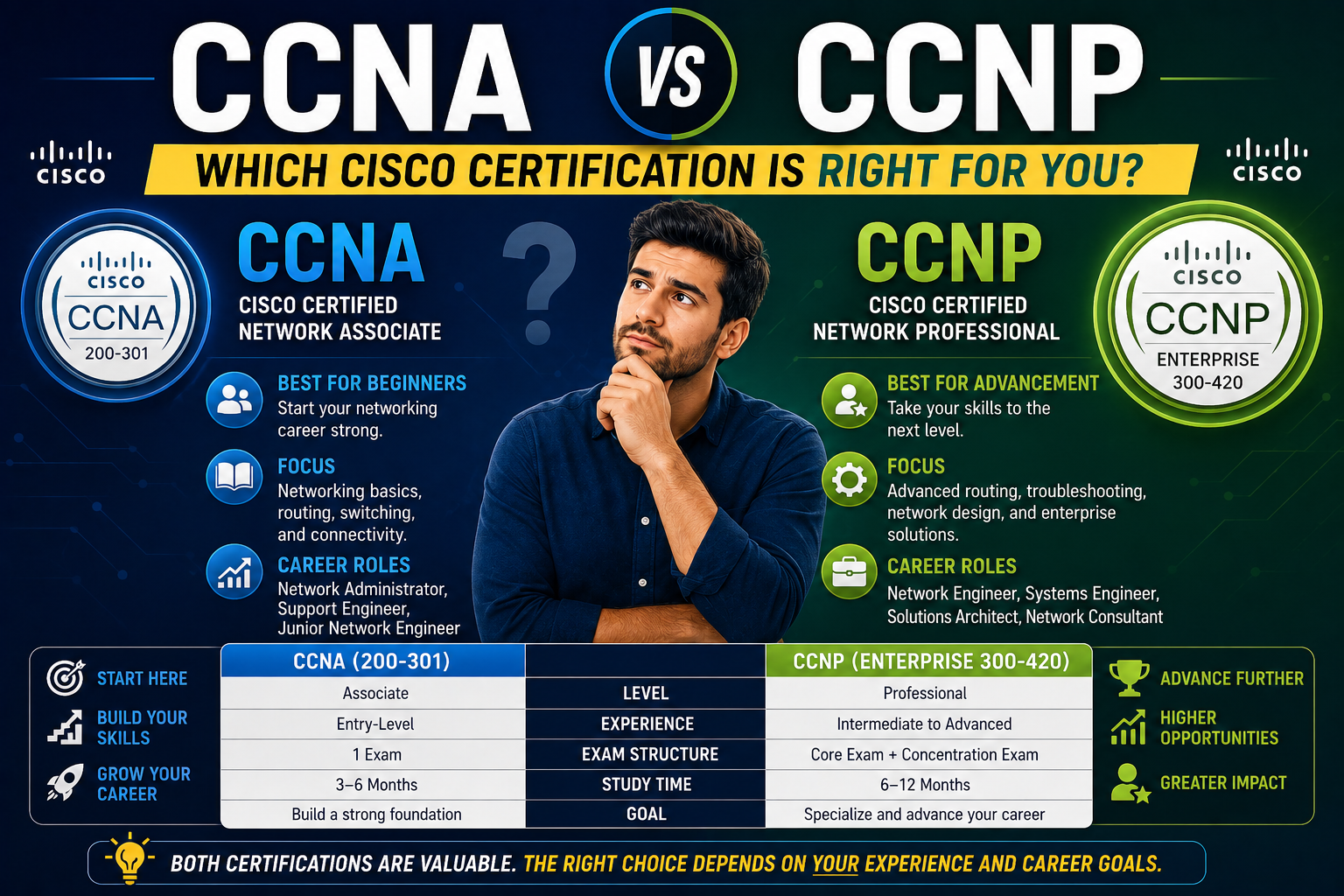
Choosing between CCNA and CCNP depends mainly on your current networking experience, career stage, and how deeply you need to work with enterprise infrastructure.
In 2026, CCNA remains the better choice for beginners and early-career networking professionals, while CCNP is designed for more experienced engineers who need deeper knowledge of enterprise networking, troubleshooting, design, automation, and specialization.
The simplest way to think about it is:
CCNA = build a strong networking foundation
CCNP = prove advanced professional-level networking skills
If you are new to networking, CCNA is usually the right starting point. If you already work with routing, switching, enterprise infrastructure, and troubleshooting, CCNP may offer greater career value.
CCNA vs CCNP at a Glance
|
Factor |
CCNA |
CCNP |
|
Level |
Associate |
Professional |
|
Best For |
Beginners and junior professionals |
Experienced networking professionals |
|
Number of Exams |
1 |
2 |
|
Main Focus |
Broad networking fundamentals |
Advanced enterprise skills and specialization |
|
Difficulty |
Moderate |
High |
|
Experience Needed |
No formal prerequisite |
No formal prerequisite, but experience strongly recommended |
|
Typical Roles |
Network Technician, Junior Network Engineer |
Network Engineer, Senior Engineer, Consultant |
|
Depth |
Broad |
Deep |
|
Cost |
Lower |
Higher |
|
Best Career Stage |
Early career |
Mid-career |
What Is CCNA?
CCNA stands for Cisco Certified Network Associate.
It is Cisco’s core associate-level networking certification and is one of the most recognized credentials for professionals entering networking.
In 2026, candidates are still taking 200-301 CCNA v1.1. Cisco has announced a refreshed CCNA version for February 3, 2027, so current 2026 candidates should prepare for the existing v1.1 blueprint.
CCNA covers:
-
Network fundamentals
-
Network access
-
IP connectivity
-
IP services
-
Security fundamentals
-
Automation and programmability
This makes CCNA broad rather than highly specialized.
What Skills Does CCNA Teach?
CCNA helps candidates build foundational skills in areas such as:
-
IPv4 and IPv6
-
Subnetting
-
VLANs
-
Trunking
-
Spanning Tree Protocol
-
EtherChannel
-
Static routing
-
OSPF
-
NAT
-
ACLs
-
Wireless networking
-
Network security
-
Basic automation
-
APIs
You are expected to understand how enterprise networks operate and how common technologies fit together.
CCNA is therefore an excellent first serious networking certification.
What Is CCNP?
CCNP stands for Cisco Certified Network Professional.
Unlike CCNA, CCNP is not one single exam.
For CCNP Enterprise, candidates must pass:
-
One core exam
-
One concentration exam
The core exam is:
350-401 ENCOR – Implementing Cisco Enterprise Network Core Technologies
Then you choose a concentration based on your specialization.
Examples include:
-
300-410 ENARSI – Advanced Routing and Services
-
300-415 ENSDWI – SD-WAN
-
300-420 ENSLD – Enterprise Design
-
300-435 ENAUTO – Enterprise Automation
-
300-440 ENCC – Cloud Connectivity
-
300-445 ENNA – Network Assurance
This makes CCNP much more flexible and specialized than CCNA.
Main Difference Between CCNA and CCNP
The biggest difference is depth.
CCNA asks:
Do you understand networking fundamentals well enough to configure and troubleshoot common environments?
CCNP asks:
Can you handle complex enterprise networking, advanced troubleshooting, design decisions, automation, and specialized technologies?
CCNA is broad.
CCNP is deep.
Difficulty: CCNA vs CCNP
CCNA is challenging for beginners, but it is still designed as an associate-level certification.
You need to understand networking concepts and practice configuration, but the material is relatively broad.
CCNP is significantly harder because it expects deeper knowledge and stronger troubleshooting ability.
You may need to understand:
-
More complex routing
-
Enterprise architecture
-
Virtualization
-
Network assurance
-
SD-WAN
-
Advanced security
-
Automation
-
Infrastructure services
-
Complex troubleshooting
The concentration exam then adds another layer of specialization.
Exam Structure
CCNA
CCNA requires one exam:
200-301 CCNA
This makes the path simple.
You study the full blueprint, pass one exam, and earn the certification.
CCNP Enterprise
CCNP Enterprise requires:
350-401 ENCOR + one concentration exam
This gives candidates flexibility.
For example:
ENCOR + ENARSI
Best for advanced routing and troubleshooting.
ENCOR + ENAUTO
Best for automation-focused engineers.
ENCOR + ENSDWI
Best for SD-WAN professionals.
Which Is Better for Beginners?
CCNA.
If you are new to networking, CCNP is usually too advanced as a starting point.
A better roadmap is:
Networking fundamentals → CCNA → work experience → CCNP
You do not need to rush.
CCNA gives you the foundation required to understand the deeper concepts in CCNP.
Can You Take CCNP Without CCNA?
Yes.
Cisco no longer requires CCNA as a formal prerequisite for CCNP.
You can take CCNP exams directly.
However, just because it is allowed does not mean it is always the best choice.
Skipping CCNA makes sense if you already have strong networking experience.
For example, you may be ready for CCNP if you already work with:
-
OSPF
-
BGP
-
VLANs
-
Enterprise routing
-
Network troubleshooting
-
Wireless
-
Automation
-
Cisco infrastructure
If these concepts are unfamiliar, CCNA is the safer path.
CCNA vs CCNP for Jobs
CCNA is more aligned with entry and junior roles.
Typical job titles include:
-
Network Technician
-
Junior Network Engineer
-
NOC Technician
-
IT Support Specialist
-
Network Support Engineer
-
Infrastructure Technician
CCNP is more aligned with professional and senior-level roles.
Typical positions include:
-
Network Engineer
-
Senior Network Engineer
-
Network Consultant
-
Enterprise Network Engineer
-
Network Architect
-
Infrastructure Engineer
-
Network Automation Engineer
The certification does not guarantee a job, but it can help validate skills for the type of role you are targeting.
CCNA vs CCNP for Salary
There is no fixed “CCNA salary” or “CCNP salary.”
Salary depends on:
-
Experience
-
Job title
-
Location
-
Employer
-
Specialization
-
Industry
-
Responsibilities
In general, CCNP-aligned roles tend to be more senior than CCNA-aligned roles, so they may offer higher compensation.
However, this is because of the job level and experience, not simply because someone holds the certification.
A highly experienced CCNA holder can earn more than a newly certified CCNP candidate with limited practical experience.
CCNA vs CCNP for Career Growth
CCNA is best for building the foundation.
CCNP is better for specialization and progression.
A common Cisco career path is:
CCNA → CCNP Enterprise → CCIE Enterprise Infrastructure
You can also branch into:
-
Security
-
Automation
-
Wireless
-
Data Center
-
Service Provider
-
Collaboration
CCNP becomes more valuable when you know which area you want to specialize in.
CCNA vs CCNP for Network Automation
Automation is now part of both levels.
CCNA introduces:
-
APIs
-
Controller-based networking
-
Automation concepts
-
Programmability
CCNP goes much deeper.
For example, ENAUTO focuses on:
-
APIs
-
Python
-
Automation workflows
-
Network programmability
-
Infrastructure automation
Cisco has also developed a dedicated automation certification path.
So if you want to work in modern network engineering, automation skills are increasingly important.
CCNA vs CCNP for Cloud Networking
CCNA introduces networking concepts that transfer into cloud environments.
CCNP can take those skills further through areas such as:
-
Hybrid networking
-
Cloud connectivity
-
Automation
-
Enterprise architecture
The ENCC concentration is particularly relevant to professionals working across enterprise and cloud infrastructure.
This makes CCNP more attractive for engineers moving toward hybrid-cloud networking.
How Long Does It Take to Prepare?
CCNA
A beginner may need roughly:
2–4 months
Someone with existing networking knowledge may need less.
CCNP
Preparation is usually longer.
A realistic range may be:
3–6+ months
depending on your experience and concentration.
The deeper the specialization, the more hands-on practice you need.
Hands-On Practice Matters
Both certifications benefit heavily from labs.
For CCNA, practice:
-
VLAN configuration
-
Trunking
-
OSPF
-
ACLs
-
NAT
-
Routing
-
Troubleshooting
For CCNP, practice more advanced scenarios such as:
-
Multi-area OSPF
-
BGP
-
Route redistribution
-
Enterprise troubleshooting
-
SD-WAN
-
Automation
-
Network assurance
Tools such as Cisco Packet Tracer and Cisco Modeling Labs can help.
Prepare for CCNA and CCNP exams with updated practice questions and Cisco certification study resources: https://certmage.com/exams/cisco/
Which Certification Has Better ROI?
That depends on your career stage.
CCNA usually has better ROI if:
-
You are new to networking
-
You need an entry credential
-
You want to build fundamentals
-
You are applying for junior roles
CCNP usually has better ROI if:
-
You already work in networking
-
You want senior roles
-
You need specialization
-
You want stronger technical credibility
-
You plan to pursue CCIE
The wrong certification can reduce ROI.
For example, taking CCNP too early may require far more effort without immediately improving your career prospects.
CCNA vs CCNP Study Strategy
For CCNA:
-
Learn networking basics.
-
Practice subnetting.
-
Build Packet Tracer labs.
-
Study routing and switching.
-
Learn security fundamentals.
-
Review automation concepts.
-
Take practice exams.
For CCNP:
-
Master ENCOR topics.
-
Build advanced labs.
-
Strengthen troubleshooting.
-
Choose the right concentration.
-
Practice complex scenarios.
-
Study automation.
-
Use timed practice exams.
The biggest difference is depth.
Common Mistake: Taking CCNP Too Early
A common mistake is assuming that the higher certification is automatically better.
It is not.
CCNP is most valuable when it validates skills you already use or are actively developing.
If you still struggle with:
-
Subnetting
-
VLANs
-
OSPF
-
Routing tables
-
ACLs
-
Basic troubleshooting
you should probably focus on CCNA first.
Common Mistake: Staying at CCNA Too Long
The opposite can also happen.
If you already work as a network engineer and routinely troubleshoot enterprise networks, CCNA may no longer challenge you enough.
At that point, CCNP can provide more relevant growth.
Your certification level should evolve with your responsibilities.
Which Cisco Certification Should You Choose?
Choose CCNA if:
-
You are new to networking
-
You have limited Cisco experience
-
You want a junior networking role
-
You need strong fundamentals
-
You want one straightforward exam
Choose CCNP if:
-
You already have networking experience
-
You want advanced responsibilities
-
You need a specialization
-
You work with enterprise networks
-
You want to move toward CCIE
Best Certification Path
For most professionals, the strongest roadmap is:
CCNA → Work Experience → CCNP → Specialization → CCIE
This creates a balance between certification and practical ability.
Do not rush from one exam to the next.
Use each certification to build real technical skills.
Conclusion
CCNA and CCNP are both valuable Cisco certifications, but they serve different career stages.
CCNA is the better choice for beginners and junior professionals because it builds a broad foundation in networking, routing, switching, security, and automation.
CCNP is better for experienced engineers who need deeper enterprise networking skills, advanced troubleshooting, specialization, and stronger career progression.
If you are unsure which one to choose, ask one question:
Can I already perform CCNA-level networking tasks comfortably?
If the answer is no, start with CCNA.
If the answer is yes and you already work with enterprise networking, CCNP may be the better next step.
FAQs
Is CCNP harder than CCNA?
Yes. CCNP is significantly more advanced and requires deeper knowledge of enterprise networking, troubleshooting, automation, and specialization.
Do I need CCNA before CCNP?
No. Cisco does not require CCNA as a formal prerequisite, but CCNA-level knowledge is strongly recommended.
Is CCNA good for beginners?
Yes. CCNA is one of the best Cisco certifications for people starting a networking career.
Is CCNP worth it for experienced network engineers?
Yes. CCNP can be valuable for professionals targeting senior engineering, consulting, automation, or architecture roles.
Which should I take first: CCNA or CCNP?
Most beginners should take CCNA first. Experienced network professionals may be able to move directly to CCNP.

 Arabic
 French
 Spanish
 Portuguese
 Deutsch
 Turkish
 Dutch
Dutch
 Italiano
 Russian
 Romaian
 Portuguese (Brazil)
 Greek
Greek
 Bengali