


Dedicated Server Hosting Plans Compared: Entry-Level to Enterprise
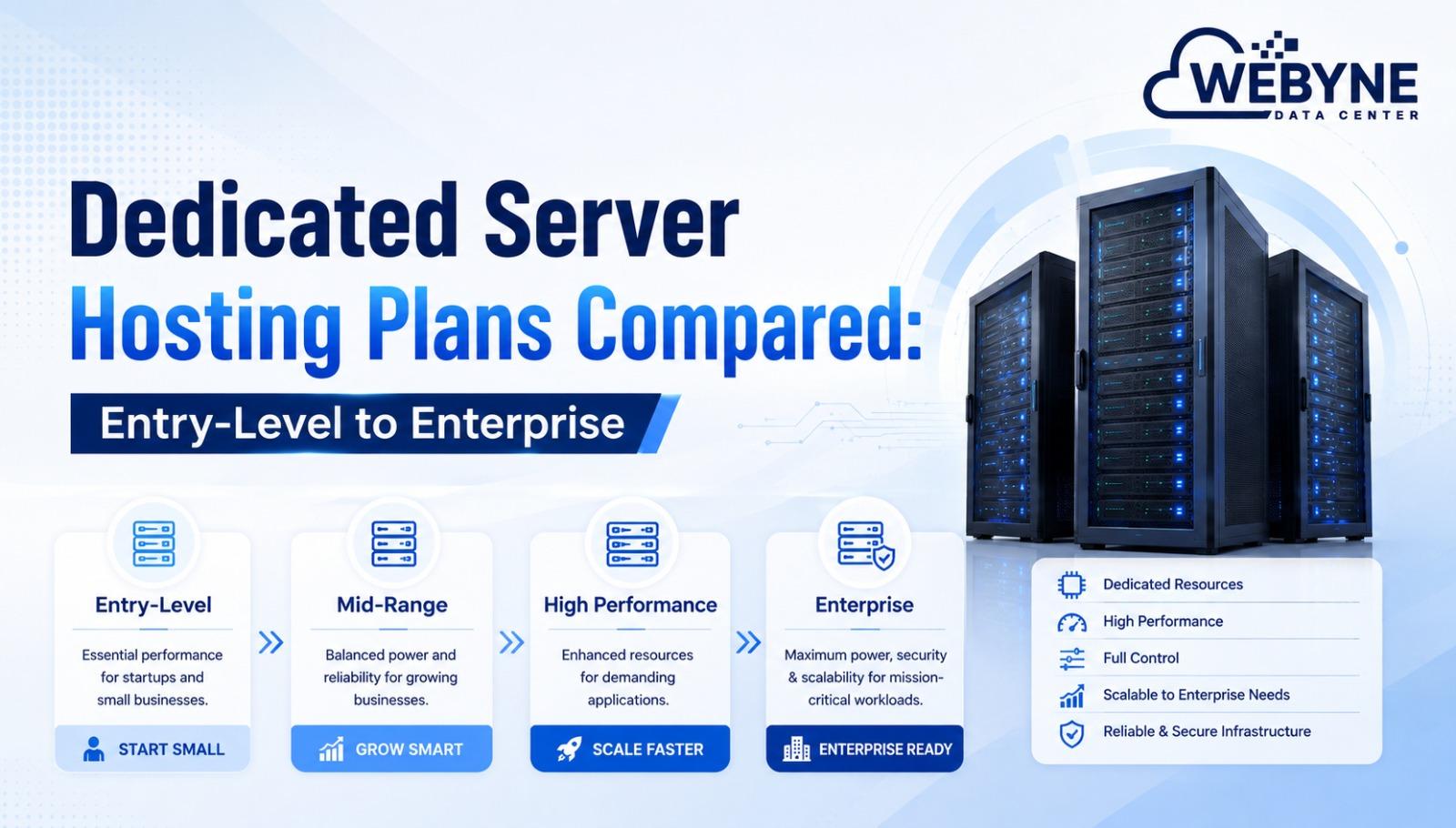
Not every business needs the same dedicated server hosting plans — a small business website has very different requirements from an enterprise application handling millions of transactions. Here’s a breakdown of the typical tiers and how to know which one fits your needs.
Entry-Level Dedicated Server Plans
Typical specs: 6–8 cores, 32–64GB RAM, 500GB–1TB NVMe SSD
Entry-level dedicated server hosting plans are built for businesses moving off shared or VPS hosting for the first time — small-to-medium websites, single-application hosting, or small development teams. Modern AMD Ryzen processors have made this tier significantly more capable than entry-level plans of just a few years ago, thanks to high clock speeds and DDR5 memory.
Best for: Small business websites, single game servers, small development/staging environments.
Mid-Range Dedicated Server Plans
Typical specs: 12–24 cores, 64–128GB RAM, 1–2TB NVMe SSD
This tier suits growing businesses running multiple applications, moderate-traffic e-commerce stores, or small-to-medium databases. AMD EPYC processors are common at this tier, offering strong multi-core performance for parallel workloads.
Best for: Growing e-commerce stores, multi-site agency hosting, moderate-traffic web applications.
High-Performance / Enterprise Dedicated Server Plans
Typical specs: 32+ cores, 128GB+ RAM (often 256GB–512GB), multiple TB of NVMe storage, sometimes dual-processor configurations.
Enterprise-tier dedicated server hosting plans are built for high-transaction applications, large databases, and businesses with strict compliance or performance requirements. Dual-EPYC configurations at this tier can offer 96+ cores for genuinely demanding, highly parallel workloads.
Best for: Large e-commerce platforms, enterprise databases, high-concurrency SaaS applications.
Comparing Plans: What to Look at Beyond Core Specs
1. Managed vs Unmanaged Support
Confirm what level of support is included at each tier — entry-level plans are sometimes unmanaged by default, while higher tiers often include managed support.
2. Uptime SLA
Higher tiers typically come with stronger SLA guarantees (99.95%–99.99%), reflecting the more mission-critical workloads they’re designed for.
3. Bandwidth Allocation
Check whether bandwidth scales proportionally with the tier, or if higher-traffic plans require a separate add-on.
4. Scalability Path
A good provider lets you move from entry-level to mid-range to enterprise without a full migration — confirm this before committing to a starting tier.
How to Choose the Right Tier
- Estimate your current resource usage — if migrating from existing hosting, check your current CPU, RAM, and storage utilization.
- Add headroom for growth — choose a tier with roughly 30–50% more capacity than your current peak usage.
- Consider workload type, not just size — a database-heavy application needs different resource allocation than a high-traffic but simpler website.
- Don’t over-provision on day one — start at the tier that matches current needs, with a clear upgrade path rather than paying enterprise pricing prematurely.
A Note on Launch and Promotional Pricing
Providers frequently offer discounted launch pricing on new dedicated server hosting plans — often on newly introduced hardware generations. These can be a genuinely good way to access higher-tier specs at entry-level pricing for the first month or two, provided you factor in the standard renewal cost afterward.
Final Thoughts
Comparing dedicated server hosting plans across entry-level, mid-range, and enterprise tiers comes down to matching specifications to your actual workload — current usage plus reasonable growth headroom, rather than either the cheapest or most powerful option available. Most businesses are best served starting at the tier that matches present needs, with a clear path to scale as traffic and data grow.
Ready to compare plans for your specific needs? Explore Webyne’s dedicated server hosting plans, from entry-level AMD Ryzen configurations to enterprise EPYC setups.
Source- https://webyne.com/blog/dedicated-server-hosting-plans-compared-entry-level-to-enterprise.php

 English
 Arabic
 French
 Portuguese
 Deutsch
 Turkish
 Dutch
Dutch
 Italiano
 Russian
 Romaian
 Portuguese (Brazil)
 Greek
Greek
 Bengali