


Middle East FRP Pipes Market Share Expands Toward USD 1.3 Billion by 2031 Amid Localization
Market Overview and Growth Outlook
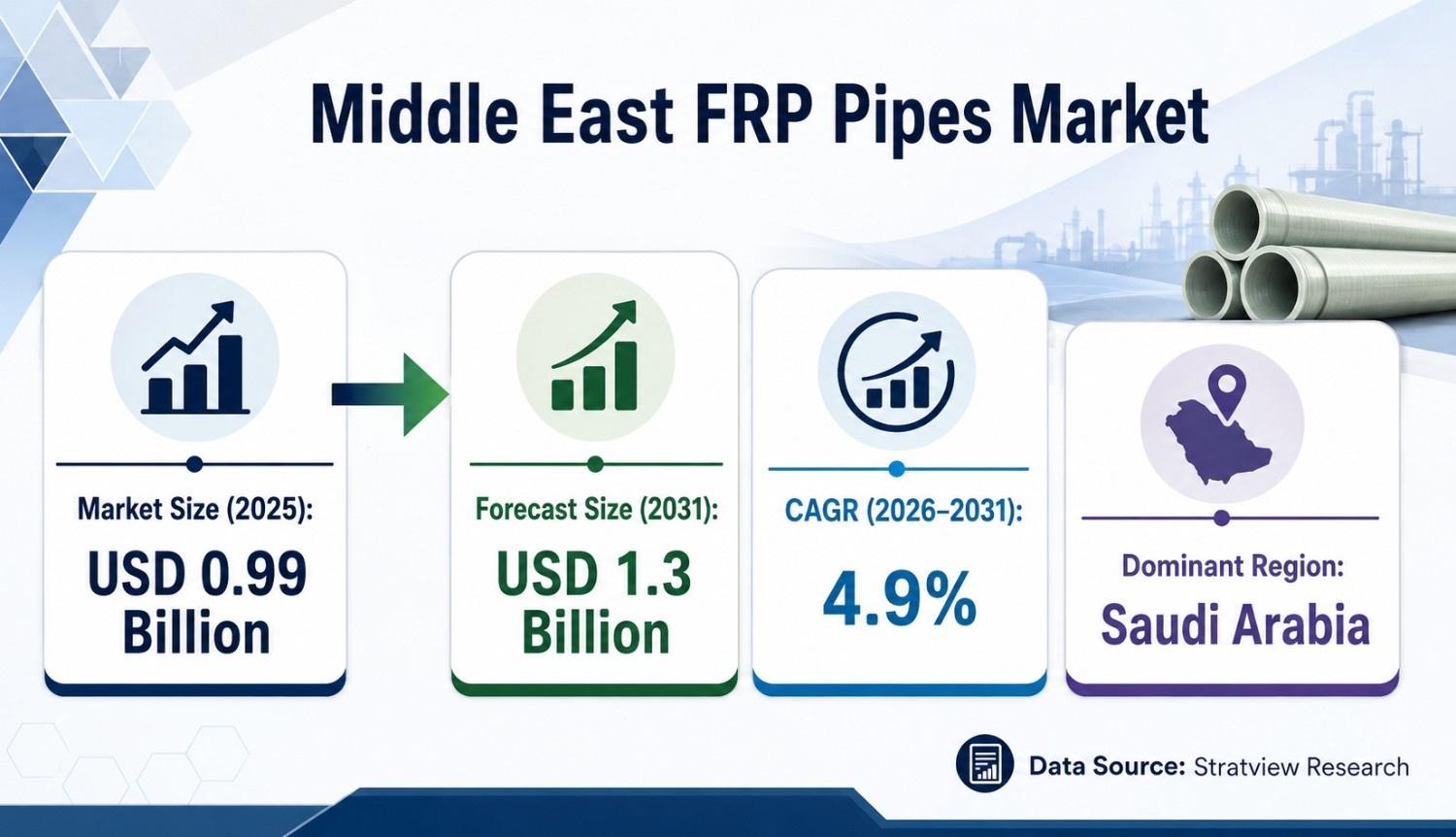
Annual demand for FRP pipes in the Middle East was approximately USD 0.99 billion in 2025. It is expected to increase to approximately USD 1.0 billion in 2026 and reach USD 1.3 billion by 2031, creating cumulative sales opportunities of more than USD 7.1 billion across the forecast period.
The Middle East FRP Pipes Market is expected to grow at a CAGR of 4.9% during 2026–2031.
The market is supported by essential infrastructure requirements and the technical characteristics of FRP systems. Corrosion resistance, hydraulic efficiency, structural performance, low weight, and long design life make the pipes relevant to municipal water, desalination, industrial processing, oil and gas, and offshore projects.
The competitive implications of Middle East FRP Pipes Market share are increasingly tied to regional presence. Manufacturers must provide qualified products while supporting large projects, maintaining international quality compliance, developing EPC and utility relationships, and aligning production capabilities with localization and national infrastructure objectives.
Request a free sample report:
https://www.stratviewresearch.com/Request-Sample/middle-east-frp-pipes-market#form
Market Segmentation Analysis
By Application Type, Oil & Gas, Industrial, Water/Wastewater, and Marine & Offshore comprise the stated market categories. Water/Wastewater is forecast to maintain dominance through desalination, water transmission, wastewater treatment, and municipal development. Industrial is anticipated to grow fastest, supported by petrochemical facilities, industrial cities, power plants, and diversification initiatives.
By Resin Type, Polyester, Vinyl Ester, and Epoxy define the market. Polyester is expected to remain dominant because its cost-effectiveness, established performance, and long service life support widespread infrastructure adoption. Vinyl Ester is projected to grow fastest as more projects require enhanced resistance in aggressive chemical and brine environments.
By Diameter Type, Medium-diameter pipes (18"-60") are expected to hold the dominant position because they address a broad range of industrial, water, oilfield, and power applications. Large-diameter pipes (>60") are forecast to grow fastest as desalination, trunk-main, and mega infrastructure requirements increase.
By Manufacturing Process Type, Filament Winding is expected to remain both dominant and fastest growing. Its ability to deliver structural integrity, pressure resistance, and dimensional consistency supports compliance with demanding specifications across infrastructure and industrial projects.
By Pressure Rating Type, the <150 PSI segment is expected to remain dominant, reflecting high-volume use in municipal water, sewer, drainage, and stormwater networks. The >300 PSI segment is expected to grow fastest through high-pressure oil and gas, desalination, and industrial-processing demand.
Regional Market Insights
Saudi Arabia is expected to remain the largest country market. Extensive investments in desalination, municipal water, transmission systems, industrial cities, and hydrocarbon infrastructure generate broad demand for FRP piping.
Saudi Arabia is also forecast to be the fastest-growing country market. Vision 2030, localized manufacturing objectives, water infrastructure, industrial diversification, and continued energy investments are expected to sustain project activity during 2026–2031.
Emerging Trends Shaping the Middle East FRP Pipes Market
Localization is influencing manufacturing and competitive strategies. National Vision agendas are encouraging regional production, testing capabilities, and stronger participation in major infrastructure programs.
Project scale is increasing demand for large-diameter and high-pressure systems. Desalination networks and transmission mains support >60" pipes, while energy and industrial applications strengthen >300 PSI demand.
Competitive differentiation is extending beyond pipe performance. Manufacturing capability, project execution, quality compliance, regional presence, and relationships with major project stakeholders are central to supplier positioning.
Key Growth Drivers of the Market
- Localization programs: National industrial agendas encourage regional manufacturing and testing, strengthening the domestic composite-pipe ecosystem.
- Major water projects: Desalination, transmission, treatment, and distribution infrastructure create long-term requirements for corrosion-resistant piping.
- Energy investment: Oilfield gathering, produced-water, and injection systems support demand for high-performance GRE and GRP products.
- Industrial diversification: Petrochemical complexes, processing facilities, industrial cities, and power plants widen the application base.
- Lifecycle requirements: Corrosion resistance, hydraulic efficiency, durability, and long service life support adoption over conventional alternatives in demanding projects.
Competitive Landscape
Top Companies in the Market
Future Pipe Industries (FPI) (Dubai, UAE)
Saudi Arabian Amiantit Company (Dammam, Saudi Arabia)
NOV Inc. (Bondstrand GRE) (USA/Global)
Abu Dhabi Pipe Factory (ADPF) (Abu Dhabi, UAE)
Advanced Piping Solutions (Saudi Arabia)
Smithline Composites (UAE)
Amiblu Holding GmbH (HOBAS/Flowtite) (Austria/Global)
Gruppo Sarplast (Italy/Global)
Hengrun Group Co., Ltd. (China/Global)
Kuzeyboru (Turkey/Global)
Conclusion and Strategic Outlook
The Middle East FRP Pipes Market is expected to reach approximately USD 1.3 billion by 2031 after expanding at a CAGR of approximately 4.9% from 2026. Water infrastructure remains the market’s demand anchor, while industrial development, high-pressure systems, larger diameters, advanced resin requirements, and localization shape incremental opportunities.
The competitive landscape is moderately consolidated and execution intensive. Future market positioning will depend on technical performance, manufacturing scale, regional capabilities, standards compliance, and access to EPC contractors, utilities, and national oil companies. Exposure to government spending and oil-price cycles will remain an important strategic consideration.
FAQs – Middle East FRP Pipes Market
1. What is the forecast size of the Middle East FRP Pipes Market?
The Middle East FRP Pipes Market is projected to reach approximately USD 1.3 billion in 2031. It is expected to stand at approximately USD 1.0 billion in 2026.
2. What is the forecast CAGR?
The market is expected to grow at a CAGR of approximately 4.9% during 2026–2031. Annual sales in 2031 are forecast to be almost 1.3 times the demand recorded in 2025.
3. Which factors are supporting market expansion?
Desalination, water transmission, wastewater infrastructure, oil and gas projects, industrial diversification, and localization support market expansion. FRP pipes also meet requirements for corrosion resistance, hydraulic performance, and service life.
4. Which regional market is expected to lead?
Saudi Arabia is forecast to remain the largest and fastest-growing country market. Its leadership reflects substantial water, industrial, energy, and municipal infrastructure investment.
5. What risks influence the competitive and investment outlook?
Oil-price volatility and changes in government expenditure can shift project schedules. Market entry also requires technical qualifications, project execution expertise, regional relationships, quality compliance, and the ability to supply large infrastructure programs.

 English
 Arabic
 French
 Spanish
 Portuguese
 Turkish
 Dutch
Dutch
 Italiano
 Russian
 Romaian
 Portuguese (Brazil)
 Greek
Greek
 Bengali