


Sticky Add to Cart Button: A Complete Shopify Conversion Guide for 2026
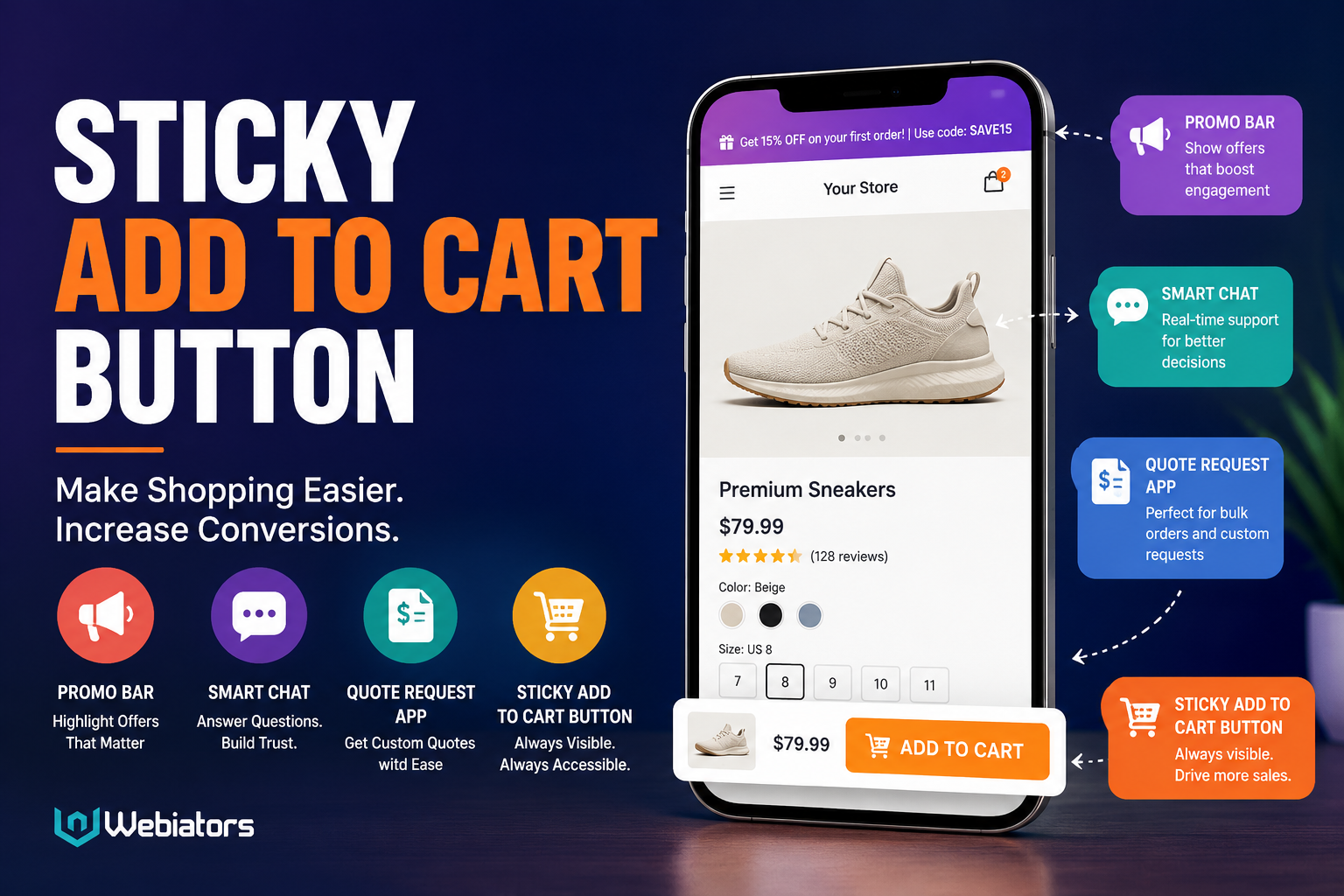
What is the best way to make Shopify product pages easier to convert? One practical approach is using a Sticky Add to Cart Button that keeps the purchase action visible while shoppers explore the page.
For Shopify marketers, the challenge is not always attracting more visitors. A store can receive strong organic, social, or paid traffic and still lose potential customers if the buying process feels inconvenient. Long product descriptions, reviews, specifications, images, shipping information, and FAQs can push the standard Add to Cart button far below the visitor's current position.
A sticky cart helps solve this usability gap while supporting a broader Shopify conversion rate optimization (CRO) strategy.
What Is a Sticky Add to Cart Button?
A Sticky Add to Cart Button is a fixed purchase element that remains available while a shopper scrolls through a product page.
With a traditional Add to Cart button, the customer may need to scroll back to the product section after finishing their research. A sticky version keeps the action accessible so customers can add the product whenever purchase intent develops.
For marketers, this can be particularly relevant for:
- Long-form product pages
- Mobile-first Shopify stores
- High-consideration products
- Stores running paid campaigns
- Product pages with extensive reviews
- B2C and selected B2B ecommerce journeys
The purpose is simple: reduce unnecessary friction between product interest and purchase action.
Why Is Sticky Add to Cart Important for Shopify Conversion Optimization?
Getting a customer to a product page is only one part of ecommerce marketing.
A visitor arriving through Google Search, Google Shopping, social media, email, or a paid advertisement may still need several minutes to evaluate the product.
They might ask:
Is this right for me?
Does it have the features I need?
What do other customers think?
How much will delivery cost?
Can I return it?
Once these questions are answered, the customer may be ready to purchase—but the original Add to Cart button could be several screens away.
A Sticky Add to Cart Button keeps the conversion action available during this decision-making process.
It should not be treated as a guaranteed conversion booster. Instead, marketers should view it as a UX and CRO experiment designed to remove a specific source of friction.
Sticky Add to Cart and Mobile Ecommerce
Mobile shoppers deserve particular attention.
A product page that looks manageable on desktop can become very long on a smartphone. Customers may scroll through images, product descriptions, reviews, specifications, and shipping information before making a decision.
A mobile-friendly sticky cart can reduce the amount of navigation required.
However, good implementation matters. The sticky element should not cover important information, interfere with menus, or make the page uncomfortable to browse.
Marketers should test:
- Button size
- Position
- Tap accessibility
- Product variant selection
- Price visibility
- Mobile screen coverage
- Compatibility across devices
The objective is not to make the button impossible to miss. The objective is to make purchasing easy when the customer is ready.
How a Promo Bar Supports the Buying Journey
A Promo Bar can work alongside a Sticky Add to Cart Button by communicating important information at the right time.
For example, Shopify marketers may use a promo bar for:
- Free shipping thresholds
- Limited-time discounts
- Seasonal campaigns
- New product announcements
- Delivery updates
- Promotional codes
The best promotional messages answer a relevant customer question quickly.
For example, a shopper may be deciding whether to purchase one item or add another product. A clear free-shipping message can provide useful information at that moment.
The two features therefore serve different purposes:
Promo Bar = communicates the offer.
Sticky Add to Cart = keeps the purchase action accessible.
Smart Chat Can Help Convert Uncertainty Into Action
Not every customer who hesitates is uninterested.
Sometimes they simply have an unanswered question.
Smart Chat can give visitors a convenient way to ask about product compatibility, sizing, delivery, returns, availability, or customization.
This is especially useful for marketers because customer questions provide valuable insight into purchase friction.
Suppose visitors repeatedly ask about product compatibility. That could indicate that the product page needs a clearer compatibility section.
Similarly, repeated shipping questions may suggest that delivery information should be more prominent.
This makes Smart Chat useful not only as a communication feature but also as a source of customer-intent insights.
When Should You Use a Quote Request App?
A standard Add to Cart journey is not ideal for every business.
Consider a Shopify store selling wholesale products or large quantities. A customer may want to know the price for 50, 100, or 500 units before placing an order.
A Quote Request App can provide an alternative conversion path.
It can be particularly relevant for:
- Wholesale ecommerce
- Bulk orders
- Custom products
- B2B Shopify stores
- Large-value purchases
- Products requiring personalized pricing
Instead of treating every visitor as a standard checkout customer, marketers can provide different actions based on buying intent.
For example:
Ready to buy → Add to Cart
Need information → Smart Chat
Need custom pricing → Quote Request
This creates a more flexible customer journey.
How Should Shopify Marketers Combine These Features?
The strongest approach is to make every feature serve a specific customer need.
| Shopify Feature | Customer Need | Marketing Purpose |
|---|---|---|
| Sticky Add to Cart Button | “I want to buy.” | Reduce purchase friction |
| Promo Bar | “Is there an offer?” | Communicate promotions |
| Smart Chat | “I have a question.” | Reduce uncertainty |
| Quote Request App | “I need custom pricing.” | Capture high-intent leads |
A typical customer journey could look like:
Discover → Research → Ask → Decide → Purchase
These features can support different points within that journey.
The mistake marketers should avoid is adding every available feature without considering usability. More functionality does not automatically mean better conversion performance.
AEO Strategy: Answer Questions Before Customers Ask
Answer Engine Optimization (AEO) focuses on creating content that directly addresses the questions users ask search engines and AI-powered answer systems.
For this topic, useful questions include:
- What is a Sticky Add to Cart Button?
- Does sticky cart improve Shopify conversion rates?
- Is Sticky Add to Cart useful on mobile?
- How does sticky cart reduce purchase friction?
- What is the difference between sticky cart and normal Add to Cart?
- When should Shopify stores use a Quote Request App?
The strongest answers are concise, specific, and followed by useful context.
For marketers, this same approach should be applied to product pages. Answer customer questions directly instead of forcing visitors to search through multiple sections.
GEO Strategy: Build Context Around the Topic
Generative Engine Optimization (GEO) requires more than repeating a target keyword.
Content should establish relationships between concepts such as:
Shopify → Product Page → User Experience → Conversion Rate Optimization → Mobile Ecommerce → Customer Intent → Add to Cart → Checkout
Supporting terms such as product-page optimization, ecommerce UX, mobile conversion, purchase friction, customer journey, CRO, Shopify marketing, and conversion funnel help create topical context naturally.
This is more useful than repeatedly inserting the same keyword into every paragraph.
What Should Marketers Measure?
After implementing a Sticky Add to Cart Button, measure actual user behavior.
Important metrics include:
- Add-to-cart rate
- Product-page conversion rate
- Mobile conversion rate
- Checkout initiation
- Cart abandonment
- Revenue per visitor
- Engagement from paid traffic
- Quote requests
- Chat interactions
Where possible, compare performance before and after implementation or run controlled experiments.
A feature should earn its place through measurable value.
Best Practices for a High-Converting Sticky Cart
Keep the design simple and recognizable. Make sure the button works correctly across mobile and desktop. If a product has variants, make selections easy to understand.
Avoid covering important content or navigation.
Do not overload the sticky element with multiple messages, icons, and promotional elements. The customer's primary question should be obvious:
“What can I do next?”
If the customer is ready to purchase, the answer should be easy to find.
Webiators offers Shopify-focused tools that can support merchants looking to build a more convenient and conversion-oriented storefront experience.
FAQs
Does a Sticky Add to Cart Button improve Shopify conversions?
It can improve the purchasing experience by reducing navigation friction, but results vary by store and audience. Marketers should test the feature and measure conversion-related metrics.
Is Sticky Add to Cart good for mobile Shopify stores?
Yes. It can be particularly useful on mobile product pages because shoppers often scroll extensively before deciding to purchase.
Does Sticky Add to Cart affect SEO directly?
No. Its primary role is UX and conversion optimization rather than direct SEO ranking. However, it can improve the experience for visitors arriving through organic search.
Should every Shopify store use a Sticky Add to Cart Button?
Not necessarily. Stores should evaluate page length, customer behavior, mobile traffic, and conversion data before deciding whether it is appropriate.
How does a Promo Bar work with Sticky Add to Cart?
A Promo Bar communicates offers or important information, while the Sticky Add to Cart Button keeps the purchase action accessible. Together, they can support different parts of the buying journey.
Why add Smart Chat to a Shopify store?
Smart Chat can help customers get answers about products, delivery, returns, compatibility, or other concerns that may affect their purchasing decision.
What is the purpose of a Quote Request App?
It provides an alternative conversion path for customers who need bulk pricing, custom pricing, wholesale terms, or other information before ordering.
What is the best way to optimize a Sticky Add to Cart Button?
Prioritize usability. Keep it visible without being intrusive, optimize it for mobile, ensure product variants work correctly, and measure its impact using conversion and engagement data.
Final Takeaway
A Sticky Add to Cart Button is most valuable when it solves a real customer-experience problem.
For Shopify marketers, the strategy should go beyond simply adding a fixed button. Combine it with relevant supporting experiences such as a Promo Bar for promotions, Smart Chat for customer questions, and a Quote Request App for customized or bulk purchasing.
For SEO, AEO, and GEO, focus on genuine search intent, direct answers, semantic relevance, and helpful context.
Ultimately, the best Shopify conversion strategy is simple: bring the right visitors to the store, answer their questions, remove unnecessary friction, and make the next action easy.

 English
 Arabic
 French
 Spanish
 Portuguese
 Deutsch
 Turkish
 Dutch
Dutch
 Italiano
 Russian
 Portuguese (Brazil)
 Greek
Greek
 Bengali