


How do Andrology Room Setup Services Improve Laboratory Efficiency?
Introduction
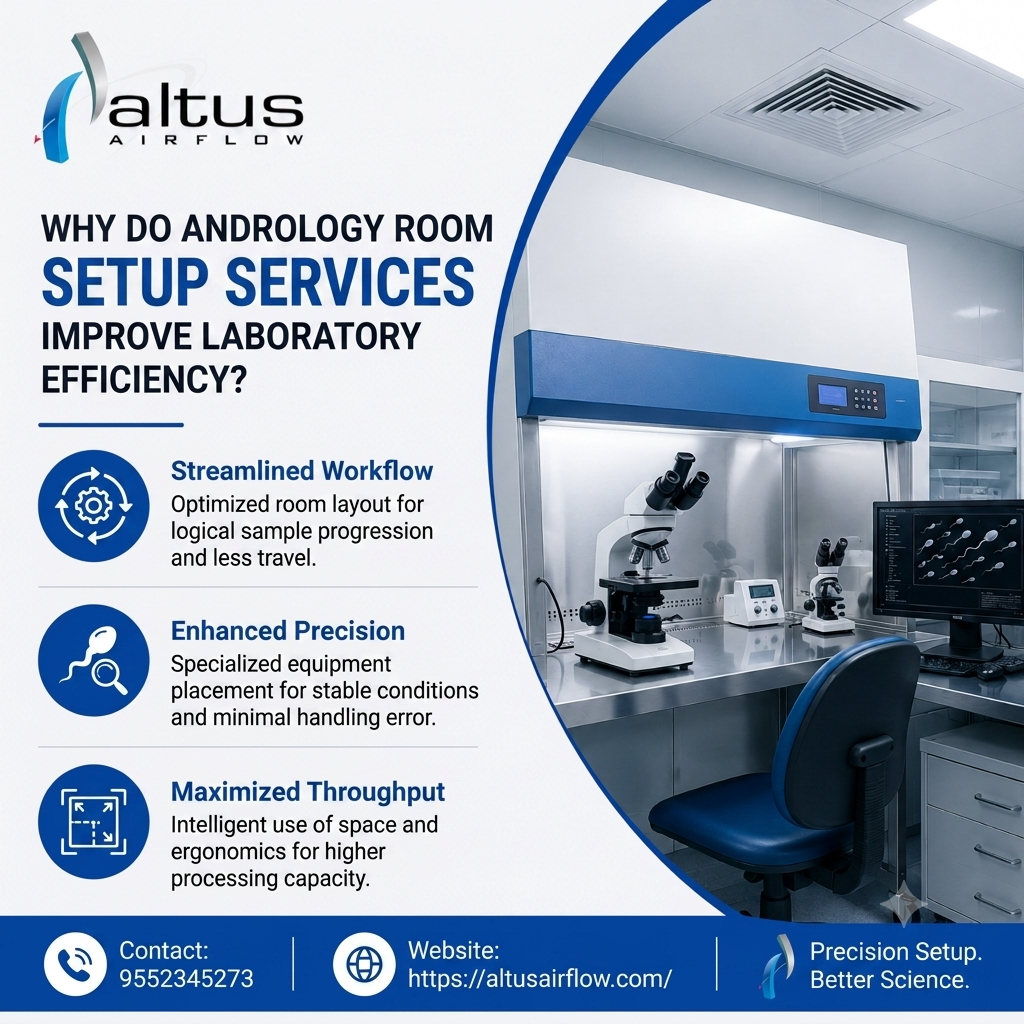
Modern fertility laboratories rely on precision, consistency, and contamination-free environments to achieve reliable diagnostic and treatment outcomes. Andrology Room Setup Services play a vital role in designing laboratories that support accurate semen analysis, sperm preparation, cryopreservation, and other reproductive procedures. A professionally planned andrology laboratory is much more than a room with equipment—it is a controlled environment where airflow, cleanliness, temperature, humidity, and workflow are carefully managed to improve operational efficiency.
In fertility clinics and IVF centers, laboratory performance directly impacts productivity and the quality of patient care. Proper planning helps reduce errors, improves staff efficiency, protects sensitive samples, and ensures compliance with healthcare standards. Investing in a well-designed laboratory creates a safe and reliable workspace that supports long-term operational excellence.
Understanding an Andrology Laboratory
An andrology laboratory is a specialized facility dedicated to the examination and handling of male reproductive samples. It supports procedures such as:
- Semen analysis
- Sperm preparation
- Sperm washing
- Morphology assessment
- Motility testing
- Cryopreservation
- Sample storage
- Quality control procedures
Since biological samples are highly sensitive to environmental changes, laboratories require carefully controlled conditions. Even minor fluctuations in temperature, humidity, or airborne contamination may influence laboratory performance.
Why Laboratory Efficiency Matters?
Laboratory efficiency is about much more than completing tasks quickly. It involves creating an environment where every procedure can be performed accurately, safely, and consistently.
An efficient laboratory offers several advantages:
- Faster workflow
- Reduced handling errors
- Better sample integrity
- Improved staff productivity
- Consistent testing quality
- Easier compliance with laboratory standards
- Enhanced patient confidence
Efficient laboratories also reduce unnecessary movement, equipment downtime, and workflow interruptions.
Importance of Proper Laboratory Design
A thoughtfully designed laboratory creates an organized workspace that minimizes delays and improves coordination between technicians.
Key design considerations include:
- Dedicated work zones
- Logical equipment placement
- Clean and dirty area separation
- Controlled access
- Proper ventilation
- Ergonomic workstations
These design elements allow technicians to perform procedures smoothly without unnecessary interruptions.
Controlled Air Quality Improves Performance
One of the biggest contributors to laboratory efficiency is indoor air quality.
Sensitive reproductive samples require a contaminant-free environment. Airborne particles, dust, microorganisms, and volatile organic compounds can affect laboratory performance if not properly controlled.
Modern ventilation systems help maintain:
- Stable airflow
- Low particulate levels
- Controlled pressure
- Temperature consistency
- Humidity control
Cleaner air supports better laboratory reliability while reducing contamination risks.
Better Workflow Planning Reduces Delays
Workflow planning is an essential part of laboratory design.
An efficient layout ensures that technicians move naturally from one procedure to the next without unnecessary walking or repeated handling of samples.
Typical workflow includes:
- Sample reception
- Registration
- Processing
- Analysis
- Documentation
- Storage
- Disposal
A logical sequence helps reduce turnaround time while maintaining sample traceability.
Proper Equipment Placement Enhances Productivity
Laboratory equipment should be positioned according to workflow rather than available space.
Important equipment may include:
- Laminar airflow units
- Microscopes
- Incubators
- Centrifuges
- Cryostorage systems
- Refrigerators
- Imaging systems
Correct positioning minimizes technician movement and allows procedures to be completed more efficiently.
Temperature Stability Supports Reliable Results
Biological samples are extremely sensitive to environmental conditions.
Temperature fluctuations may affect sample quality and laboratory consistency.
An efficient laboratory maintains:
- Stable room temperature
- Equipment temperature monitoring
- Controlled storage environments
- Continuous environmental monitoring
Stable conditions help laboratories produce consistent results throughout the day.
Humidity Control Protects Laboratory Operations
Humidity affects both laboratory equipment and biological materials.
Excess humidity may contribute to:
- Equipment corrosion
- Condensation
- Microbial growth
Very low humidity can increase static electricity, which may interfere with delicate laboratory instruments.
Maintaining balanced humidity improves equipment performance and creates a more comfortable working environment.
Cleanroom Standards Reduce Contamination
Many advanced fertility laboratories incorporate cleanroom principles.
These include:
- HEPA filtration
- Positive air pressure
- Controlled entry
- Easy-to-clean surfaces
- Regular air monitoring
Reducing contamination risks improves testing reliability while protecting valuable biological samples.
Efficient Lighting Improves Accuracy
Laboratory work requires precision.
Proper lighting reduces eye strain and improves visibility during microscopic examination and laboratory procedures.
Well-designed lighting systems provide:
- Uniform illumination
- Reduced glare
- Comfortable working conditions
- Better observation quality
Improved visibility supports greater accuracy during routine analysis.
Ergonomic Workstations Improve Technician Performance
Technicians spend long hours performing repetitive tasks.
Ergonomic laboratory design helps reduce fatigue by providing:
- Adjustable seating
- Comfortable work heights
- Accessible equipment placement
- Organized storage
- Reduced unnecessary movement
Comfortable staff members can maintain concentration and productivity for longer periods.
Organized Storage Saves Valuable Time
Proper storage systems improve laboratory efficiency by ensuring that every item has a designated location.
Storage planning includes:
- Reagent cabinets
- Sample storage
- Documentation areas
- Consumable inventory
- Equipment storage
Well-organized storage reduces search time and minimizes workflow interruptions.
Automation Supports Faster Laboratory Operations
Modern laboratories increasingly use automation to improve efficiency.
Automated systems may assist with:
- Sample tracking
- Environmental monitoring
- Data recording
- Equipment alerts
- Inventory management
Automation reduces manual errors while improving consistency and documentation.
Compliance Becomes Easier
Healthcare laboratories must follow strict quality standards.
A properly planned laboratory simplifies compliance by supporting:
- Controlled environments
- Standard operating procedures
- Equipment validation
- Calibration schedules
- Documentation systems
- Maintenance planning
Efficient facilities make inspections and audits easier to manage.
Sample Safety is Improved
Protecting biological samples is one of the highest priorities in an andrology laboratory.
Good laboratory planning supports sample safety through:
- Controlled access
- Secure storage
- Proper labeling
- Organized workflows
- Reduced handling
These measures help preserve sample quality throughout the testing process.
Better Infection Control
Infection prevention is essential in any laboratory handling biological materials.
Effective laboratory design incorporates:
- Hand hygiene stations
- Easy-to-clean surfaces
- Proper waste disposal
- Controlled airflow
- Dedicated cleaning protocols
These features help maintain a hygienic working environment.
Reduced Maintenance Interruptions
A well-designed laboratory considers long-term maintenance requirements.
Proper installation allows easier access to:
- HVAC systems
- Electrical panels
- Plumbing
- Gas pipelines
- Monitoring equipment
Routine maintenance can be completed with minimal disruption to laboratory activities.
Energy-Efficient Laboratory Design
Modern laboratory planning also focuses on sustainability.
Energy-efficient systems include:
- Smart HVAC controls
- LED lighting
- Energy-saving equipment
- Automated monitoring systems
- Efficient insulation
These features help laboratories operate more efficiently while supporting environmental responsibility.
Future-Ready Laboratory Planning
Healthcare technologies continue to evolve.
Flexible laboratory layouts allow future expansion without major structural modifications.
Future-ready designs include:
- Modular furniture
- Expandable utilities
- Additional equipment space
- Flexible electrical systems
- Scalable ventilation
This adaptability supports long-term operational growth.
Staff Collaboration Improves Efficiency
An organized laboratory encourages better communication between technicians, clinicians, and laboratory managers.
Benefits include:
- Faster decision-making
- Improved coordination
- Better scheduling
- Reduced workflow conflicts
- Increased operational efficiency
Collaboration ultimately contributes to smoother laboratory performance.
Benefits of Professional Laboratory Planning
Professionally designed laboratories provide long-term operational advantages.
Major benefits include:
- Improved workflow
- Better contamination control
- Higher productivity
- Enhanced sample protection
- Comfortable working conditions
- Easier compliance
- Reduced maintenance issues
- Reliable environmental control
- Better equipment performance
- Long-term operational efficiency
Conclusion
A modern andrology laboratory requires much more than advanced equipment. Environmental control, intelligent workflow planning, ergonomic design, contamination prevention, and reliable infrastructure all contribute to efficient laboratory operations. Investing in professional laboratory planning helps improve productivity, supports consistent testing quality, and creates a safe environment for both technicians and biological samples.
Altus Airflow understands the importance of precision, controlled airflow, and laboratory infrastructure when planning advanced fertility laboratories. By delivering reliable design solutions that support performance, safety, and compliance, Altus Airflow helps healthcare facilities create efficient laboratories prepared for current requirements and future advancements.
Frequently Asked Questions
1. What are Andrology Room Setup Services?
Andrology Room Setup Services involve the planning, design, ventilation, environmental control, workflow optimization, and infrastructure development of specialized laboratories used for male fertility testing and reproductive procedures.
2. Why is airflow important in an andrology laboratory?
Proper airflow minimizes airborne contamination, maintains clean conditions, and protects sensitive biological samples during laboratory procedures.
3. How does laboratory layout improve efficiency?
A well-planned layout reduces unnecessary movement, speeds up workflows, improves organization, and enhances technician productivity.
4. Why is temperature control necessary in an andrology lab?
Stable temperature conditions help preserve sample quality, improve equipment performance, and support consistent laboratory results.
5. What role does humidity control play?
Humidity control protects equipment, reduces microbial growth, and maintains suitable environmental conditions for laboratory operations.
Read Our Previous Blog --------------->How do Turnkey Andrology Room Solutions improve laboratory efficiency?

 Arabic
 French
 Spanish
 Portuguese
 Deutsch
 Turkish
 Dutch
Dutch
 Italiano
 Russian
 Romaian
 Portuguese (Brazil)
 Greek
Greek
 Bengali