


What Are Rigid Boxes? Materials, Construction and Uses
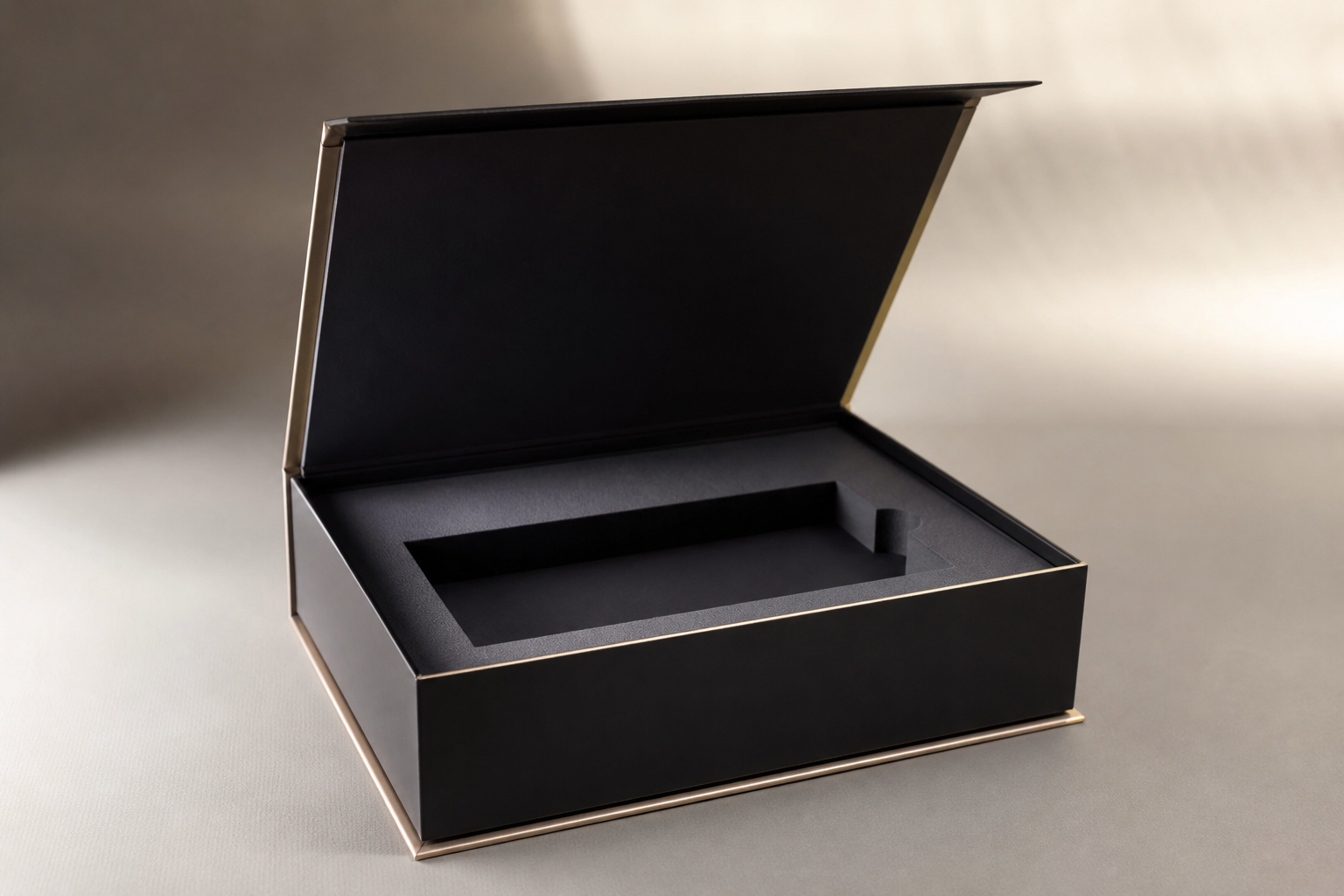
Not every product needs rigid packaging, but the ones that benefit from it benefit enormously. Rigid boxes are the format brands reach for when the box itself needs to communicate quality before the product inside ever gets touched.
Understanding what actually makes a box "rigid," and how that differs from the folding cartons most e-commerce shipments use, is the first step to deciding whether it's the right fit for your product.
What Makes a Box "Rigid"
A rigid box is built around a solid paperboard core, typically chipboard ranging from 1.5mm to 3mm in thickness, wrapped in a printed or specialty paper.
Unlike folding cartons, which are die-cut, scored, and shipped flat before being assembled at the point of use, rigid boxes are pre-assembled at the factory and ship in their final, set-up form.
That construction method is exactly what gives rigid boxes their signature weight and structural permanence: there are no fold lines to weaken the walls, and the box holds its shape under pressure in a way a folding carton simply can't replicate.
Core Construction Components
A rigid box typically consists of three layered elements. The chipboard core provides structural rigidity and determines how the box feels in hand, thicker board generally signals a more premium product.
The wrap paper, glued over the chipboard, carries the printed design, branding, and any specialty finish. And the interior lining, often a plain or coordinated paper, gives the inside of the box a finished look rather than exposed raw board.
Some rigid box styles add a fourth element, a separate base and lid construction, which is where terms like "two-piece" or "collapsible rigid" come from, each describing a different way the lid and base relate to one another structurally.
Common Rigid Box Styles
Rigid boxes come in several structural formats, each suited to different product and shipping needs. Two-piece boxes, a separate base and lid, offer the most premium unboxing experience but take up more shelf and storage space unassembled.
Collapsible rigid boxes fold flat for shipping and storage while still using rigid-weight board, a practical middle ground for brands that need the premium feel without the storage footprint of fully rigid construction.
Book-style or magnetic closure boxes hinge open like a book, popular in cosmetics and electronics packaging where the unboxing sequence itself is part of the brand experience.
When Rigid Packaging Makes Sense
Rigid boxes earn their higher per-unit cost when the product itself justifies a premium presentation, jewelry, cosmetics, electronics, spirits, and gift sets are common categories.
They also make sense whenever the box will be reused or displayed rather than immediately discarded, since the structural durability holds up to repeated handling in a way folding cartons don't.
If you're sourcing custom rigid boxes for a product launch, we work with brands to match board weight and finish to both the product's protection needs and the unboxing experience they're trying to create, since those two goals don't always point to the same specification.
When a Folding Carton Is the Better Choice
Rigid boxes aren't the right fit for every product, and it's worth being direct about that. High-volume e-commerce shipping, where cost-per-unit and flat-pack shipping efficiency matter more than shelf presentation, generally favors folding cartons.
Products with frequent packaging redesigns or seasonal variations also tend to favor folding cartons, since rigid tooling and setup costs are less forgiving of frequent changes.
The honest trade-off: rigid boxes deliver a premium feel and structural durability that folding cartons can't match, but folding cartons deliver cost efficiency and shipping practicality that rigid construction can't match either.
Choosing the Right Board Weight
Board thickness is one of the most consequential specification decisions in rigid box sourcing, and it's often underexplained.
Lighter board, around 1.5mm, keeps costs down while still delivering a noticeably firmer feel than a folding carton, suitable for lighter products like jewelry or small cosmetics.
Mid-weight board, around 2mm, is the most common choice across categories, balancing cost, weight, and durability.
Heavier board, 2.5mm to 3mm, is reserved for premium spirits, luxury electronics, and gift sets where the box itself is part of the perceived product value.
Getting this specification right from the outset avoids the common and costly mistake of over-speccing a product that didn't need the added weight and cost, or under-speccing one that needed more structural presence.
Sustainability Considerations in Rigid Construction
Rigid boxes have historically had a reputation for being less sustainable than folding cartons, largely due to their weight and the glue-intensive wrapping process.
That reputation is shifting as more suppliers move toward SFI-certified board stock and soy-based inks, which meaningfully reduce the environmental footprint of the raw materials without requiring a change to the construction method itself.
For brands balancing a premium packaging goal against sustainability commitments, asking specifically about board sourcing certification and ink composition, rather than assuming rigid construction is inherently less sustainable, tends to surface options that satisfy both priorities.
A Note on Working With a Supplier the First Time
If this is your first time sourcing rigid boxes, it's worth requesting a physical sample before committing to a full production order, even a generic stock sample rather than one built to your exact specification.
Board weight and finish quality are genuinely difficult to evaluate from a spec sheet or product photo alone; holding a sample in hand tends to clarify, almost immediately, whether a given board weight or finish matches what you had in mind.
Most established suppliers, Alpha Global Packaging included, offer a free 3D mockup ahead of production specifically so brands can visualize the finished design before committing to tooling and a full run.
Rigid boxes represent a genuine investment in how a product is perceived from the moment it's picked up.
Understanding the construction fundamentals, board weight, wrap materials, and structural style, before requesting a quote puts you in a much stronger position to specify exactly what your product needs rather than defaulting to whatever a supplier suggests first.

 English
 Arabic
 French
 Spanish
 Portuguese
 Deutsch
 Turkish
 Dutch
Dutch
 Italiano
 Russian
 Romaian
 Greek
Greek
 Bengali