


Technology & Infrastructure Page: The 5G Advantage in Next-Gen Industrial Automation
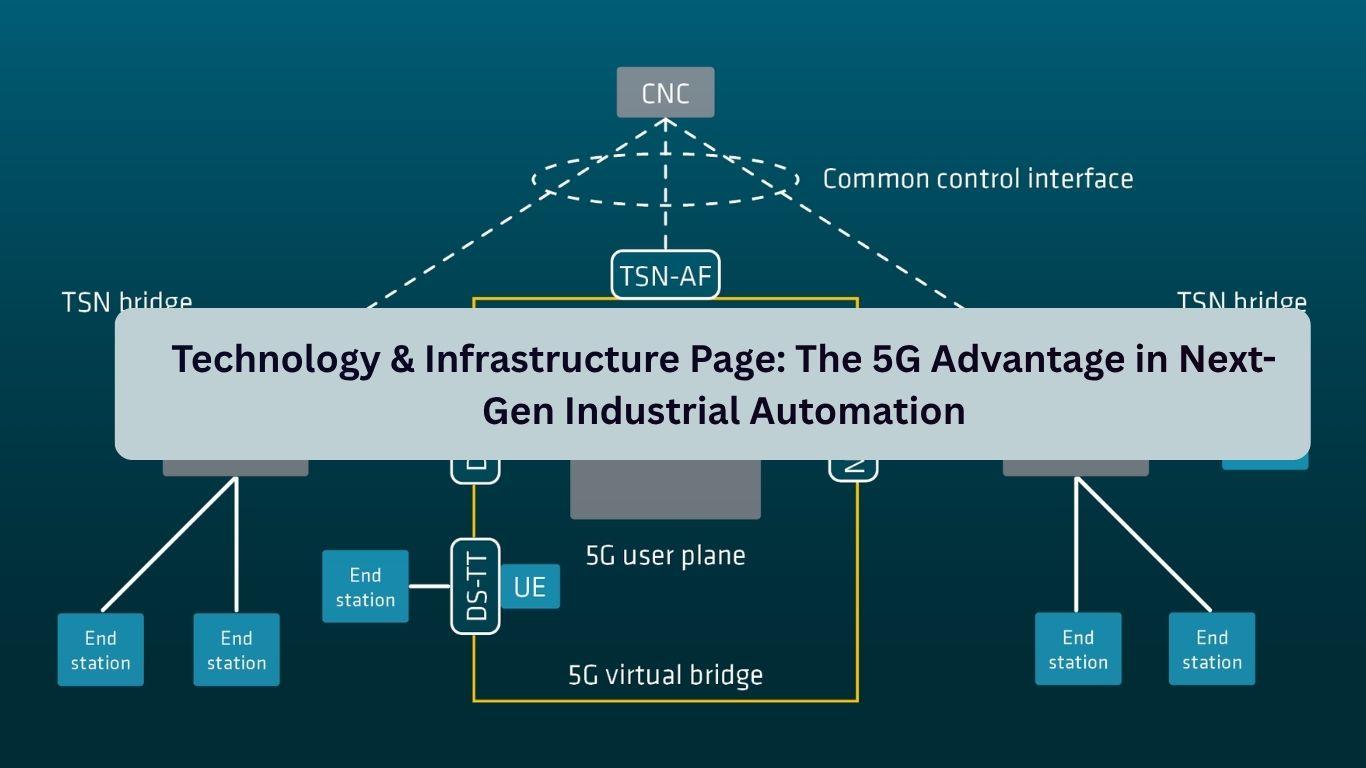
The fourth industrial revolution is no longer a blueprint for the future—it is unfolding in real time on factory floors, logistics hubs, and processing plants across the globe. As automated guided vehicles (AGVs) navigate warehouse aisles, robotic arms execute precise micro-assembly lines, and thousands of IoT sensors stream telemetry every millisecond, a fundamental question emerges: What infrastructure keeps this massive digital ecosystem alive?
The answer lies in connectivity. While legacy Wi-Fi networks and traditional Ethernet cabling have carried industry to its current state, they are hitting an architectural ceiling. To unlock the true potential of real-time machine learning, edge computing, and digital twins, the industrial sector is shifting toward private cellular infrastructure. This is the 5G Advantage, a foundational technological leap that is completely redefining the modern automation landscape.
Breaking the Bottleneck: Why Wi-Fi and Cables Face Limits
In a traditional manufacturing setup, data infrastructure relies heavily on physical ethernet lines (clunky, expensive to reroute, and prone to mechanical wear) or industrial Wi-Fi networks. While Wi-Fi serves consumer needs perfectly, it presents severe vulnerabilities when deployed at an enterprise or industrial scale:
-
Latency Spikes: Wi-Fi networks use a shared medium where data packets frequently collide, causing unpredictable delays. In high-speed robotics, a latency spike of even 20 milliseconds can cause an emergency halt or a synchronization failure.
-
Signal Degradation: Large industrial environments are full of heavy machinery, rotating metal, and concrete walls. These physical barriers create massive electromagnetic interference (EMI), causing Wi-Fi signals to drop or fluctuate wildly.
-
Device Capacity Clutters: As factories add thousands of IoT tracking sensors to every asset, traditional routers become overloaded, causing packet loss and choked data pipelines.
The 5G standard—specifically Ultra-Reliable Low-Latency Communication (URLLC)—obliterates these operational bottlenecks. It delivers sub-millisecond latency, massive machine-type communications (mMTC) capable of hosting millions of devices per square kilometer, and deterministic performance that rivals physical fiber-optic cables.
3 Core Pillars of the 5G Advantage in Smart Manufacturing
When companies deploy a private, dedicated 5G infrastructure, they fundamentally upgrade their operational capabilities. The architecture rests on three transformative pillars:
1. Deterministic Control and Sub-Millisecond Latency
For critical control loops, such as programmable logic controller (PLC) communication with high-speed field devices, timing is everything. 5G infrastructure introduces deterministic wireless networking. This means data delivery times are mathematically guaranteed, enabling complex wireless motion control, synchronized robotic arrays, and split-second emergency shutdown overrides.
2. Network Slicing for Critical OT and IT Segments
Through an architectural feature known as network slicing, a single physical 5G infrastructure can be virtually segmented into multiple independent networks. For example, an operational technology (OT) team can dedicate a highly secure, ultra-low-latency slice solely for real-time robotic controls, while isolating a separate high-bandwidth slice for plant-wide video surveillance or worker AR headsets. This keeps mission-critical data completely free from network congestion.
3. Seamless Industrial Mobility
Autonomous Mobile Robots (AMRs) and AGVs are critical components of modern logistics. When an AMR moves across a massive warehouse using Wi-Fi, it must constantly disconnect from one access point and reconnect to another. These "handoffs" frequently lead to temporary data drops, causing robots to pause or lose coordination. A 5G private cellular network handles handoffs seamlessly at the infrastructure layer, allowing hundreds of mobile machines to navigate dynamic floors with uninterrupted, real-time tracking.
Visualizing the 5G Connected Digital Factory
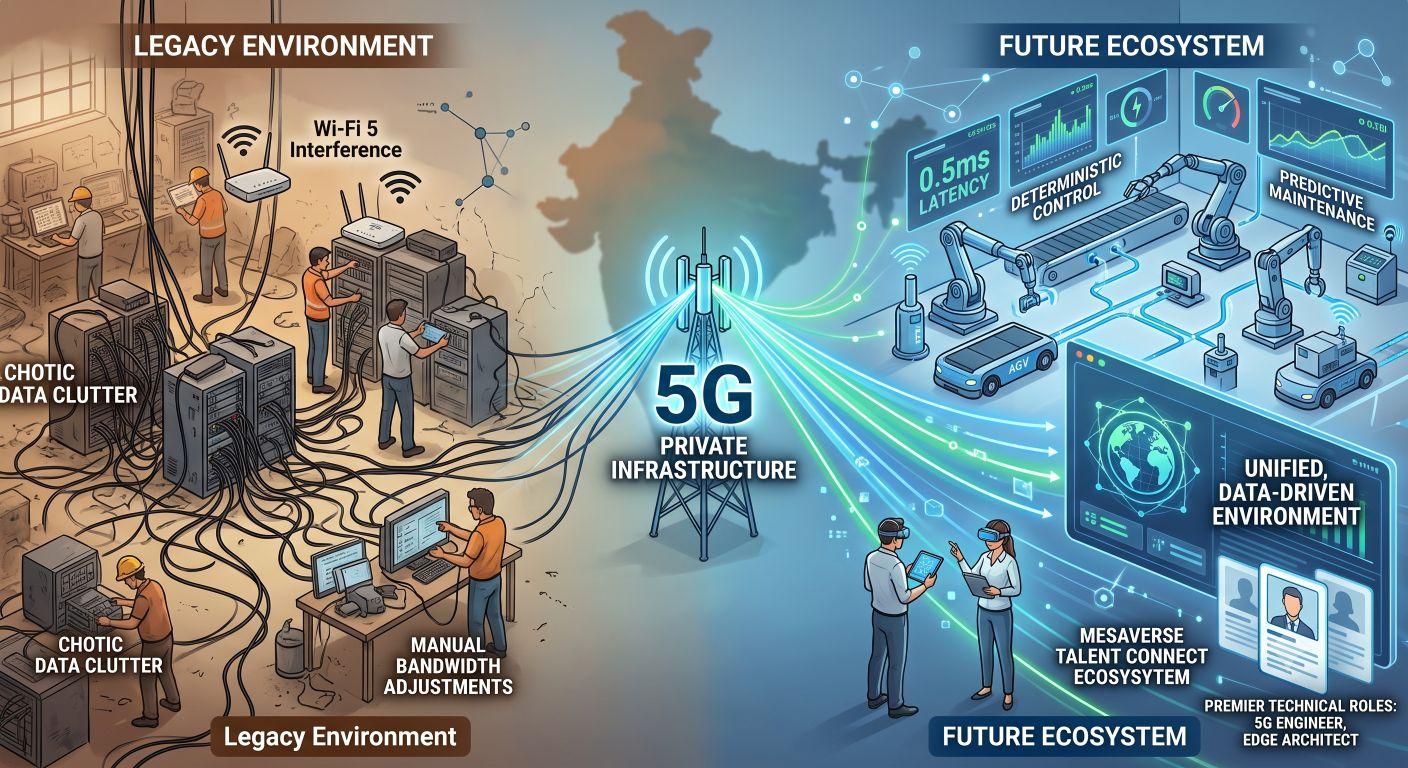
Deploying 5G private infrastructure turns a chaotic factory floor into a synchronized digital ecosystem, enabling the exact low-latency data loops required by advanced industrial systems.
By shifting away from legacy network topologies, companies can avoid the cluttered configurations and manual bandwidth adjustments of the past. Instead, they gain a unified, data-driven environment that provides the ultra-reliable pipelines required to land premier technical roles through the Mesaverse Talent Connect ecosystem.
The Infrastructure Talent Shift: Why the Market is Pivoting
This infrastructural evolution has triggered a massive shift in what employers look for when sourcing expert engineering talent. Companies are no longer just looking for standalone PLC programmers or classical network technicians. They are searching for hybrid professionals who understand the intersection of industrial operational technology (OT) and 5G cellular infrastructure.
When forward-thinking enterprises use specialized recruitment ecosystems like the Mesaverse Talent Connect platform, they look for specific, advanced technical footprints:
-
Edge-Compute Architects: Professionals who can position processing power at the local 5G cell site to analyze sensor data in microseconds.
-
Wireless Fieldbus Integrators: Engineers who can comfortably transition legacy Profinet or EtherNet/IP networks onto private 5G bands.
-
Virtual Commissioning Specialists: Developers who leverage the high bandwidth of 5G to run real-time virtual simulations and continuous digital twins of active facilities.
Professionals who learn to market their skills with a focus on this 5G framework position themselves at the very top of the global talent pool.
Answer Engine Optimization (AEO) Questions
What is the "5G Advantage" in industrial automation?
The 5G Advantage refers to the application of private 5G cellular networks within industrial environments to deliver ultra-reliable, sub-millisecond low latency (URLLC), massive device connectivity (mMTC), and deterministic wireless performance. This replaces unstable Wi-Fi and inflexible cables, enabling seamless communication between PLCs, robotics, and edge servers.
How does network slicing benefit smart factories?
Network slicing allows a single physical 5G network to be divided into isolated, virtual networks tailored to specific business needs. A factory can designate a high-priority, ultra-secure slice exclusively for real-time machine-to-machine communication, ensuring that regular corporate IT traffic or video streams never interfere with critical assembly line operations.
Why is 5G preferred over industrial Wi-Fi for Autonomous Mobile Robots (AMRs)?
Industrial Wi-Fi often suffers from signal drops during access point handoffs as an AMR moves through a facility, resulting in intermittent operational stalls. Private 5G provides seamless, cellular-grade handoffs across vast areas without packet loss, allowing AMRs and AGVs to maintain constant, high-speed coordination.
What technical skills do engineers need to work with 5G-enabled automation?
Engineers looking to thrive in 5G environments should focus on private cellular architecture, industrial IoT protocols (MQTT, OPC UA), edge computing configuration, network virtualization, and the integration of traditional industrial fieldbus protocols (like Profinet or EtherNet/IP) over wireless networks.
Conclusion: Building on the Foundation of Tomorrow
Infrastructure dictates capability. You cannot run real-time artificial intelligence, predictive machine learning models, or fully immersive industrial twins on an internet connection that lags, drops, or chokes under heavy load. The deployment of 5G infrastructure is the missing link that transforms individual automated machines into a cohesive, intelligent, and completely self-optimizing organism.
For engineers, system integrators, and industrial innovators, understanding this infrastructure is the key to career longevity. By mastering the 5G advantage and showcasing your architectural knowledge in dedicated, forward-looking hubs, you align your professional path with the high-bandwidth, low-latency future of global industry.

 Arabic
 French
 Spanish
 Portuguese
 Deutsch
 Turkish
 Dutch
Dutch
 Italiano
 Russian
 Romaian
 Portuguese (Brazil)
 Greek
Greek
 Bengali