Introduction
In today’s healthcare environment, psychiatric practices face increasing pressure to balance quality patient care with efficient administrative operations. While psychiatrists and mental health professionals focus on diagnosing and treating complex behavioral conditions, the administrative side—especially billing and coding—can quickly become overwhelming.
This is where psychiatric billing services play a crucial role. Unlike general medical billing, psychiatric billing involves unique coding requirements, time-based therapy sessions, strict payer guidelines, and frequent claim rejections if documentation is not precise. Even a small error can lead to delayed reimbursements or denied claims.
Outsourcing or optimizing psychiatric billing is no longer just an option—it has become a necessity for many mental health providers who want to maintain steady cash flow, reduce administrative burden, and improve operational efficiency.
In this blog, we will explore how psychiatric billing works, the challenges involved, and how professional billing support can transform revenue cycle performance for behavioral health practices.
Understanding Psychiatric Billing Services and Their Importance
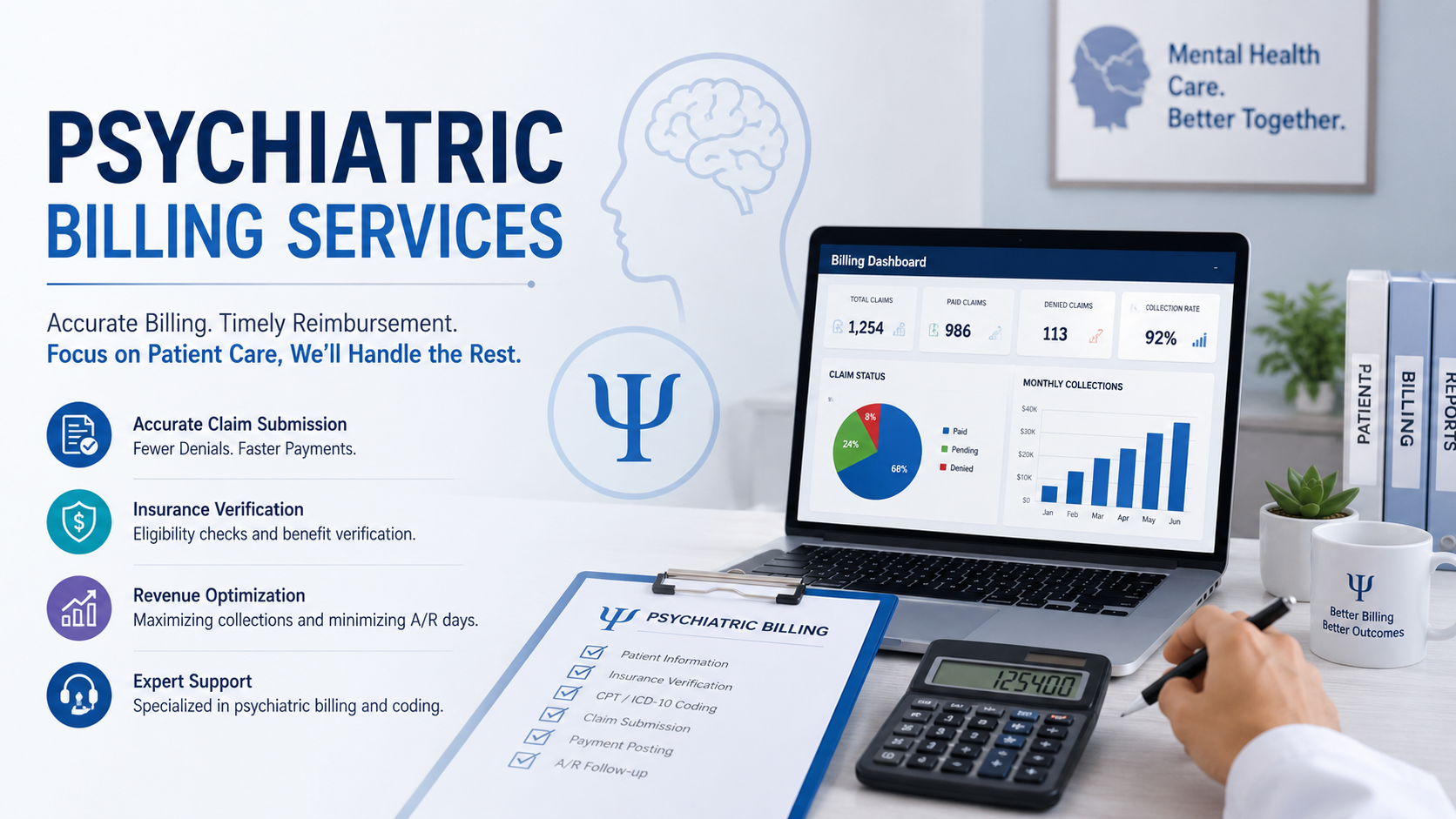
Psychiatric billing services refer to specialized medical billing solutions designed specifically for mental and behavioral health providers. These services handle everything from patient eligibility verification and coding to claim submission and denial management.
Unlike standard medical specialties, psychiatric billing involves:
- Time-based evaluation and management (E/M) coding
- Psychotherapy add-on codes
- Medication management billing
- Telepsychiatry billing complexities
- Frequent documentation requirements for medical necessity
One of the biggest challenges in psychiatry billing is ensuring accurate time tracking. Many psychiatric services are billed based on session duration, and even minor inaccuracies can lead to underpayment or claim rejection.
Professional billing teams ensure that every claim is coded correctly according to payer guidelines and current CPT (Current Procedural Terminology) standards. This not only improves reimbursement rates but also reduces compliance risks.
Additionally, psychiatric billing services help practices stay updated with ever-changing insurance rules, especially for Medicaid and Medicare behavioral health coverage. This is crucial because mental health billing regulations often differ significantly from general healthcare billing.
Common Challenges Faced in Psychiatric Billing
Psychiatric practices often struggle with billing inefficiencies that directly impact revenue flow. Understanding these challenges is the first step toward improving the revenue cycle.
1. Complex Coding Requirements
Psychiatric services involve multiple CPT codes such as psychotherapy (90832, 90834, 90837), psychiatric evaluations, and medication management codes. Each code has strict time and documentation requirements. Incorrect selection of codes can lead to underbilling or claim denial.
2. High Claim Denial Rates
Behavioral health claims are more likely to be denied due to missing documentation, eligibility issues, or incorrect modifiers. Many insurance payers require prior authorization for psychiatric services, which adds another layer of complexity.
3. Time-Based Billing Errors
Unlike other specialties, psychiatry heavily relies on session duration. If a provider documents a 45-minute session but bills it as 60 minutes, it can trigger audits or claim rejections.
4. Insurance Verification Issues
Patients often have behavioral health coverage limitations or require separate mental health benefits. Without proper verification, claims may be denied after services are already rendered.
5. Compliance and Audit Risks
Psychiatric practices must comply with HIPAA, payer policies, and behavioral health documentation standards. Inaccurate billing can lead to audits, penalties, or revenue loss.
These challenges highlight the importance of having a structured and experienced billing system in place.
Benefits of Outsourcing Psychiatric Billing Services
Outsourcing psychiatric billing services offers several advantages for mental health providers, especially small to mid-sized practices.
Improved Revenue Cycle Management
Professional billing companies streamline the entire revenue cycle—from patient intake to final payment posting. This reduces delays and ensures faster reimbursements.
Reduced Administrative Burden
Psychiatrists and therapists can focus more on patient care instead of spending hours on claim submissions, follow-ups, and insurance calls.
Fewer Claim Denials
Experienced billing specialists ensure accurate coding, proper documentation, and timely claim submission, which significantly reduces denial rates.
Better Compliance and Accuracy
Billing experts stay updated with the latest CPT and ICD-10 changes, ensuring that claims meet all regulatory requirements and reducing audit risks.
Faster Payments and Cash Flow
With clean claims submitted on time and fewer errors, psychiatric practices experience faster reimbursement cycles and improved financial stability.
Scalable Support for Growing Practices
As patient volume increases, outsourced billing services can scale easily without the need for hiring and training in-house staff.
Key Features of Effective Psychiatric Billing Services
Not all billing services are the same. High-quality psychiatric billing support typically includes:
- Accurate mental health coding and claim submission
- Insurance eligibility and benefit verification
- Prior authorization management
- Denial tracking and resolution
- Patient billing and statement processing
- Monthly revenue cycle reporting
- HIPAA-compliant data handling
- Dedicated account management support
These features ensure that psychiatric practices operate smoothly without interruptions in cash flow or administrative delays.
A reliable billing partner also provides analytics and reporting, helping providers identify revenue leaks and improve overall financial performance.
Technology and Automation in Psychiatric Billing
Modern psychiatric billing services are increasingly supported by technology-driven solutions. Automation tools help reduce manual errors and speed up billing processes.
Electronic Health Records (EHR) systems integrated with billing software allow seamless data transfer from clinical notes to billing codes. This reduces duplication of work and improves accuracy.
Artificial intelligence and automated claim scrubbing tools also help identify errors before claims are submitted, significantly reducing rejection rates.
Additionally, telehealth expansion has made psychiatric billing more complex, but technology has simplified remote session tracking, virtual visit coding, and digital documentation.
Practices that adopt these technologies often see improved efficiency and better financial outcomes.
FAQs About Psychiatric Billing Services
1. What makes psychiatric billing different from general medical billing?
Psychiatric billing is primarily time-based and includes specific psychotherapy and behavioral health codes. It also requires stricter documentation and often involves prior authorization from insurance providers.
2. Why do psychiatric claims get denied frequently?
Common reasons include incorrect coding, missing documentation, eligibility issues, lack of prior authorization, and errors in time-based billing.
3. Can small psychiatric practices benefit from billing services?
Yes, even small practices benefit significantly. Outsourcing helps reduce administrative workload, improves claim accuracy, and ensures steady cash flow.
4. Is psychiatric billing compliant with HIPAA regulations?
Professional billing services follow strict HIPAA guidelines to ensure patient data security and confidentiality throughout the billing process.
5. How do psychiatric billing services improve revenue?
They reduce claim denials, ensure accurate coding, speed up reimbursement cycles, and minimize billing errors, leading to improved overall revenue.
Conclusion
Managing psychiatric billing in today’s healthcare landscape requires precision, expertise, and constant attention to changing regulations. From complex coding structures to strict insurance requirements, even minor errors can lead to significant revenue loss for mental health providers.
This is why psychiatric billing services have become an essential part of modern behavioral health practices. By outsourcing billing operations to experienced professionals, psychiatric providers can focus more on patient care while ensuring consistent financial performance.
A well-managed billing system not only improves cash flow but also strengthens compliance and reduces administrative stress. For practices looking to scale efficiently and minimize revenue leakage, partnering with a reliable Medical Billing Services provider can make a measurable difference in long-term success.



 Arabic
 French
 Spanish
 Portuguese
 Deutsch
 Turkish
 Dutch
Dutch
 Italiano
 Russian
 Romaian
 Portuguese (Brazil)
 Greek
Greek
 Bengali