


Aircraft Interiors Market Growth to Reach USD 21.1 Billion by 2034 on Rising Seat and IFEC Demand
Market Overview and Growth Outlook
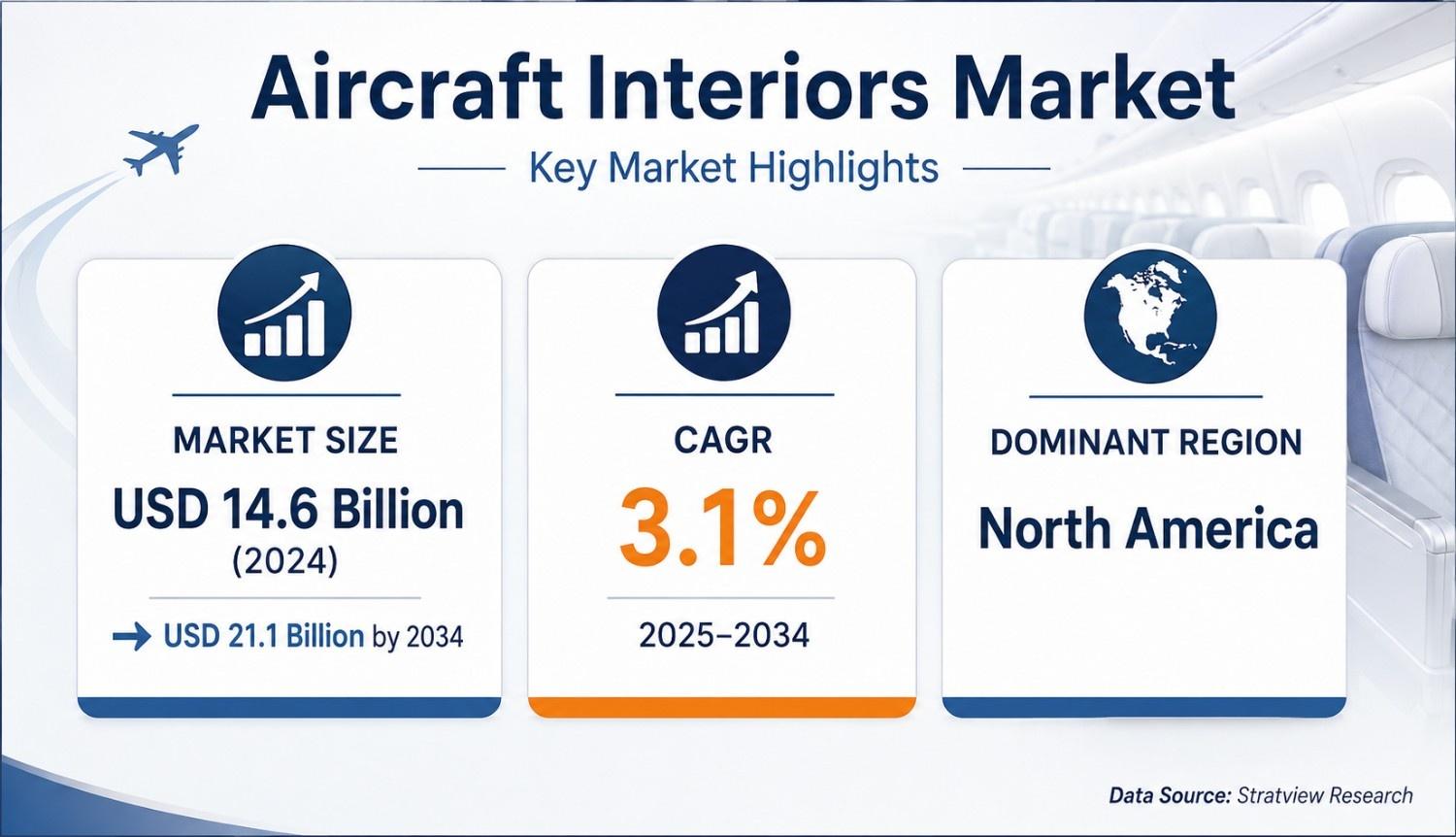
The Aircraft Interiors Market was USD 14.6 billion in 2024 and is forecast to reach USD 21.1 billion in 2034. The market is expected to grow from USD 16.1 billion in 2025, registering a CAGR of 3.1% during 2025–2034. The Aircraft Interiors Market is expected to grow at a CAGR of 3.1% during 2025–2034.
Market demand is increasing as aircraft interiors become central to comfort, safety, passenger engagement, and airline competitive positioning. Manufacturers are developing technologies that improve onboarding experience and cabin efficiency. Growth trends are supported by refurbishments, space optimization, seating upgrades, wireless IFEC, connectivity, hygiene-related products, spacious bins, and LED cabin lighting.
Request a free sample report:
https://www.stratviewresearch.com/Request-Sample/aircraft-interiors-market#form
The Aircraft Interiors Market growth story is closely linked to cabin value creation. Airlines are using interiors to improve experience, support revenue potential, and differentiate service levels. This market analysis indicates that interiors are becoming a strategic factor in fleet modernization and passenger-facing investment.
Market Segmentation Analysis
By Aircraft Type, the market is segmented into Narrow Body Aircraft, Wide-Body Aircraft, Regional Aircraft, and Business Jets. Narrow-body aircraft is likely to continue to maintain its dominance during the forecast period. Faster short-haul recovery may support interior demand, while single-aisle aircraft are expected to hold a major share of aircraft deliveries during 2024–2034.
By Application Type, the market is segmented into Seats, Galleys/ Galley Inserts, Lavatories, Stowages, IFEC, Floor Panels, Cabin Linings, and Others. Seats are expected to be the largest application in the aircraft interiors market in the coming years. Demand is supported by accommodation needs, premium revenue potential, ergonomic innovation, and in-seat entertainment integration.
By Furnished Equipment Type, the market is segmented into BFE and SFE. BFE is expected to lead the market during the forecast period. BFE is becoming the choice of equipment, especially in seats and IFEC. In cabin applications, SFE is being preferred due to delays in wide-body aircraft deliveries.
By End-User Type, the market is segmented into OE and Aftermarket. OE is expected to remain the dominant segment during the forecast period. OE demand is mainly supported by seat demand, particularly business class seats. Aftermarket demand is linked to cabin spare parts, seats, widebody market recovery, and positive air traffic momentum.
Regional Market Insights
North America is expected to continue its dominance during the forecast period. The region benefits from an established aircraft interiors ecosystem and a value chain that includes raw material suppliers, interior product manufacturers, aircraft OEMs, airlines, leasing companies, and MRO companies. This supports continued competitive landscape strength.
Asia-Pacific’s growing share is driven by high aircraft demand. Increased participation from Asian companies, particularly AVIC Cabin Systems, in M&As and JVs is also shaping the region. Airlines in China and India are increasing capacity and investing in higher-specification and more bespoke interiors to address increasing passenger traffic.
Emerging Trends Shaping the Aircraft Interiors Market
A major trend is the continued transformation of cabin design and technology. Aircraft interiors are evolving from basic cabin components into passenger experience platforms. Airlines are investing in comfort, safety, service differentiation, and products that improve the onboard journey while also supporting operating efficiency.
IFEC is another important trend shaping strategic insights. Demand for in-flight entertainment systems has grown because they can act as an additional revenue source for airlines. Increasing focus on in-flight internet connectivity for passenger engagement is also supporting IFEC demand across the aircraft interiors value chain.
Key Growth Drivers of the Market
- Cabin refurbishments are creating demand because airlines need updated interiors to improve comfort and protect competitive positioning.
- Rising seat demand is supporting growth because airlines are increasing accommodation while also upgrading business class and premium seating.
- IFEC adoption is increasing because entertainment and connectivity improve passenger engagement and can add airline revenue opportunities.
- Lightweight components are driving market demand because airlines seek comfort-focused cabin upgrades that also support fuel conservation.
- Higher-specification interiors are expanding demand because airlines in fast-growing markets are investing in more bespoke cabin experiences.
Competitive Landscape
Top Companies in the Market
Safran S.A.
Collins Aerospace
Panasonic Avionics
AVIC Cabin Systems
Gogo Inc.
Intelsat S.A.
Thales Group
Recaro Aircraft
Diehl Aviation
Jamco Corporation
Conclusion and Strategic Outlook
The Aircraft Interiors Market is set to grow steadily, reaching USD 21.1 billion by 2034 at a CAGR of 3.1% during 2025–2034. Growth is supported by seat demand, IFEC, refurbishments, lightweight components, and higher-specification cabin products. The market outlook remains anchored in passenger experience, airline differentiation, and interior technology advancement.
FAQs – Aircraft Interiors Market
1. What is the Aircraft Interiors Market forecast value?
The Aircraft Interiors Market is forecast to reach USD 21.1 billion by 2034. It was valued at USD 14.6 billion in 2024 and is expected to reach USD 16.1 billion in 2025.
2. What CAGR will the Aircraft Interiors Market register?
The Aircraft Interiors Market is expected to grow at a CAGR of 3.1% during 2025–2034. This reflects steady expansion across OE and aftermarket demand channels.
3. What are the main growth drivers in the Aircraft Interiors Market?
Main growth drivers include aircraft refurbishments, seat demand, IFEC, wireless connectivity, lightweight components, and higher-specification interiors. These drivers improve comfort, engagement, safety, and airline differentiation.
4. Which region dominates the Aircraft Interiors Market?
North America is expected to remain the largest market during the forecast period. Asia-Pacific is gaining share due to high aircraft demand and increased capacity investment by airlines in China and India.
5. What challenges could affect Aircraft Interiors Market investment?
Supplier delays, wide-body delivery delays, and aircraft production issues may affect procurement timing. The transition from BFE to SFE products also indicates airline efforts to reduce delays and additional costs.

 English
 Arabic
 French
 Spanish
 Portuguese
 Turkish
 Dutch
Dutch
 Italiano
 Russian
 Romaian
 Portuguese (Brazil)
 Greek
Greek
 Bengali