


Do Forged Rims Change Motorcycle Performance?
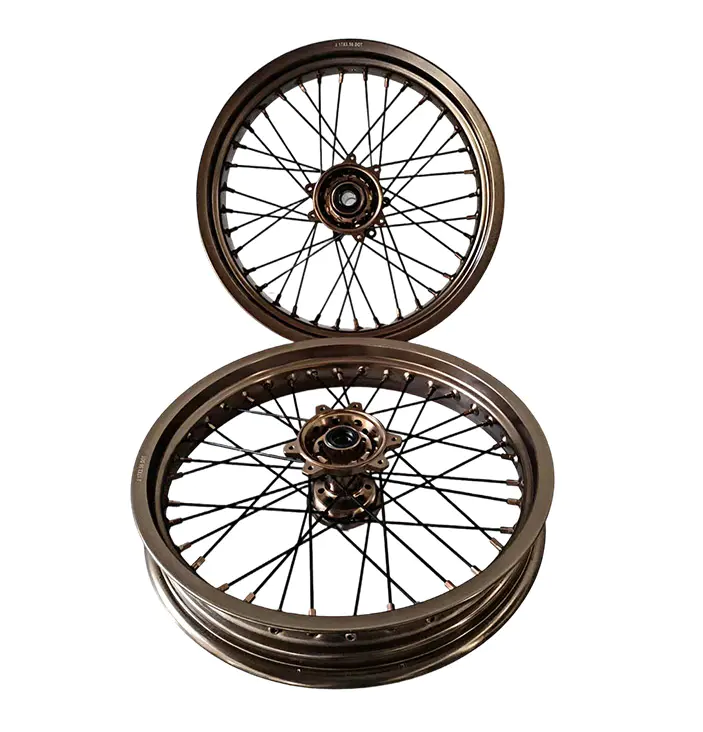
Forged wheels represent a high-strength category within Motorcycle Rim Customization, designed through extreme pressure shaping rather than traditional casting methods. This process significantly changes the internal grain structure of aluminum alloys, producing wheels that are lighter, stronger, and more resistant to fatigue.
Forging process and structural refinement
Forged rims are manufactured by compressing aluminum billets under pressures exceeding 8,000–12,000 tons. This aligns the grain structure, reducing voids and improving density consistency.
Material improvements include:
Grain refinement: increased uniformity
Porosity reduction: near-zero internal cavities
Density increase: 2.7 g/cm³ stable aluminum matrix
Common alloy used: 6061-T6 or 7075-T6 aluminum variants.
Mechanical performance advantages
Forged rims in Motorcycle Rim Customization offer measurable performance changes:
Tensile strength: 300–520 MPa depending on alloy grade
Impact resistance: significantly higher than cast rims
Fatigue life: extended under repeated load cycles
Weight reduction is one of the most important factors:
Cast rim (17-inch): ~7.0 kg
Forged rim (17-inch): ~5.0–6.0 kg
Reducing rotational mass improves acceleration response and braking efficiency.
Rotational inertia impact
Lower rotational inertia affects how quickly a motorcycle responds to throttle and steering input. Forged rims reduce inertia by 10–25%, depending on design.
Effects include:
Faster directional changes
Reduced suspension load lag
Improved braking feedback
This is especially noticeable in high-speed corner transitions.
Heat dissipation characteristics
Aluminum forged rims provide strong thermal conductivity:
Thermal conductivity: ~160–180 W/m·K
Heat spread efficiency: faster dissipation from brake rotor area
Better heat distribution reduces localized stress on rim edges during aggressive braking.
Structural design flexibility
Forged wheels allow deeper machining freedom:
Hollow spoke structures
Variable thickness rim beds
Optimized spoke geometry for stress reduction
These features are integrated in Motorcycle Rim Customization for performance motorcycles.
Limitations and practical considerations
Despite advantages, forged rims require precise manufacturing and higher material cost. Additionally:
Repair complexity is higher than cast rims
Impact damage may require full replacement
Fitment accuracy must remain within ±0.05–0.1 mm tolerances
Application scenarios
Forged rims are commonly used in:
Track motorcycles
High-performance street bikes
Lightweight sport builds
They are less commonly used in heavy-duty off-road builds due to rigidity preference differences.
Summary perspective
Motorcycle Rim Customization using forged wheels prioritizes reduced weight, higher structural strength, and faster response dynamics. The benefits are most noticeable in performance riding environments where acceleration, braking, and cornering speed transitions are frequent.

 Arabic
 French
 Spanish
 Portuguese
 Deutsch
 Turkish
 Dutch
Dutch
 Italiano
 Russian
 Romaian
 Portuguese (Brazil)
 Greek
Greek
 Bengali