


WBCS Booklist: The Question Almost Every Aspirant Asks First
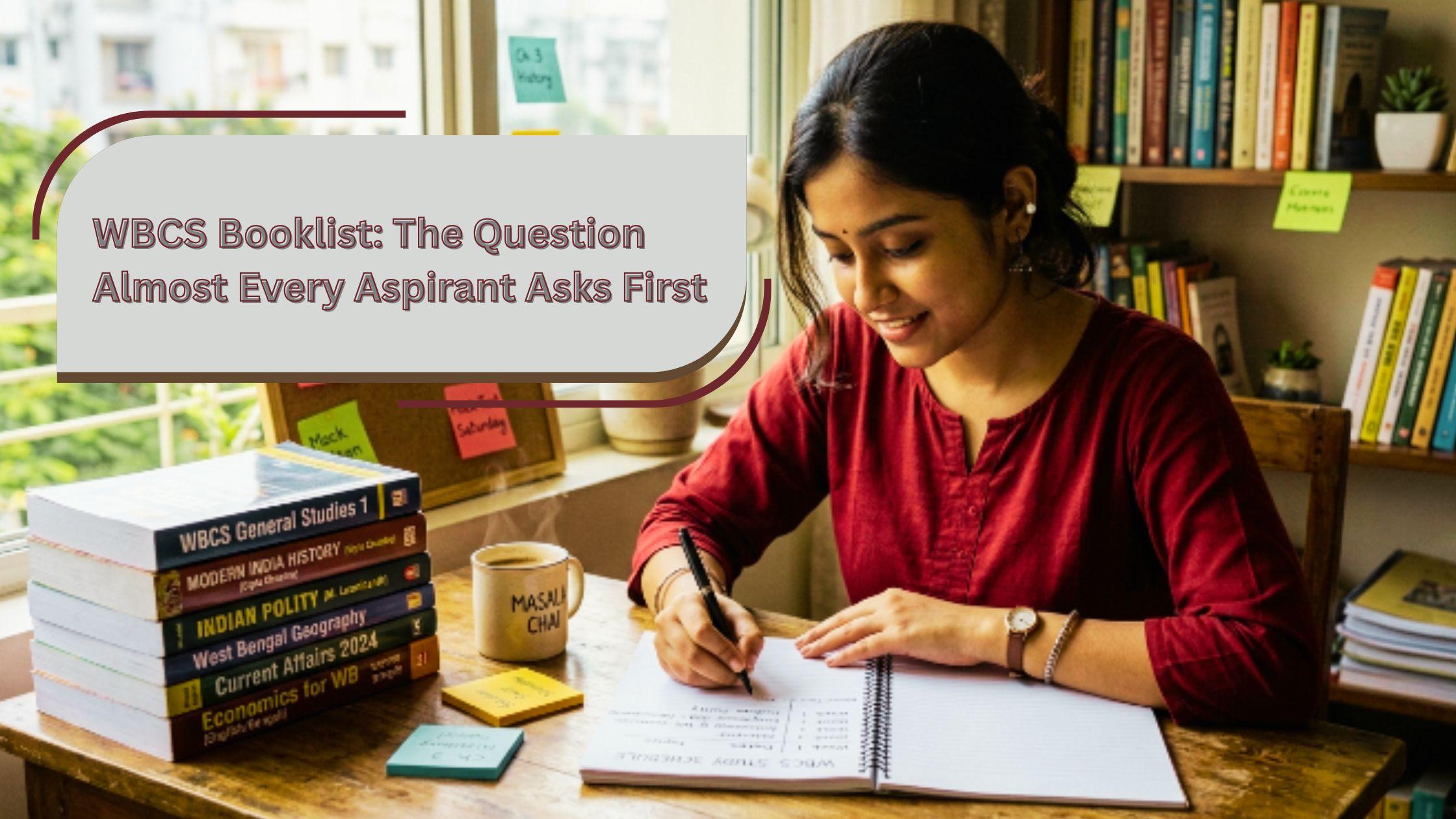
A few years ago, I met a WBCS aspirant who had a bookshelf that could have passed for a small library. History books, current affairs magazines, guidebooks, test series compilations, optional subject notes—everything was there.
What wasn't there, surprisingly, was confidence.
When I asked him how many of those books he had actually finished, he laughed and said, "That's the problem."
That conversation comes back to me whenever someone asks about the ideal WBCS booklist.
Most candidates think the struggle begins with studying. In reality, it often begins much earlier—with deciding what to study and what to ignore.
The Marketplace of Confusion
Anyone preparing for WBCS today has access to more resources than aspirants had ten years ago. On paper, that's a good thing.
In practice, it can be exhausting.
Search online and you'll find dozens of "must-read" lists. Walk into a bookstore and every second publication claims to be essential. Join a Telegram group and you'll suddenly discover twenty more PDFs that someone insists are life-changing.
After a while, preparation starts feeling less like studying and more like collecting.
That's where a sensible WBCS booklist becomes important. Not because books alone guarantee success, but because they help reduce noise.
And there is a lot of noise.
The Best Book Is Often the One You Actually Finish
This may sound obvious, but many aspirants overlook it.
A highly recommended book that remains unopened on your desk has less value than a simpler book you've revised three times.
I've seen candidates spend weeks comparing recommendations for Indian Polity instead of actually studying Polity. The search for the "perfect" resource quietly replaces preparation itself.
At some point, you simply have to choose a source and begin.
Nobody clears WBCS because they found a magical book hidden from everyone else.
Why Basic Sources Still Work
There's something unfashionable about recommending foundational textbooks these days.
Many students want advanced material from day one. They feel that if a book looks simple, it probably isn't enough.
The exam doesn't think that way.
Year after year, questions continue to reward conceptual understanding. A candidate who understands the causes of a historical event usually performs better than someone who has memorized ten pages of facts without context.
Strong foundations rarely feel exciting while you're building them.
The benefits show up later.
Usually during revision.
The Current Affairs Trap
Current affairs deserve a special mention because they create more anxiety than almost any other section.
I remember speaking with an aspirant who read four different monthly magazines every month. He spent hours doing it.
When mock tests started, however, he struggled to connect current events with the underlying subjects.
That's a common problem.
Current affairs work best when they're linked to Polity, Economy, Geography, Environment, and governance. Reading headlines alone often creates information overload without creating understanding.
The goal isn't to know everything.
The goal is to know what matters.
Revision Is Boring. That's Why It Works.
Nobody posts glamorous social media updates about revising the same chapter for the fourth time.
Yet that's exactly what many successful candidates do.
The uncomfortable truth about competitive examinations is that repetition matters.
A lot.
Most aspirants underestimate how much they forget. They read a chapter in January, feel confident in February, and by April struggle to recall half of it.
Revision fixes that.
A carefully selected WBCS booklist becomes powerful only when the same books return to your table again and again.
Previous Year Papers Tell Their Own Story
There's a certain honesty in previous year question papers.
Unlike coaching advertisements or online discussions, they show what the examination has actually asked.
Whenever I speak to serious aspirants, I suggest spending time with old papers earlier than they think necessary.
Patterns begin to emerge.
Certain themes return.
Certain mistakes become obvious.
And sometimes you discover that topics you considered minor are more important than you assumed.
The examination leaves clues. Previous year papers are where many of those clues are hiding.
The Booklist Nobody Talks About
If I had to create an unofficial WBCS booklist, it would contain something unusual.
Not another reference book.
A notebook.
A plain, ordinary notebook.
Because eventually every serious aspirant starts creating personal summaries, shortcuts, diagrams, timelines, and revision notes. Those pages often become more valuable than the original sources.
Months later, before the examination, candidates rarely revise every book again.
They revise what they wrote.
And what they understood.
There's a difference.
Final Thoughts
The conversation around the WBCS booklist sometimes becomes bigger than the examination itself. Students debate resources endlessly, compare recommendations, and keep searching for certainty.
Unfortunately, no booklist can provide that.
What it can provide is direction.
And direction is usually enough.
Choose reliable sources. Stay with them longer than feels comfortable. Revise more than you think you need to. Ignore the temptation to constantly switch materials.
Most importantly, remember that books are tools, not trophies.
Owning them is easy.
Using them well is where the real work begins.
About WBCS Made Easy
WBCS Made Easy has been helping aspirants navigate the challenges of the West Bengal Civil Service Examination through structured guidance, study resources, mock tests, and mentorship. The platform focuses on practical preparation strategies rather than overwhelming students with unnecessary materials.
For admission and course-related enquiries, contact WBCS Made Easy at +91 8274048710.

 Arabic
 French
 Spanish
 Portuguese
 Deutsch
 Turkish
 Dutch
Dutch
 Italiano
 Russian
 Romaian
 Portuguese (Brazil)
 Greek
Greek
 Bengali