


Automotive V2X Market Growth Analysis: Key Trends, Forecast, and Regional Outlook
Market Overview and Growth Outlook
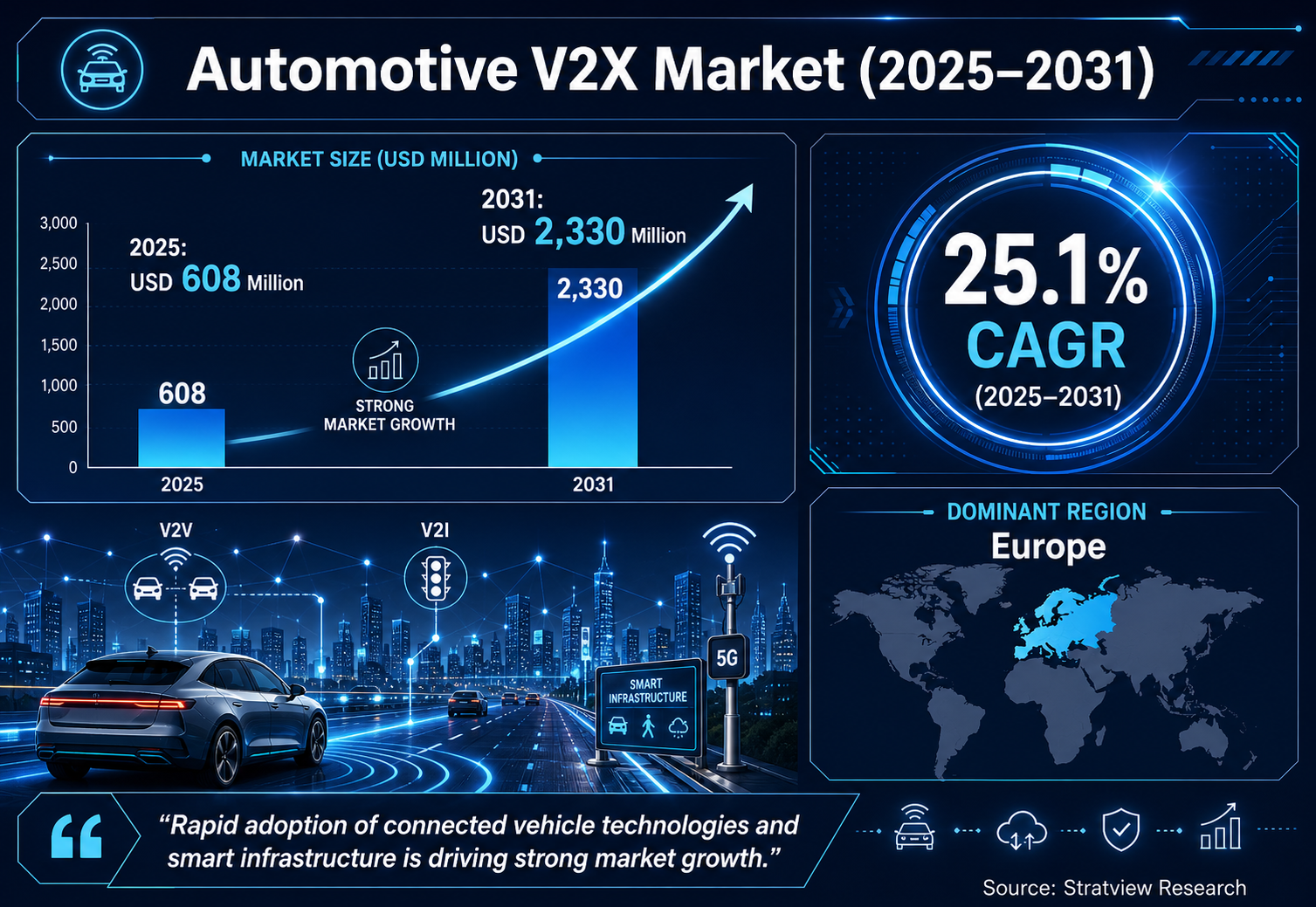
The Automotive V2X Market was valued at USD 490 million in 2024 and is expected to reach USD 2,330 million by 2031, according to Stratview Research. The market is forecast to grow at a CAGR of 25.1% during 2025–2031, supported by rising demand for connected vehicles, safer roads, and intelligent transportation systems.
“The Automotive V2X Market is expected to grow at a CAGR of 25.1% during 2025–2031.”
The acceleration of Automotive V2X Market growth reflects a broader shift in how automotive ecosystems use data, connectivity, and infrastructure intelligence. As OEMs integrate advanced communication platforms, V2X solutions are becoming essential for reducing collision risks, supporting autonomous driving functions, and enabling coordinated mobility across urban and highway environments.
Market Segmentation Analysis
Automotive V2X Market, by Technology Type
- DSRC
- C-V2X
Automotive V2X Market, by Communication Type
- V2V & V2I
- Integrated
Automotive V2X Market, by Region
- North America
- Europe
- Asia-Pacific
- Rest of the World
By technology type, DSRC currently holds the dominant share of the market, while C-V2X is likely to grow faster during the forecast period. DSRC has been dominant in Europe and was widely used in the USA by 2023. From 2024 onward, C-V2X is expected to take over in the USA due to the FCC agreement in April 2023, which approved C-V2X deployment for connected vehicles.
This shift creates a clear cause-effect path. DSRC supports secure and low-latency communication, while C-V2X gains traction through better range, higher bandwidth, lower latency, cost efficiency, 5G compatibility, and support from automotive and telecom industries. The strategic implication is that technology selection will remain central to future V2X deployment plans.
By communication type, Integrated V2X holds a larger market share and is also expected to remain dominant during the forecast period. Integrated V2X includes Vehicle-to-Vehicle, Vehicle-to-Infrastructure, Vehicle-to-Pedestrian, and Vehicle-to-Network communication types.
This broader communication model increases demand because it supports more complete, real-time, and future-proof connectivity. It enhances road safety, supports autonomous vehicles, optimizes traffic flow, and uses 5G for data exchange. The strategic implication is that integrated communication platforms will remain important for OEMs and mobility ecosystem participants.
Regional Market Insights
Europe holds the largest share of the market. Its position is supported by strict safety regulations, early DSRC adoption, smart city investments, automotive innovation, and growing 5G-based C-V2X deployment. The presence of Volkswagen, BMW, Mercedes-Benz, Audi, and Volvo further supports adoption through automotive and technology partnerships.
Asia-Pacific is expected to experience the fastest growth during the forecast period. Growth is supported by government initiatives and regulations, large vehicle production bases in China, India, and Japan, rising demand for connected and autonomous vehicles, smart city investments, intelligent transportation infrastructure, and consumer focus on safety and advanced driving features.
Request a free sample report: https://www.stratviewresearch.com/Request-Sample/3948/automotive-v2x-market.html#form
Emerging Trends Shaping the Automotive V2X Market
The market forecast indicates a shift from early V2X adoption toward broader connected mobility integration. As vehicles, roads, and devices become more connected, V2X systems are positioned to support autonomous transportation, smarter cities, and sustainable transportation networks.
Another important direction is the growing role of C-V2X. Its expected faster growth reflects the increasing relevance of cellular networks, 5G compatibility, and telecom-industry support. This trend connects automotive systems with broader digital infrastructure.
Integrated V2X also reflects a structural market trend. By combining V2V, V2I, V2P, and V2N communication, integrated platforms support safety, traffic efficiency, autonomous driving, and network-based vehicle communication within one ecosystem.
Key Growth Drivers of the Market
- Rising road safety demand increases the need for real-time vehicle communication, helping OEMs support safer driving and accident avoidance features.
- Growth in autonomous vehicles increases demand for V2X systems because vehicles need reliable communication with roads, networks, and nearby users.
- Infrastructure expansion supports V2X adoption as smart city and intelligent transportation systems require connected roads, signals, and mobility networks.
- Regulations support deployment because safety-focused policies and government initiatives encourage automotive ecosystem participants to adopt connected communication technologies.
- Industry ecosystem collaboration increases demand as automotive manufacturers, telecom providers, semiconductor suppliers, infrastructure developers, and regulatory bodies must integrate V2X systems.
Competitive Landscape
The market is moderately concentrated with the presence of over 15 players across the region. The automotive V2X market involves a complex supply chain that requires integration between automotive manufacturers, telecom providers, semiconductor suppliers, infrastructure developers, and regulatory bodies.
Top Companies in the Market
- Harman International (A Samsung Company)
- LG Electronic Vehicle Solution
- NXP Semiconductor
- JOYNEXT
- Robert Bosch GmbH
- DENSO Corporation
- Continental AG
Conclusion and Strategic Outlook
The Automotive V2X Market is moving from USD 490 million in 2024 toward USD 2,330 million by 2031, with a CAGR of 25.1% during 2025–2031. The growth trajectory reflects expanding demand for connected vehicles, safety systems, smart infrastructure, and integrated mobility communication.
Technology choices will remain important as DSRC currently leads, while C-V2X is expected to grow faster. Integrated V2X is likely to remain dominant because it connects vehicles, infrastructure, pedestrians, and networks into one communication framework.
From a regional perspective, Europe remains the largest market, while Asia-Pacific is expected to grow fastest. For market participants, the industry outlook is shaped by regulation, infrastructure expansion, OEM adoption, and collaboration across the automotive and telecom ecosystem.
FAQs – Automotive V2X Market
What is the market size and forecast for the Automotive V2X Market?
The Automotive V2X Market was valued at USD 490 million in 2024. It is expected to reach USD 2,330 million by 2031, growing at a CAGR of 25.1% during 2025–2031.
What are the key growth drivers of the market?
Key drivers include demand for road safety, rising autonomous vehicle adoption, stringent government regulations, consumer focus on smart vehicles, and advancements in 5G and AI technology. These factors increase demand for real-time vehicle communication.
Which regions are leading and growing fastest?
Europe holds the largest share of the market. Asia-Pacific is expected to experience the fastest growth during the forecast period, supported by government initiatives, vehicle production, and smart infrastructure investment.
What is the investment outlook for the market?
The market forecast shows strong expansion from USD 608 million in 2025 to USD 2,330 million in 2031. This indicates growing opportunities across technology, communication systems, infrastructure, and connected mobility ecosystems.
What risks or constraints may affect market growth?
The market requires seamless integration between automotive manufacturers, telecom providers, semiconductor suppliers, infrastructure developers, and regulatory bodies. This complex supply chain can create coordination challenges for deployment and scaling.

 Arabic
 French
 Spanish
 Portuguese
 Deutsch
 Turkish
 Dutch
Dutch
 Italiano
 Russian
 Romaian
 Portuguese (Brazil)
 Greek
Greek
 Bengali