


Blast Valve Checks Every Safety Manager Should Run
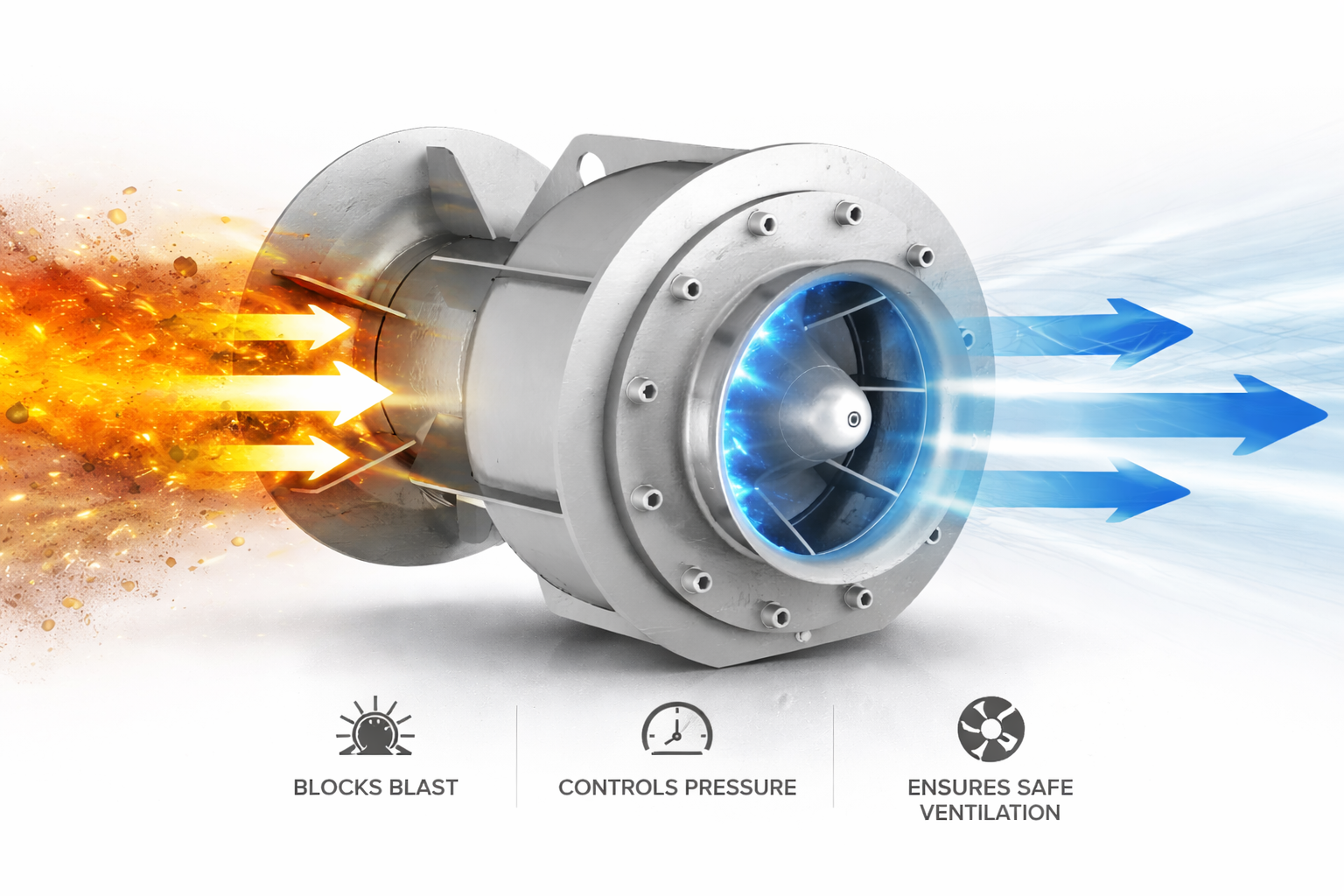
Safety managers responsible for industrial facilities carry an enormous amount of accountability. They oversee compliance documentation, coordinate maintenance programmes, manage audits, and ensure that the systems protecting their workforce are genuinely operational — not just present on a schematic.
Yet when it comes to blast valve maintenance, even experienced safety managers often rely on inspection protocols that were designed for general HVAC safety equipment rather than explosion protection components. A blast damper is not a standard damper. A blast valve is not a standard valve. The checks that confirm general mechanical condition are not the same checks that confirm blast protection performance.
The five checks below are the ones that matter most — the ones that tell you whether your industrial safety systems will actually perform when an overpressure event occurs, not just whether they look acceptable during a walkthrough.
Actuator Closure Speed Measurement
This is the single most important performance check for any blast valve or blast damper, and it is the one most frequently omitted from standard maintenance schedules. Closure speed determines whether the damper closes before the pressure wave passes — and it degrades silently over time through actuator wear, spring fatigue, and mechanical friction.
Closure speed must be measured directly using timed functional testing, not estimated from visual observation. The measured result should be compared against the manufacturer's rated closure time for that specific unit under the installation conditions. Any result outside the acceptable range requires immediate investigation — regardless of how the damper appears visually.
If your current maintenance programme does not include documented closure speed measurements, that gap needs to be addressed before the next inspection cycle.
Evaluate your current safety systems by confirming that closure speed testing is formally documented for every blast-rated component in your facility.
Seal Integrity Under Simulated Pressure
A blast damper seal that appears intact during visual inspection may no longer achieve the compression necessary to prevent pressure bypass when the damper is closed. Compression set — the permanent deformation of seal material through repeated thermal and pressure cycling — is invisible to the eye but directly impacts performance.
Seal integrity should be assessed through pressure differential testing with the damper in the closed position. This confirms whether the seal achieves and maintains the required closure against a defined pressure load — not just whether it appears undamaged. In corrosive or high-humidity environments, seal condition deteriorates faster, and testing frequency should reflect that reality.
Facilities operating in aggressive environments should treat seal integrity testing as a higher-frequency check rather than a standard annual item.
Mounting Interface Inspection
The blast valve itself can be in perfect working order while a gap at its mounting interface allows overpressure to bypass the closed damper entirely. Building settlement, thermal cycling, vibration from adjacent equipment, and poor original installation can all create bypass pathways at the junction between the damper frame and the blast wall penetration.
This check requires physical inspection of the full perimeter of every mounting interface — not just the damper mechanism. Look for gaps, cracked sealant, displaced packing material, and signs of differential movement between the damper frame and the surrounding structure. Any pathway that allows air or gas movement around the closed damper is a pathway for overpressure.
The importance of this check is consistently underestimated. In several documented incidents, correctly specified and well-maintained blast dampers failed to contain overpressure because mounting interface integrity had degraded without detection.
Certification and Specification Currency
Industrial safety systems operate within regulatory frameworks that evolve over time. A blast valve that was correctly specified and certified at commissioning five years ago may no longer satisfy current standards — particularly if facility operations have changed, new risk assessments have been conducted, or applicable regulations have been updated.
Safety managers should periodically verify that installed blast valves and blast dampers carry certifications that remain valid under current standards and that their specified performance parameters still match the current risk profile of the zones they protect. Facilities that have undergone expansion, process changes, or HVAC modifications are particularly vulnerable to specification drift.
Consulting specialists in industrial blast valve solutions during periodic safety reviews ensures that installed components continue to meet both regulatory requirements and genuine protection needs as facilities evolve.
Consider scheduling a formal specification currency review alongside your next major regulatory compliance audit.
Post-Incident Functional Verification
Any pressure event in a facility — even one that did not reach the blast valve's activation threshold — should trigger a mandatory functional verification before the system is returned to normal operational status. Sub-threshold pressure events can stress internal components, partially compress seals, and introduce mechanical changes that affect future performance without causing any immediately visible damage.
This check is almost universally omitted from post-incident protocols, which typically focus on visible structural damage and process continuity rather than the condition of explosion protection components. A blast damper that was subjected to a near-miss pressure event and then returned to service without verification is a component with an unknown performance status — which is the same as an unreliable one.
Post-incident functional verification should be explicitly included in your emergency response and recovery procedures, not left to the discretion of whoever is managing the immediate aftermath.
Conclusion
These five checks — closure speed measurement, seal integrity testing, mounting interface inspection, specification currency review, and post-incident verification — represent the difference between a blast protection programme that looks compliant and one that is genuinely reliable.
None of them are technically complex. All of them are frequently missing from standard maintenance schedules. And each one addresses a failure mode that has contributed to real incidents in industrial facilities where visual inspection protocols were considered sufficient.
Explore additional insights on explosion protection systems and build these checks into your safety management programme before the next inspection cycle. The gaps in blast valve maintenance are rarely obvious — which is precisely why closing them matters most.

 Arabic
 French
 Spanish
 Portuguese
 Deutsch
 Turkish
 Dutch
Dutch
 Italiano
 Russian
 Romaian
 Portuguese (Brazil)
 Greek
Greek
 Bengali