


Beyond GEO Satellite Market Trends: Hybrid Orbits, Advanced Propulsion and Miniaturization
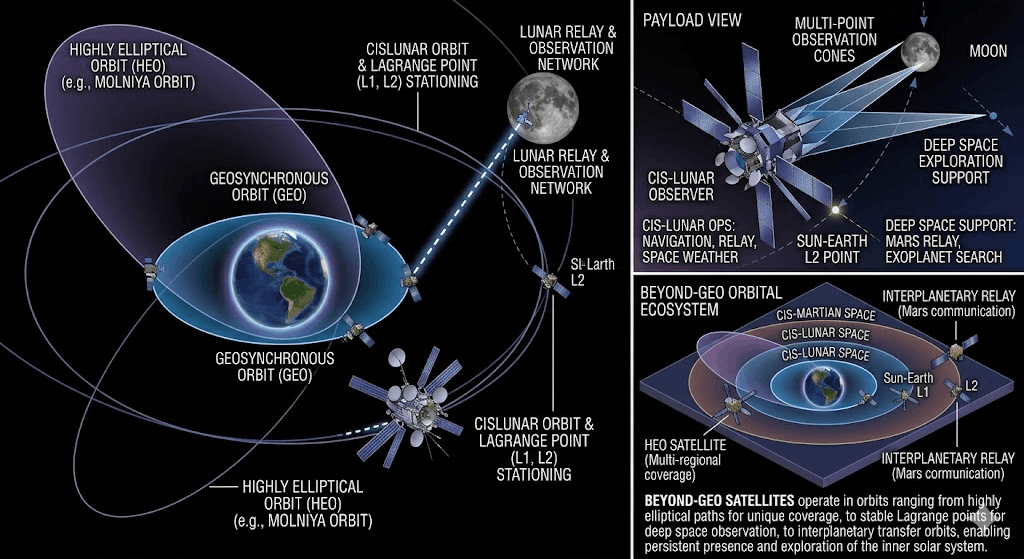
The beyond GEO satellite market is being shaped by three technology and architectural trends that are each independently significant but create a larger combined commercial effect when considered together. They are not incremental improvements to existing approaches. Hybrid orbit system architectures represent a fundamental rethinking of how satellite constellations are designed. Advanced propulsion development is addressing the core operational constraint that limits mission duration and flexibility beyond GEO. And satellite miniaturization is democratizing access to beyond GEO missions in ways that institutional programs alone could never sustain. The Beyond GEO Satellite Market Trends identified in The Insight Partners upcoming study covering the confirmed 14.5% CAGR from 2025 to 2031 document how these developments are building the commercial structure of an emerging sector.
Trend 1: Shift Toward Hybrid Orbit Systems
The commercial realization that no single orbit class serves all connectivity and coverage requirements optimally is driving architectural designs that deliberately combine GEO, HEO, and LEO satellites within a single service offering. Viasat's multi-orbit broadband strategy, combining its GEO high-throughput satellites with LEO coverage for latency-sensitive applications, is a current commercial reference. The next evolution extends this logic into HEO and beyond GEO positions for Arctic coverage and deep space relay applications that neither GEO nor LEO adequately serves. Defense operators managing multi-orbit satellite architectures for resilient communications are further accelerating this trend, as national security requirements for connectivity continuity across all geographic areas including polar regions create procurement pressure for satellite systems positioned in orbits where conventional GEO coverage fails.
Get exclusive insights into the Beyond GEO Satellite Market – https://www.theinsightpartners.com/sample/TIPRE00025975
Trend 2: Increased Focus on Advanced Propulsion for Beyond GEO Missions
Electric propulsion systems including ion and Hall effect thrusters are becoming the standard specification for beyond GEO satellite missions because their specific impulse advantages over chemical propulsion are far more commercially significant at the distances and delta-V budgets involved in reaching and maintaining HEO, highly elliptical, and cislunar orbits. A satellite that can achieve its target orbit using electric propulsion while launching as a rideshare secondary payload costs dramatically less to place in operation than one requiring dedicated launch and chemical upper stage propulsion. NASA's CAPSTONE mission demonstrated electric propulsion efficiency at cislunar distances. Commercial operators developing small beyond GEO satellites are building electric propulsion capability as a baseline rather than an optional upgrade.
Trend 3: Satellite Miniaturization Enabling Broader Market Access
The same miniaturization trend that created the LEO smallsat market is extending into beyond GEO missions as radiation-hardened component technology becomes available in smaller form factors and at lower cost. CubeSat-class beyond GEO missions that would have been technically impossible five years ago are entering operational service through programs like CAPSTONE and planned commercial lunar relay deployments. Each successful small satellite beyond GEO mission adds to the technical heritage database that subsequent operators and mission managers require before specifying similar approaches on their own programs, compounding the adoption momentum progressively through the forecast period.
Competitive Landscape
- Airbus Defense and Space
- Boeing Defense Space and Security
- JSC Information Satellite Systems
- Lockheed Martin Corporation
- Northrop Grumman Corporation
- Thales Group
- OHB SE
- Space Systems/Loral (Maxar Technologies)
- Viasat Inc.
- INVAP S.E.
Q1. What specific operational gap does hybrid orbit system architecture address that neither GEO nor LEO alone can solve?
GEO cannot provide high-elevation angles for Arctic and polar region users, while LEO constellations require large numbers of satellites for continuous coverage and have latency advantages only for applications where GEO latency is operationally significant, meaning neither orbit class alone efficiently serves continuous polar connectivity requirements that HEO satellites address with far fewer spacecraft.
Q2. How does electric propulsion advantage become more commercially significant beyond GEO than in lower orbit classes?
Delta-V requirements for reaching and maintaining HEO, cislunar, and interplanetary orbits are orders of magnitude larger than for LEO and GEO orbit maintenance, making the specific impulse advantage of electric propulsion over chemical alternatives translate into dramatically larger propellant mass savings that directly reduce launch mass and cost in proportion to the larger total delta-V budget involved.
Q3. What commercial significance does CAPSTONE's CubeSat mission at cislunar distance have for the market?
CAPSTONE demonstrating that a CubeSat-class spacecraft can operate successfully in a near-rectilinear halo orbit at lunar distance provides the first flight heritage reference for small satellite beyond GEO operation that mission planners for subsequent commercial and government programs can reference when evaluating small satellite approaches for their own cislunar missions.
Q4. How does miniaturization compound adoption momentum through the forecast period?
Each successful small satellite beyond GEO mission generates flight heritage data that reduces the technical risk perceived by subsequent program managers, progressively lowering the heritage evidence threshold that conservative institutional buyers require before approving small satellite approaches for their own high-value beyond GEO missions, creating an adoption acceleration that builds progressively rather than advancing linearly.
Q5. Which trend creates the most durable commercial advantage for manufacturers who lead it?
Advanced propulsion development creates the most durable advantage because flight-proven electric propulsion heritage for beyond GEO applications takes years of mission accumulation to build, the performance requirements are more demanding than LEO electric propulsion applications providing less direct technology transfer, and the missions involved are high-enough value that buyers require substantial heritage evidence before accepting propulsion systems without equivalent qualification.
About The Insight Partners
The Insight Partners is a one-stop industry research provider of actionable solutions. We help our clients in getting solutions to their research requirements through our syndicated and consulting research services. We specialize in industries such as Semiconductor and Electronics, Aerospace and Defense, Automotive and Transportation, Biotechnology, Healthcare IT, Manufacturing and Construction, Medical Devices, Technology, Media and Telecommunications, Chemicals and Materials.
Contact Us
The Insight Partners
Phone: +1-646-491-9876
E-mail: sales@theinsightpartners.com

 Arabic
 French
 Spanish
 Portuguese
 Deutsch
 Turkish
 Dutch
Dutch
 Italiano
 Russian
 Romaian
 Portuguese (Brazil)
 Greek
Greek
 Bengali