


QSR Consultant Tips for Creating a Profitable Fast Food Business
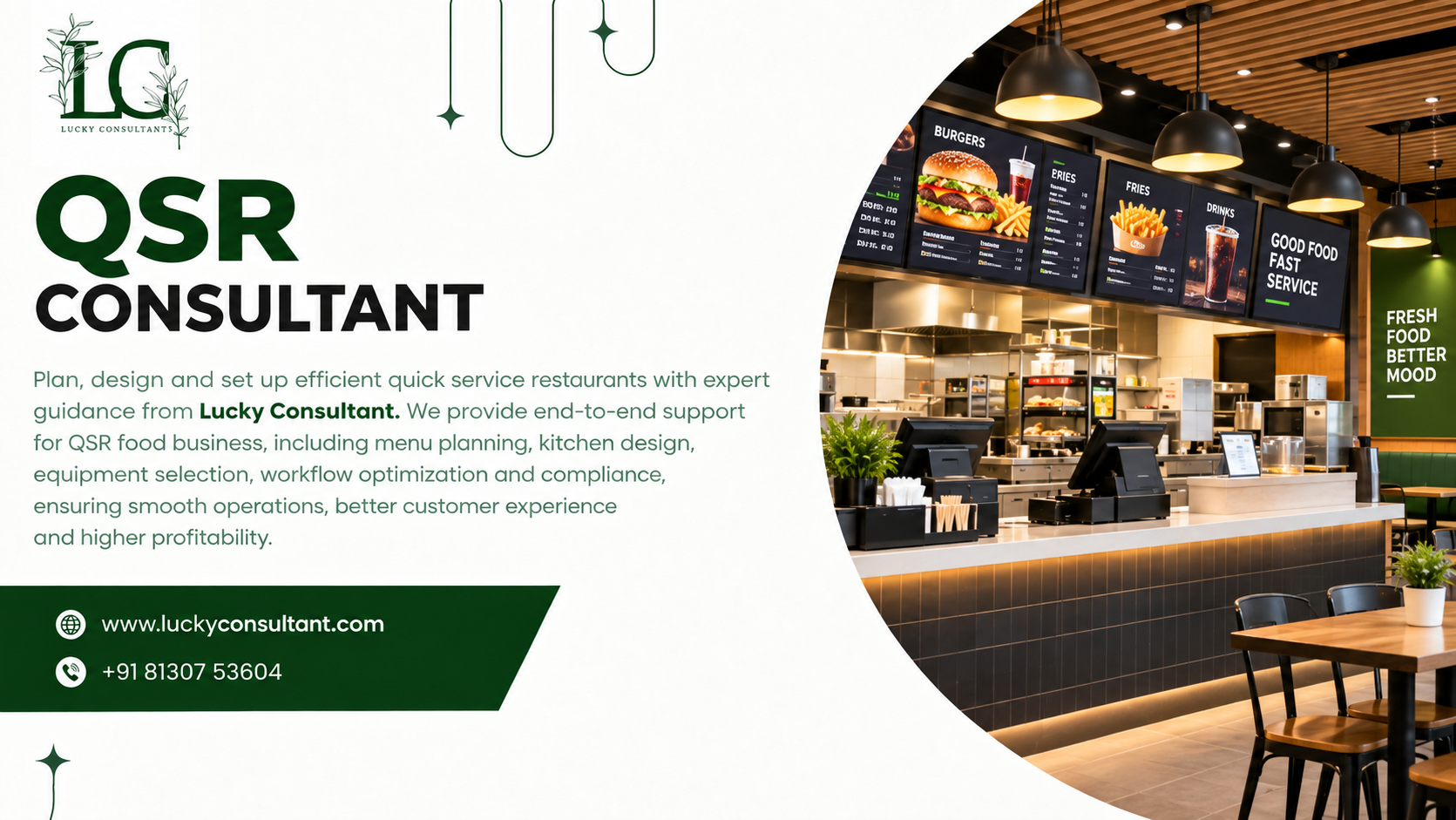
Starting a fast food business can be a promising opportunity for entrepreneurs who want to enter the food and hospitality industry. Quick Service Restaurants (QSRs) are popular because customers value quick service, affordable meals, consistent food quality, and convenient locations. However, running a profitable fast food business requires more than preparing tasty food. It involves careful planning, cost management, menu development, staff training, and efficient daily operations.
A professional QSR Consultant can help entrepreneurs make informed decisions at every stage of restaurant development. At Lucky Consultant, the focus is on helping business owners plan, establish, and manage food businesses with a practical approach to restaurant setup, kitchen planning, menu development, and operational efficiency.
1. Choose the Right Fast Food Business Concept
The first step towards building a profitable QSR is selecting a clear business concept. Decide what type of food you want to serve, who your target customers are, and what will make your restaurant different from competitors.
You could consider burgers, pizza, sandwiches, rolls, fried chicken, Indian fast food, or a specialised takeaway outlet. Your concept should match local demand, customer preferences, and your available investment.
A QSR Consultant can help evaluate your concept, identify your target market, and develop a business plan that reflects your goals. A well-defined concept also makes it easier to plan your menu, pricing, kitchen layout, and marketing strategy.
2. Select a Location with Strong Customer Potential
Location plays an important role in the success of a fast food business. Areas near offices, colleges, residential communities, shopping centres, and busy roads may offer opportunities to attract regular customers.
Before finalising a property, study the local competition, customer movement, accessibility, parking options, rental costs, and visibility. A location with high footfall is not always profitable if the rent is too expensive or the target customers do not match your concept.
An experienced QSR Consultant can help you assess location suitability and estimate whether the expected sales can support rent, salaries, utilities, and other operating expenses.
3. Design a Profitable and Practical Menu
Your menu directly influences customer satisfaction, kitchen efficiency, and profit margins. Offering too many items can increase ingredient costs, storage requirements, preparation time, and food waste.
Start with a focused menu featuring popular products that can be prepared consistently and served quickly. Choose ingredients that can be used across multiple dishes without compromising food quality.
Menu engineering is another important step. Review the selling price, ingredient cost, popularity, and contribution margin of each item. This helps identify which products deserve greater attention and which may need changes.
Lucky Consultant can help entrepreneurs plan menus that suit their business concept, kitchen capacity, and customer expectations while keeping profitability in mind.
4. Prepare a Realistic Business Budget
A fast food outlet needs proper financial planning before operations begin. Your budget should include rent deposits, interior work, kitchen equipment, furniture, licences, initial inventory, staff salaries, packaging, utilities, and marketing.
It is also important to maintain working capital for the initial months, when sales may take time to stabilise. Avoid investing the entire budget in interiors or expensive equipment while leaving insufficient funds for daily operations.
A QSR Consultant can help you organise your setup costs, estimate recurring expenses, and prepare realistic sales projections. Understanding your break-even point will help you determine how much revenue your restaurant needs to cover its costs.
5. Build an Efficient Commercial Kitchen
A well-planned kitchen helps employees prepare orders quickly, maintain hygiene, and reduce unnecessary movement. The layout should support a smooth workflow from ingredient storage and preparation to cooking, packing, and order dispatch.
Select equipment according to your menu and expected order volume. Purchasing equipment that is too large or unnecessary can increase investment and energy costs, while inadequate equipment may slow down service during busy periods.
Proper ventilation, refrigeration, food storage, cleaning facilities, and safe working practices are equally important. Professional kitchen planning can help create a functional workspace that supports consistent service as the business grows.
6. Control Food Costs and Reduce Waste
Food cost management is essential for maintaining healthy profit margins. Even a busy restaurant can struggle financially if ingredients are wasted, portions are inconsistent, or purchasing decisions are poorly managed.
Use standard recipes, portion-control tools, inventory records, and regular stock checks. Train employees to follow preparation guidelines and store ingredients correctly. Monitor expiry dates and use a suitable stock rotation system.
Review supplier prices and ingredient quality regularly rather than choosing suppliers based only on the lowest price. Consistent ingredients help maintain product quality and customer trust.
A QSR Consultant can help establish practical systems for purchasing, inventory management, portion control, and cost monitoring.
7. Train Staff for Fast and Consistent Service
Customers expect QSR outlets to deliver accurate orders without unnecessary delays. Staff members should understand food preparation procedures, hygiene standards, customer communication, billing, and order handling.
Create clear standard operating procedures (SOPs) for daily tasks, opening and closing routines, cleaning, and complaint management. Train employees to follow the same processes so that food quality remains consistent across shifts.
Monitor order preparation time, customer feedback, order accuracy, and employee productivity. Regular training can improve teamwork and reduce operational mistakes.
8. Use Technology and Digital Marketing
Technology can simplify restaurant operations and help business owners understand customer behaviour. A suitable point-of-sale (POS) system can track sales, record transactions, monitor popular products, and support inventory control.
Online ordering, takeaway services, and food delivery platforms can expand your customer reach. However, review platform commissions, packaging expenses, discounts, and delivery-related costs before deciding whether an offer is profitable.
Promote your restaurant through Google Business Profile, social media, local advertising, and customer reviews. Share clear menu information, food photographs, offers, and updates to encourage customers to visit or order again.
9. Monitor Performance and Improve Continuously
A profitable QSR requires regular performance reviews. Track daily sales, average order value, food costs, labour expenses, wastage, customer complaints, and repeat orders.
Compare actual performance with your original business plan. If sales are low, review your pricing, menu, location, service quality, and promotional activities before making major investments.
Small improvements in purchasing, portion sizes, order processing, and staff scheduling can make a meaningful difference over time.
Conclusion
Building a profitable fast food business requires a combination of planning, customer understanding, financial discipline, and efficient operations. From selecting the right concept and location to designing a practical kitchen and controlling food costs, every decision can influence long-term performance.
Lucky Consultant helps entrepreneurs approach restaurant development with structured planning and professional hospitality guidance. Working with a knowledgeable QSR Consultant can help you identify potential challenges, improve operational systems, and build a business model suited to your market and investment.
With a clear strategy, consistent food quality, and a strong focus on customer satisfaction, your fast food business can develop a solid foundation for sustainable growth.

 English
 Arabic
 French
 Spanish
 Portuguese
 Deutsch
 Turkish
 Italiano
 Russian
 Romaian
 Portuguese (Brazil)
 Greek
Greek
 Bengali