


Monochrome Display and Square LCD Screen: Reliable Display Solutions for Modern Electronic Devices
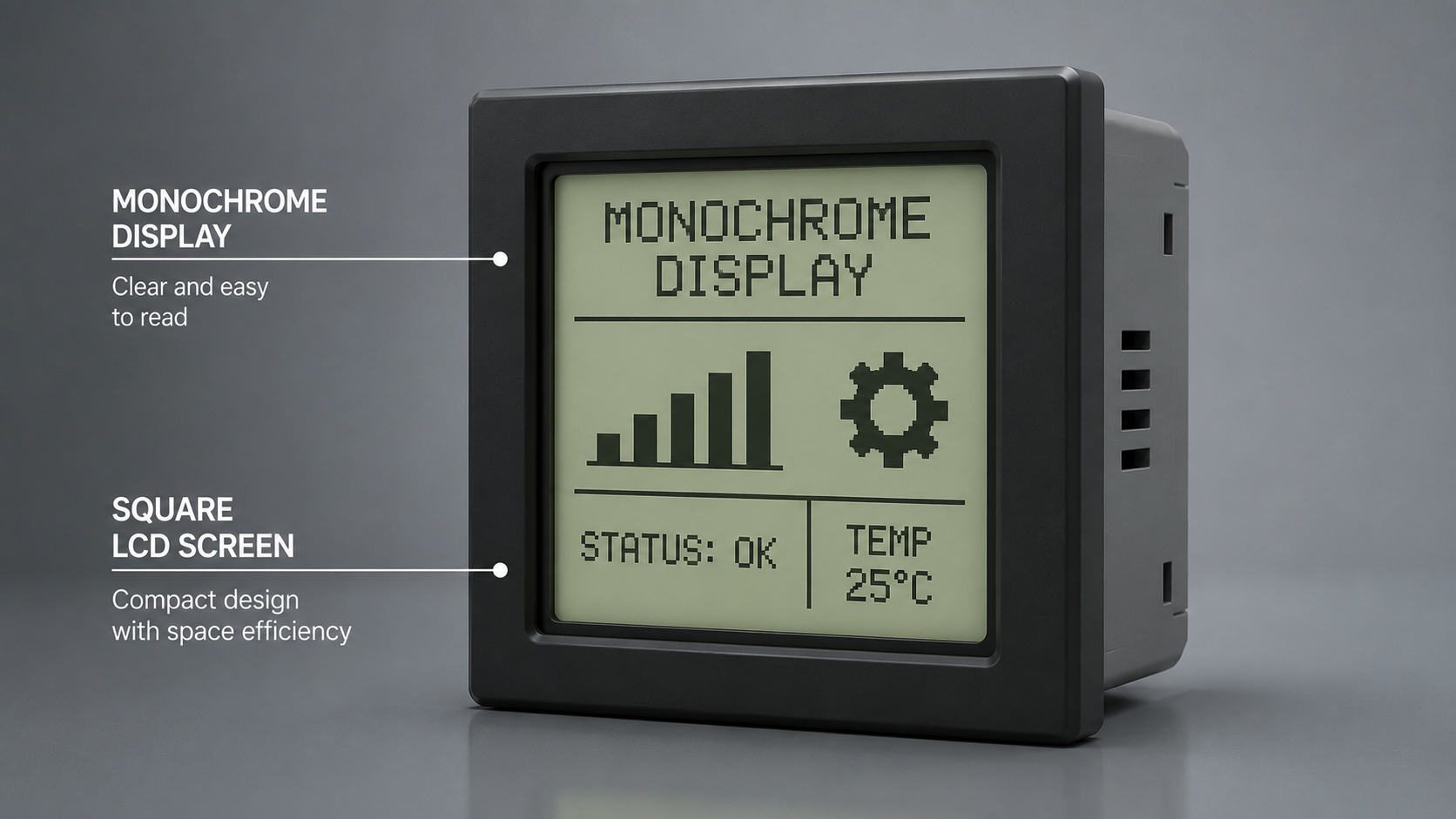
While high-resolution color displays dominate smartphones and entertainment devices, many industrial and embedded applications require something simpler, more reliable, and energy-efficient. This is where a Monochrome Display and Square LCD Screen become practical choices.
These display technologies are widely considered for control panels, measuring instruments, handheld electronics, medical equipment, smart devices, industrial systems, and other products where clear information presentation is more important than complex graphics.
Understanding their features, benefits, and applications helps engineers, designers, manufacturers, and product developers select the right display solution.
What Is a Monochrome Display?
A Monochrome Display is designed to show information using a limited color combination rather than displaying a full range of colors. Depending on the LCD technology and backlight configuration, information may appear as dark characters against a light background or illuminated characters against a darker background.
Its simplified visual structure makes it particularly useful for applications requiring numbers, symbols, icons, menus, measurements, or basic graphics.
Key Characteristics of Monochrome Displays
Common characteristics include:
-
Clear presentation of text and numerical information
-
Relatively low power requirements
-
Simple electronic integration
-
Compact module options
-
Good readability for dedicated applications
-
Cost-efficient design for mass-produced devices
-
Multiple display modes and backlight configurations
Because fewer visual elements need to be managed, a Monochrome Display can provide an efficient interface without placing unnecessary demands on the electronic system.
Why Monochrome Displays Remain Important
Advanced color displays are not automatically the best solution for every electronic product. An industrial controller displaying temperature, voltage, pressure, or operating status may not need millions of colors.
In such environments, simplicity becomes an advantage.
Advantages for Electronic Product Design
A monochrome LCD can help manufacturers achieve:
-
Lower overall system complexity
-
Efficient power consumption
-
Easy-to-read information
-
Reduced display processing requirements
-
Practical integration into compact devices
-
Reliable operation in dedicated user interfaces
For battery-operated and portable devices, these advantages can become particularly valuable.
Designed for Functional Interfaces
Instead of focusing on decorative visuals, monochrome technology prioritizes information delivery. Engineers can use the display for operational data, warnings, settings, symbols, status indicators, and measurements without introducing unnecessary graphical complexity.
What Is a Square LCD Screen?
A Square LCD Screen uses a display area with equal or approximately equal horizontal and vertical dimensions. This form factor offers designers an alternative to conventional rectangular screens and can be especially valuable when a product has a balanced or compact interface.
Square displays can support menus, icons, numerical data, graphical indicators, and other interface elements depending on the chosen LCD technology.
Where Square Displays Add Design Value
A Square LCD Screen can be suitable for:
-
Smart control panels
-
Industrial instruments
-
Portable testing devices
-
Home automation controllers
-
Measuring equipment
-
Medical electronics
-
Compact monitoring systems
-
Consumer electronic devices
The symmetrical shape allows product designers to organize information around a central visual structure while maintaining a clean appearance.
Monochrome Display vs Square LCD Screen
Although these terms are sometimes discussed together, they describe different aspects of a display. Monochrome refers primarily to the visual color capability, while square refers to the physical form factor.
| Feature | Monochrome Display | Square LCD Screen |
|---|---|---|
| Main characteristic | Limited-color information display | Square-shaped viewing area |
| Primary advantage | Simple and efficient presentation | Balanced interface design |
| Power requirements | Often relatively low | Depends on display technology |
| Typical content | Text, icons, symbols, data | Text, graphics, menus, icons |
| Applications | Instruments, meters, controllers | Smart devices, panels, equipment |
| Design focus | Functional readability | Form factor and interface layout |
A display can therefore be both monochrome and square when the application requires the advantages of both technologies.
Important Factors When Selecting an LCD Display
Choosing a display should involve more than checking dimensions. Manufacturers need to evaluate the complete operating environment and interface requirements.
Display Size and Viewing Area
The active viewing area should provide enough space for the information users need to see. Text, icons, numerical values, and navigation elements should remain readable without making the product unnecessarily large.
Resolution Requirements
Higher resolution can support more detailed graphics, but not every application needs it. A straightforward measurement device may require significantly less resolution than a graphical control interface.
Viewing Conditions
Consider where the device will operate. Indoor equipment, portable instruments, brightly illuminated environments, and industrial machinery may have different visibility requirements.
Power Consumption
Energy efficiency is particularly important for portable and battery-powered electronics. Choosing an appropriately designed Monochrome Display can help reduce unnecessary power demand.
Interface Compatibility
Display communication must be compatible with the product's processor or controller. Engineers should consider interface requirements, driver support, operating voltage, and software integration early in the development process.
Operating Environment
Temperature, humidity, vibration, continuous operating time, and other environmental conditions can affect LCD selection. Industrial applications often require more careful specification than ordinary indoor consumer products.
Applications of Monochrome and Square LCD Technology
The versatility of LCD technology allows manufacturers to incorporate these displays into many product categories.
Industrial Equipment
Machines and controllers commonly need screens for displaying operating modes, temperatures, pressure readings, alarms, production information, or equipment status.
Measurement Instruments
A Monochrome Display is well suited for meters and testing devices because users can quickly read numerical data without distracting graphical elements.
Medical and Laboratory Devices
Compact displays can present measurements, operating instructions, status indicators, and device information in diagnostic or laboratory equipment.
Smart Home Systems
A Square LCD Screen can complement modern thermostats, controllers, environmental monitors, and automation panels where compact dimensions and balanced styling are desirable.
Portable Electronics
Handheld equipment often requires compact dimensions and efficient energy use, making LCD solutions attractive for portable monitoring, measuring, and control applications.
Benefits for Product Manufacturers
Selecting an appropriate LCD module can influence not only product appearance but also usability and production efficiency.
Manufacturers can benefit from:
-
Flexible screen sizes and configurations
-
Clear information presentation
-
Compact equipment design
-
Efficient electronic architecture
-
Integration with embedded systems
-
Custom interface possibilities
-
Suitable solutions for both simple and specialized equipment
The correct display should support the product's purpose rather than adding technology that users do not actually need.
How to Choose the Right Display Supplier
Display quality can influence the reliability of the finished electronic product. Buyers should therefore evaluate suppliers based on technical capability rather than price alone.
Important Supplier Considerations
Look for a supplier that can provide clear technical specifications, suitable LCD options, engineering communication, stable manufacturing capabilities, customization support, and consistent quality management.
Customization Can Improve Product Integration
Depending on production requirements, manufacturers may require customized dimensions, interfaces, backlights, connectors, viewing areas, or display configurations. Discussing these requirements during the design stage can reduce integration problems later.
Frequently Asked Questions
1. What is a Monochrome Display?
A Monochrome Display presents information using a limited color arrangement and is commonly used for text, numbers, icons, symbols, and basic graphical information.
2. Why choose monochrome instead of a color display?
Monochrome technology may provide a simpler interface, lower system complexity, practical readability, and efficient power usage for applications that do not require full-color graphics.
3. What is a Square LCD Screen?
A Square LCD Screen is an LCD with equal or nearly equal width and height proportions, making it suitable for compact and symmetrical user interfaces.
4. Can a square LCD also be monochrome?
Yes. Shape and color capability are separate characteristics, so manufacturers can design a square display using monochrome LCD technology.
5. Where are monochrome LCDs commonly used?
They are commonly suitable for industrial controllers, meters, portable devices, instrumentation, medical equipment, household electronics, and embedded systems.
6. Are monochrome screens energy-efficient?
Many monochrome LCD solutions can operate with relatively low power requirements, although actual consumption depends on display technology, backlighting, size, and operating conditions.
7. What should I check before selecting an LCD module?
Check dimensions, viewing area, resolution, interface, operating voltage, viewing conditions, environmental requirements, backlight options, and controller compatibility.
8. Why use a square screen in product design?
Square displays can provide balanced visual proportions and efficient use of space in control panels, smart devices, meters, and compact electronic interfaces.
9. Can LCD modules be customized?
Yes. Depending on manufacturing capabilities and production requirements, customization may include dimensions, connectors, backlights, interfaces, viewing areas, and other module specifications.
10. Which display is best for industrial equipment?
The best option depends on required information, environmental conditions, viewing distance, power availability, dimensions, interface compatibility, and expected operating conditions.

 English
 Arabic
 French
 Spanish
 Portuguese
 Deutsch
 Dutch
Dutch
 Italiano
 Russian
 Romaian
 Portuguese (Brazil)
 Greek
Greek
 Bengali