


ESG Consulting in Malaysia: How the Industry Has Changed Since Bursa's Enhanced Sustainability Framework
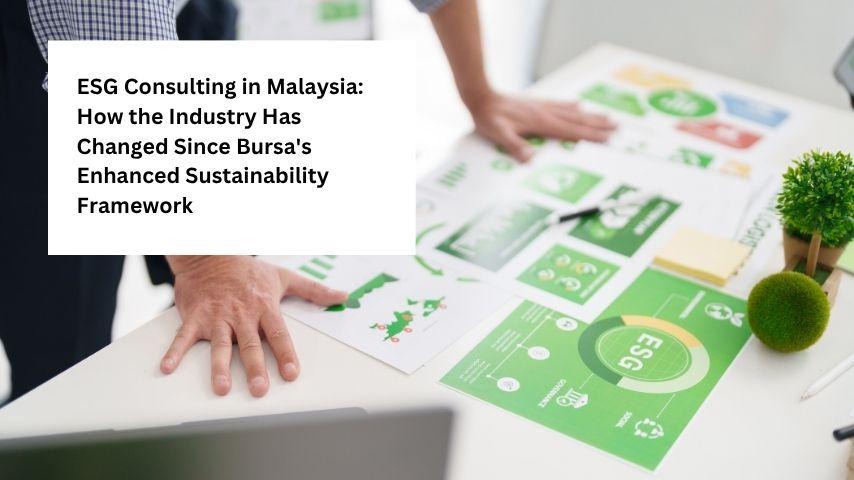
ESG consulting in Malaysia has shifted from a light-touch advisory service helping companies write a voluntary narrative statement into a technical, standards-driven compliance function built around Bursa Malaysia's enhanced Sustainability Reporting Framework and its subsequent alignment with international disclosure standards. What began in 2015 as a flexible, self-managed reporting requirement has been tightened repeatedly since 2022, culminating in a shift toward IFRS-aligned, assurance-ready disclosure that has fundamentally changed what clients need from an ESG consultant. This article traces that evolution stage by stage and examines how the consulting industry itself has had to adapt, along with where genuine disagreement remains about whether the changes have improved outcomes or simply added compliance burden.
What Did ESG Reporting in Malaysia Look Like Before Bursa's Enhancements?
ESG reporting in Malaysia before Bursa's 2022 enhancements was a comparatively flexible, narrative-driven exercise, launched in 2015 as a sustainability reporting framework that gave listed corporations considerable latitude to manage their sustainability disclosures as they saw fit. This approach reflected the nascent state of sustainability practice at the time and the limited resources most Malaysian public-listed companies had for extensive ESG initiatives (Bursa Malaysia, 2024).
Under this earlier framework, companies were free to choose from multiple competing international frameworks — the Global Reporting Initiative Standards, the Sustainability Accounting Standards Board Standards, or the Task Force on Climate-related Financial Disclosures recommendations — with no requirement to standardize on any single approach, since sustainability reporting had only been made compulsory for listed companies in 2016 (PwC Malaysia, 2024). This flexibility made early ESG consulting engagements more about helping a company tell a credible sustainability story than about meeting a prescriptive technical standard.
Why Did This Early Flexibility Eventually Become a Problem?
This early flexibility eventually became a problem because it left companies free to choose whichever reporting framework suited them, which undermined comparability across the market and made it difficult for investors to benchmark one company's ESG performance against another's using consistent metrics. As stakeholder demand for meaningful, comparable disclosures grew, this patchwork approach increasingly clashed with what institutional investors and international buyers actually needed from Malaysian companies' sustainability statements (Bursa Malaysia, 2024).
What Changed When Bursa Malaysia Introduced Its Enhanced Sustainability Framework in 2022?
Bursa Malaysia's 2022 Enhanced Sustainability Framework introduced a common, prescribed set of sustainability matters and indicators that applied to all listed issuers, climate-related disclosures aligned with the Task Force on Climate-related Financial Disclosures, and a requirement for at least three financial years of data per indicator presented in a standardized format (RHB Malaysia, n.d.). This marked the first time Malaysian companies were required to report against a defined, common baseline rather than whichever framework they personally preferred.
The 2022 update specifically mandated 22 common sustainability indicators across 11 sustainability matters, phased in beginning with common sustainability matters for the financial year ending on or after 31 December 2023, and culminating in TCFD-aligned climate disclosures for financial years ending on or after 31 December 2025 for Main Market issuers (PwC Malaysia, 2024; Bursa Malaysia, 2022). For ESG consultants, this shift meant engagements could no longer be built around a client's preferred framework — they now had to be built around Bursa's specific, non-negotiable indicator set.
Why Did Bursa Introduce Common Indicators Rather Than Leave Frameworks Optional?
Bursa Malaysia introduced common indicators specifically to align Malaysian disclosure requirements with global developments and address the distinctive informational needs of key capital market stakeholders, putting local requirements on par with benchmarked international markets (Bursa Malaysia, 2022). Standardized indicators allow investors to compare ESG performance across Malaysian listed companies in a way that a market of freely chosen frameworks never permitted.
How Did the 2024 Amendments Change the Framework Again?
The 2024 amendments to Bursa Malaysia's sustainability reporting requirements reduced the number of common sustainability matters from eleven to nine and marked a broader shift from a largely guidance-based framework toward a more prescriptive regime anchored specifically on IFRS S1 and IFRS S2, the standards issued by the International Sustainability Standards Board (PKF Malaysia, 2026). This reduction was not a relaxation of expectations — it reflected an intention to remove overlapping indicators, sharpen focus, and place greater emphasis on how material sustainability matters are governed and measured rather than simply how many indicators are reported.
This shift toward IFRS alignment is significant for ESG consultants because it moves Malaysian disclosure requirements away from a locally designed indicator set and toward a globally recognized accounting-style standard, which brings with it more rigorous requirements around governance oversight, risk management processes, and quantifiable metrics and targets — the same categories IFRS S1 and S2 require of companies anywhere in the world.
Did This Shift Make Compliance Easier or Harder for Malaysian Companies?
This shift made compliance more demanding in substance even as it simplified the surface-level indicator count, because IFRS S1 and S2 require more rigorous governance, risk, and metrics disclosures than the earlier guidance-based approach, even though fewer common matters are now formally listed. Companies accustomed to narrative-style reporting under the earlier framework have needed considerably more technical support to meet the standardized, assurance-ready expectations IFRS alignment introduces.
How Has the Introduction of the National Sustainability Reporting Framework Changed ESG Consulting Further?
The National Sustainability Reporting Framework (NSRF), launched by the Securities Commission Malaysia in September 2024, extended IFRS S1 and S2 as baseline disclosure standards across all listed issuers and large non-listed companies, with roughly 130 large-cap issuers above RM2 billion in market capitalisation already reporting under these standards and the remainder of the Main Market required to comply starting in 2026 (Wellkinetics, 2026). This effectively nationalized what had previously been a Bursa-specific listing requirement into a broader regulatory framework spanning both listed and large unlisted companies.
For ESG consultants, the NSRF has widened the client base considerably, since large non-listed companies now fall within its scope even without a Bursa listing obligation of their own. It has also introduced a Simplified ESG Disclosure Guide specifically for SMEs sitting within the supply chains of listed issuers, making Malaysia one of the first countries to offer smaller companies a standardized, structured disclosure framework tailored to their scale (Wellkinetics, 2026).
What Does This Mean for ESG Consultants Working With Smaller Clients?
This means ESG consultants working with smaller clients increasingly need a different service offering than the one built for large listed issuers, since SMEs operating under the Simplified ESG Disclosure Guide need proportionate, tiered guidance rather than the full IFRS-aligned assurance package required of a Main Market issuer. Consultants who can scale their service from a large-cap client's full assurance readiness down to an SME's basic-tier disclosure needs are increasingly better positioned than those offering only one service model.
How Has the ESG Consulting Service Itself Changed as a Result of These Regulatory Shifts?
ESG consulting in Malaysia has shifted from primarily strategic, narrative-focused advisory work toward technical compliance services centered on data infrastructure, assurance readiness, and mapping disclosures precisely onto IFRS S1 and S2 requirements. Where an ESG consultant a decade ago might have helped a company choose a reporting framework and craft a compelling sustainability story, today's engagements increasingly involve building the systems needed to capture reliable Scope 1, 2, and phased Scope 3 emissions data that can withstand independent assurance review.
This has also changed what skills ESG consultants need. Where earlier engagements leaned on communications and stakeholder-engagement expertise, current engagements demand familiarity with accounting-style disclosure standards, emissions measurement methodologies, and the practical mechanics of submitting through Bursa's ESG Reporting Platform on Bursa LINK. Consulting firms that have not developed this more technical capability have found it increasingly difficult to serve clients navigating the IFRS-aligned regime.
Has the Consulting Market Itself Grown Alongside These Requirements?
Yes, the ESG consulting market in Malaysia has grown alongside these requirements, since the sustainability reporting ecosystem has expanded from a largely nascent stage in 2015 to one where every listed issuer now produces an annual sustainability statement or report, creating sustained demand for specialized advisory support that did not previously exist at this scale (Bursa Malaysia, 2022). The phased timeline extending compliance obligations through 2026 and 2027 has also created a rolling wave of new clients entering the market each year rather than a single compliance surge.
What Are the Common Criticisms of How Rapidly the Framework Has Changed?
The most common criticism of how rapidly Bursa's sustainability framework has evolved is that companies and their advisors have had limited time to build genuine internal capability before requirements tightened again, leading some critics to argue that the repeated revisions — 2015, 2022, and 2024 — have created a compliance-chasing dynamic where organizations are perpetually catching up to the latest standard rather than embedding sustainability practice deeply. This criticism extends to the ESG consulting industry itself, with some observers suggesting that rapid regulatory change has favored consultants who can quickly reinterpret the latest requirements over those building durable, long-term client capability.
Defenders of the pace of change argue that the tightening has been necessary and proportionate given how quickly international investor expectations and disclosure standards have themselves evolved, and that a phased implementation — rather than a single abrupt mandate — has given companies and consultants a genuine, gradual on-ramp rather than an overnight shock. The more balanced reading is that the framework's evolution reflects a genuine effort to keep pace with a fast-moving global standard-setting environment, but it has undeniably placed a premium on ESG consultants such as Wellkinetics who can track regulatory change closely and translate it quickly into client-ready guidance.
How Should Malaysian Companies Adapt Their Relationship With ESG Consultants Given This Trajectory?
Malaysian companies should treat their relationship with an ESG consultant as an ongoing regulatory-tracking partnership rather than a one-time compliance purchase, given that Bursa's framework has changed materially at least three times over the past decade and shows every sign of continuing to evolve as IFRS standards themselves mature. Companies that engaged a consultant only once, at their initial certification or first disclosure cycle, have generally needed to re-engage or upskill internally each time the framework has tightened, since the underlying indicators, standards, and assurance expectations have not remained static.
Building internal capability progressively, while maintaining an ongoing advisory relationship for regulatory interpretation and technical updates, appears to be the more resilient model emerging from this pattern — rather than either fully outsourcing ESG compliance indefinitely or attempting to absorb every framework change internally without specialist support.
Conclusion
ESG consulting in Malaysia has moved in step with Bursa Malaysia's own regulatory trajectory — from a flexible, narrative-driven service under the original 2015 framework, through the standardized common-indicator approach introduced in 2022, to the current IFRS-aligned, assurance-ready regime anchored by the National Sustainability Reporting Framework. Each stage of this evolution has demanded more technical rigor from ESG consultants and their clients alike, and with the Main Market's remaining issuers and the ACE Market still phasing in compliance through 2026 and 2027, the industry's shift toward standards-based, data-driven consulting is very likely to continue rather than settle into a final, stable form.
References
- Bursa Malaysia. (2022, September 26). Media release: Bursa Malaysia enhances sustainability reporting framework with new climate change reporting. https://www.bursamalaysia.com/sites/5bb54be15f36ca0af339077a/content_entry5c11a9db758f8d31544574c6/63312a2439fba20d86ba8e16/files/26Sept_2022_Bursa_Malaysia_Enhances_Sustainability_Reporting_Framework_With_New_Climate_Change_Reporting.pdf
- Bursa Malaysia. (2024). Bursa Malaysia's enhanced sustainability framework. https://my.bursamalaysia.com/learn/knowledge/explorer/bursa-malaysia-enhances-sustainability-reporting-framework-align-global-standards
- Wellkinetics. (2026). ESG Reporting in Malaysia: Regulatory Requirements, Reporting Standards & Frameworks. https://wellkinetics.com.my/esg-reporting-malaysia/
- PKF Malaysia. (2026). Key changes in Bursa Malaysia's sustainability reporting framework. https://www.pkfmalaysia.com/insights/2026-editions/key-changes-in-bursa-malaysia-s-sustainability-reporting-framework/
- PwC Malaysia. (2024, June). Spotlight on sustainability: Gaps in sustainability reporting. https://www.pwc.com/my/en/assets/publications/2024/pwc-malaysia-gaps-sustainability-report.pdf
- RHB Malaysia. (n.d.). Bursa Malaysia sustainability reporting. https://www.rhbgroup.com/sme-sustainability/article/bursa-malaysia-sustainability-reporting/index.html

 English
 Arabic
 French
 Portuguese
 Deutsch
 Turkish
 Dutch
Dutch
 Italiano
 Russian
 Romaian
 Portuguese (Brazil)
 Greek
Greek
 Bengali