


Inside the SPARK Matrix™ for Plant Design and Engineering Software: Trends, Vendors, and Buyer Insights
A clash between a pipe rack and a vessel nozzle is found on a drawing review in the design office. It costs an hour to fix. The same clash found on site, after steel is erected, can cost weeks and a lot of money. The difference is not talent. It is whether the design was modeled, coordinated, and checked properly before construction began.
That is why Plant Design and Engineering Software for Process Industries has become a core investment for EPCs and plant engineering teams. Process facilities are complex, multi-discipline projects with little tolerance for rework. This article explains what these tools do, the challenges and trends shaping the market, and how buyers can evaluate vendors using QKS Group's SPARK Matrix™ research.
Market Overview: From Process Requirements to Plant Design
According to QKS Group, plant design and engineering software refers to specialized engineering platforms used by EPCs and plant engineering teams to plan, model, and coordinate the physical layout of industrial facilities. In practice, Plant Design and Engineering Software for Process Industries lets engineers convert process requirements into accurate, constructible, and coordinated plant designs that can be efficiently executed during construction.
Typical capabilities include:
• Intelligent 3D plant modeling of equipment, piping, and structures
• P&ID creation and synchronization so process diagrams and 3D models stay aligned
• Piping and equipment layout for efficient, buildable arrangements
• Clash detection to find conflicts before construction
• Multi-discipline coordination across process, piping, mechanical, civil, and electrical teams
QKS Group's SPARK Matrix™ analysis includes vendors such as Autodesk, AVEVA, Bentley Systems, Cadmatic, CAD Schroer, Dassault Systèmes, Hexagon, and Siemens. They bring different strengths in engineering software, 3D design, and industry-specific tools, so structured comparison is essential.
Key Challenges Businesses Face
• Disconnected design data. P&IDs, 3D models, and equipment lists drift apart when they are not synchronized.
• Late clash discovery. Conflicts found during construction are far more expensive than those found in design.
• Multi-discipline complexity. Many teams work on the same plant, often across locations and time zones.
• Tight schedules. Capital projects face pressure to compress design timelines without raising risk.
• Rework and change management. Late changes ripple through drawings, models, and procurement.
• Skills and productivity. Experienced plant designers are scarce, and manual drafting limits throughput.
Key Trends and Innovations
Intelligent, data-rich 3D models. Models carry engineering data, not just geometry, so downstream teams can rely on them.
Tighter P&ID and 3D synchronization. Keeping process diagrams and layout models consistent reduces errors and review effort.
Automated clash detection. Conflicts are identified early and continuously instead of at scheduled reviews.
Multi-discipline collaboration. Shared environments let process, piping, structural, and electrical teams work on a coordinated design.
Design for constructibility. Teams increasingly judge a design by how efficiently it can be built, not only by whether it meets process requirements.
Cloud-enabled collaboration. Distributed teams increasingly expect to share and review designs without heavy infrastructure overhead.
Benefits and Business Impact
When implemented well, Plant Design and Engineering Software for Process Industries can deliver:
• Fewer design errors through synchronized P&IDs and 3D models
• Reduced rework by catching clashes before construction
• Faster design cycles through automation and reuse
• Better coordination across disciplines and project teams
• More constructible designs that execute efficiently on site
• Lower project risk through earlier visibility into design issues
Use Cases and Real-World Examples
These are illustrative scenarios of typical applications:
• Chemical plant projects. An EPC models piping and equipment in 3D and resolves conflicts before fabrication.
• Oil and gas facilities. Engineers keep P&IDs and layout models aligned as design changes arrive.
• Brownfield expansions. A plant team plans new equipment around existing infrastructure with fewer surprises.
• Multi-office engineering. Teams in several locations coordinate one plant design in a shared environment.
• Construction handover. A design package gives contractors a clear, coordinated model to build from.
How Organizations Can Choose the Right Solution
Start with your project types, team structure, and the cost of rework in your business. Then evaluate vendors on:
1. 3D modeling depth for process plant equipment, piping, and structures
2. P&ID capabilities and synchronization with the 3D model
3. Piping and equipment layout productivity
4. Clash detection accuracy and workflow
5. Multi-discipline coordination features and data sharing
6. Integration with simulation, analysis, and downstream construction tools
7. Usability and training needs for your engineers
8. Scalability for large, multi-site projects
9. Vendor viability, including roadmap, support, and ecosystem
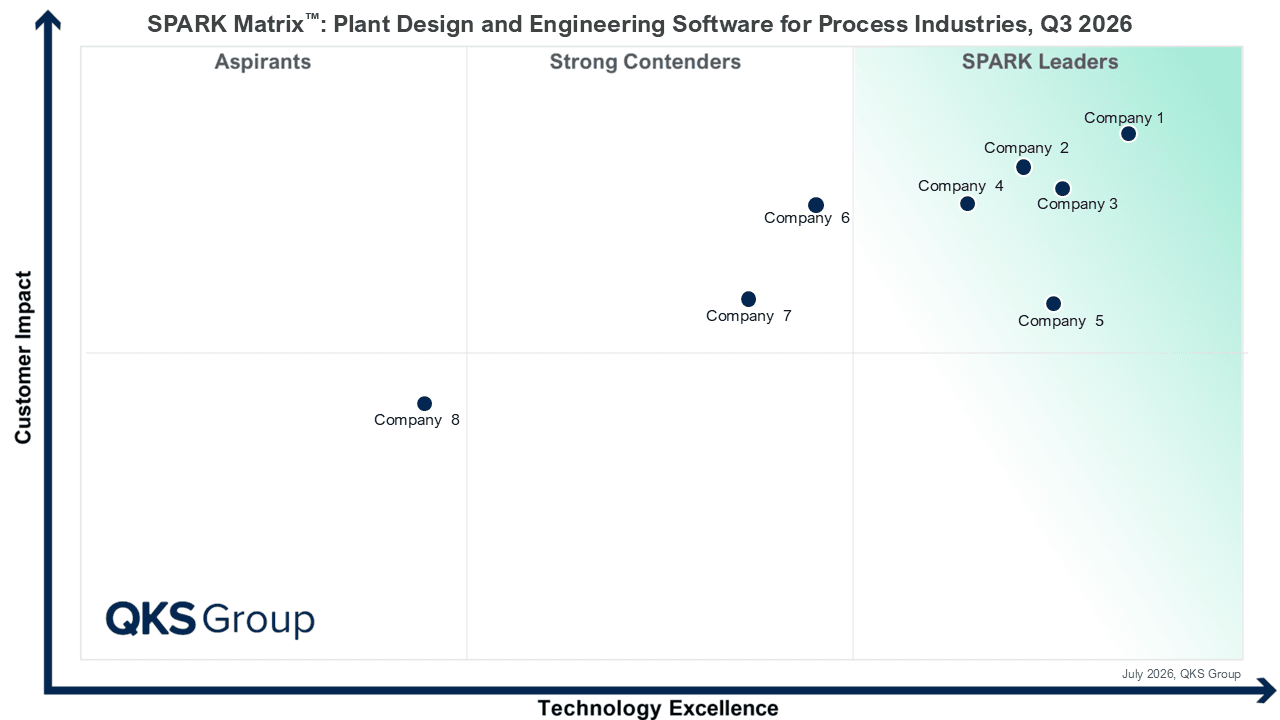
QKS Group's SPARK Matrix™ for Plant Design and Engineering Software for Process Industries ranks and positions leading vendors with global impact, giving buyers an independent shortlisting reference and vendors a benchmark for strategy.
Future Outlook: 2026–2029
• Greater automation of routine design and layout tasks
• Tighter linkage between process design data and 3D models
• More continuous clash detection and design validation
• Wider use of cloud-based, multi-discipline collaboration
• Stronger focus on constructibility and execution efficiency
Vendors that combine intelligent modeling, strong synchronization, and open collaboration are likely to stand out.
Conclusion
Plants are expensive to build and expensive to fix. Plant Design and Engineering Software for Process Industries helps EPCs and engineering teams turn process requirements into coordinated, constructible designs before the first foundation is poured. The right platform depends on your project mix, team structure, and tool landscape. QKS Group's SPARK Matrix™ research provides a vendor-neutral view of the market to support that decision.
1. What is plant design and engineering software?
It refers to specialized engineering platforms used by EPCs and plant engineering teams to plan, model, and coordinate the physical layout of industrial facilities.
2. What capabilities does it typically include?
It typically supports intelligent 3D plant modeling, P&ID creation and synchronization, piping and equipment layout, clash detection, and multi-discipline coordination.
3. Who uses plant design and engineering software?
EPCs and plant engineering teams use it to convert process requirements into accurate, constructible, and coordinated plant designs.
4. Why is clash detection important?
It identifies conflicts between design elements before construction, helping teams avoid costly rework on site.
5. Which vendors are included in QKS Group's SPARK Matrix™ for this market?
The analysis includes Autodesk, AVEVA, Bentley Systems, Cadmatic, CAD Schroer, Dassault Systèmes, Hexagon, and Siemens.

 English
 Arabic
 French
 Spanish
 Portuguese
 Deutsch
 Turkish
 Dutch
Dutch
 Russian
 Romaian
 Portuguese (Brazil)
 Greek
Greek
 Bengali