


Data Center Security Solutions in UAE for Maximum Protection
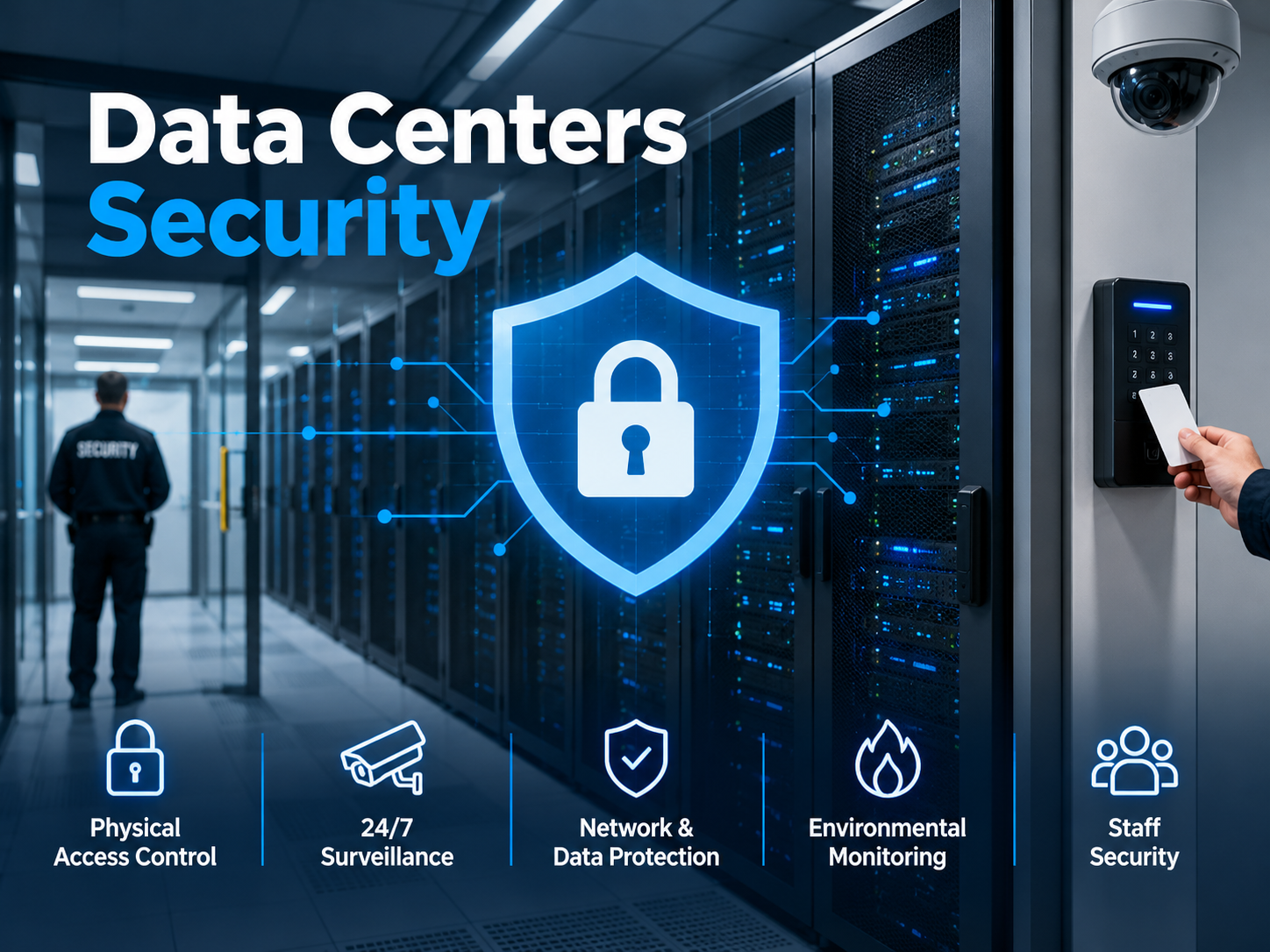
As the UAE cements its position as a regional digital hub, Data Center Security Solutions in UAE facilities have become a top priority for enterprises, cloud providers, and government entities alike. A single breach physical or digital can disrupt critical services, expose sensitive data, and damage years of client trust, which is why Data Center Security is now treated as a board-level concern rather than a purely technical one.
From perimeter fencing and biometric checkpoints to encrypted networks and 24/7 monitoring, protecting a modern facility requires a layered strategy that covers both the physical building and the digital infrastructure inside it. This article walks through what that strategy looks like for facilities operating across Dubai, Abu Dhabi, and the wider Emirates.
What Is Data Center Security and Why It Matters
Data center security refers to the combined set of physical safeguards and digital controls used to protect the servers, storage systems, and network equipment housed inside a facility. It spans everything from who is allowed to walk through the front door to which firewall rules govern traffic reaching the server racks.
For UAE-based operators, the stakes are especially high. Data centers here host financial systems, government records, healthcare data, and infrastructure for regional cloud platforms — all of which fall under strict national data protection expectations. A gap in either physical or digital defenses can quickly become a compliance failure as well as a security incident.
Core Components of a Modern Data Center Security Strategy
A well-designed security program layers several independent controls, so that a failure in one area does not compromise the entire facility. The most important physical components include the following.
Data Center Access Control for Restricted Entry
Robust Data Center Access Control ensures that only authorized personnel can reach server halls, cabling rooms, and power infrastructure. Modern facilities combine biometric verification, multi-factor credentials, and mantrap entryways to prevent tailgating, with every access event logged for audit purposes.
Data Center Surveillance for Round-the-Clock Monitoring
Continuous Data Center Surveillance through high-resolution CCTV, thermal cameras, and analytics-driven monitoring gives security teams visibility over every corridor, loading dock, and server row. Recorded footage also supports incident investigation and compliance reporting after any unusual event.
Data Center Intrusion Detection and Threat Detection Systems
Perimeter sensors, vibration detectors, and door contacts form the backbone of Data Center Intrusion Detection, flagging unauthorized attempts to breach fencing or restricted zones in real time. Paired with broader Data Center Threat Detection platforms that correlate physical alerts with network anomalies, facilities gain a unified view of risk across both domains instead of managing them in separate silos.
Cybersecurity for Data Center Environments
Physical barriers alone cannot protect a facility from remote attackers. Cybersecurity for Data Center operations must be treated as equally important, since most modern attacks target the network layer rather than the building itself.
Data Center Firewalls as the First Line of Defense
Properly configured Data Center Firewalls inspect and filter traffic entering and leaving the facility's network, blocking known malicious sources and enforcing segmentation between client environments. In multi-tenant facilities, this segmentation is essential to prevent one client's compromised workload from affecting another's.
Data Center Encryption for Data-at-Rest and In-Transit Protection
Even with strong perimeter defenses, data itself needs independent protection. Data Center Encryption secures information both while it is stored on disk and while it moves across internal and external networks, ensuring that intercepted or stolen data remains unreadable without the correct decryption keys.
Data Center Security UAE: Regional Compliance and Risk Landscape
Operators pursuing Data Center Security UAE standards must align with national data protection frameworks and sector-specific regulations covering finance, healthcare, and government workloads. Regulatory bodies increasingly expect documented physical security controls alongside standard cybersecurity certifications, making a combined physical-and-digital approach a practical necessity rather than a nice-to-have.
The Emirates' rapid growth in cloud adoption and smart-city infrastructure has also expanded the attack surface facilities must defend, from insider threats at the rack level to coordinated attempts targeting national digital infrastructure.
Conclusion
Protecting a modern facility requires layered Data Center Security that pairs physical safeguards with strong Cybersecurity for Data Center operations, including reliable Data Center Firewalls and Data Center Encryption. Effective Data Center Access Control, Data Center Surveillance, and Data Center Intrusion Detection work together with broader Data Center Threat Detection to close gaps between physical and network risk. Whether the requirement is Data Center Security UAE wide, focused on Data Center Security Abu Dhabi facilities, or Data Center Security Dubai operations, a unified strategy remains the most reliable path to maximum protection.

 English
 Arabic
 French
 Spanish
 Portuguese
 Turkish
 Dutch
Dutch
 Italiano
 Russian
 Romaian
 Portuguese (Brazil)
 Greek
Greek
 Bengali