


Functional Coffee Market to Reach USD 48.1 Billion by 2035, Driven by Health & Wellness and On-the-Go Consumption at 7.6% CAGR
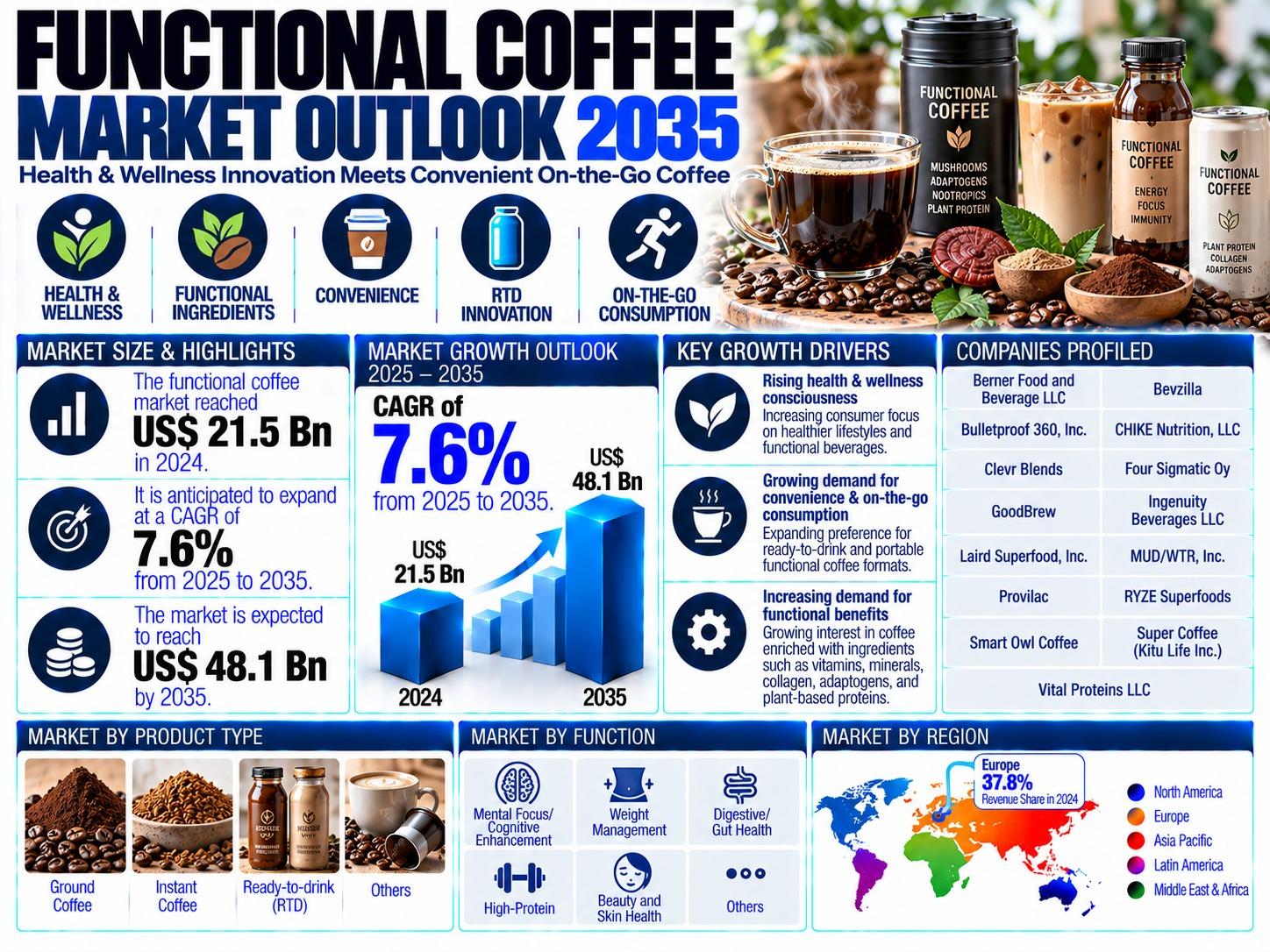
The global functional coffee market was valued at US$ 21.5 Bn in 2024 and is projected to reach US$ 48.1 Bn by 2035, expanding at a CAGR of 7.6% from 2025 to 2035. Rising health and wellness consciousness and growing demand for convenient, on-the-go beverages are driving the expansion of the market.
Functional coffee combines traditional coffee with ingredients positioned around specific wellness benefits. Products can incorporate functional ingredients such as adaptogens, nootropics, probiotics, vitamins, and other ingredients associated with focus, gut health, immunity, energy, and wellness. The category is therefore aligning conventional coffee consumption with the broader shift toward nutrition-oriented and preventive health lifestyles.
Functional coffee is available in several formats, including ground coffee, instant coffee, and ready-to-drink products. Among these, ready-to-drink (RTD) coffee held the leading position in 2024, accounting for 36.9% of the market, reflecting strong demand for convenient formats.
Europe dominated the global functional coffee market in 2024 with a revenue share of 37.8%, supported by the region's established coffee culture, premium beverage market, and growing consumer interest in wellness-oriented products.
Rising Health & Wellness Consciousness Fuels Market Growth
Increasing health and wellness consciousness is a major factor supporting the functional coffee market. Consumers are increasingly looking for beverages that provide more than traditional caffeine stimulation and are showing interest in products associated with specific health and lifestyle benefits.
Coffee already has an established position in consumers' daily routines. Functional coffee builds on this familiarity by incorporating ingredients such as adaptogens, nootropics, probiotics, and other functional components. These ingredients are marketed for applications associated with areas such as cognitive performance, gut health, immunity, energy, and stress management.
The increasing interest in preventive health and functional foods is encouraging consumers to seek products that combine convenience, taste, and perceived functional value. Functional coffee can address these requirements without requiring consumers to substantially change established beverage habits.
The continuing strength of global coffee consumption also provides a substantial consumer base for functional innovations. According to the supplied market information, global coffee production surpassed 168.5 million 60-kg bags during 2021–2022, highlighting the continued importance of coffee as a beverage category.
This established consumption pattern provides opportunities for brands to introduce functional variants and position coffee as a product that combines traditional beverage consumption with wellness-oriented attributes.
Convenience and On-the-Go Consumption Accelerate Demand
Growing demand for convenient and portable beverages is another major driver of the functional coffee market. Modern lifestyles characterized by limited time, commuting, travel, and busy work schedules are encouraging consumers to seek ready-to-consume products.
Ready-to-drink coffee has emerged as a convenient format because it eliminates preparation time and can be consumed during commuting, at workplaces, during breaks, or while traveling. Functional RTD coffee adds another layer of value by incorporating wellness-oriented ingredients into an already convenient beverage format.
The combination of convenience and functional benefits makes RTD coffee particularly relevant among urban consumers, busy professionals, commuters, and individuals with active lifestyles. These consumers can obtain coffee and perceived functional benefits through a single product.
The development of functional RTD products is therefore helping move functional coffee beyond traditional brewing occasions and into broader beverage consumption. Manufacturers are using different functional ingredients and formulations to address changing preferences around performance, wellness, and convenience.
Ready-to-Drink Segment Dominates Functional Coffee Market
Ready-to-drink (RTD) coffee accounted for the largest share of the functional coffee market in 2024, representing 36.9% of the market. The segment's leading position is associated with its convenience and suitability for consumers seeking quick and portable beverage options.
RTD functional coffee provides the familiar characteristics of coffee without requiring consumers to prepare the beverage themselves. This makes the format particularly suitable for busy professionals, daily commuters, and consumers with active lifestyles.
Another advantage of RTD products is their ability to combine different coffee formulations with functional ingredients without requiring additional preparation steps. This allows manufacturers to develop products positioned around different wellness and lifestyle requirements.
The growing preference for convenient beverages is therefore supporting the expansion of functional RTD coffee. As functional products become increasingly integrated into mainstream beverage consumption, the RTD segment is expected to remain an important source of innovation and revenue within the functional coffee market.
Europe Leads the Global Functional Coffee Market
Europe dominated the global functional coffee market in 2024, accounting for 37.8% of revenue. The region's established coffee culture and strong premium beverage market provide a favorable environment for functional coffee products.
European consumers have a strong tradition of coffee consumption alongside growing interest in products combining convenience, quality, wellness, and variety. Functional coffee, particularly fortified and ready-to-drink formats, aligns with these consumer preferences.
The region's established beverage distribution network, retail penetration, and café and foodservice infrastructure also support product visibility and consumer trial. These channels provide opportunities for functional coffee products to reach both regular coffee consumers and health-conscious customers.
Premiumization and increasing health-conscious consumption further support the development of functional coffee in Europe. These factors contribute to the region's position as a significant market influencing the global functional coffee landscape.
Key Developments in the Functional Coffee Market
Product innovation and the introduction of new functional ingredients remain important strategies among companies operating in the market.
In August 2025, Everyday Dose introduced its functional coffee products in more than 1,500 Target stores across the U.S. and on Target.com. The products combine organic Lion's Mane and Chaga mushrooms, grass-fed collagen, L-theanine, and caffeine. The company introduced Mild Roast with 45 mg of caffeine and Medium Roast with 90 mg of caffeine, along with a starter kit containing both roasts, an electric frother, and a recipe booklet.
In July 2025, Laird Superfood expanded its functional coffee portfolio with Perform Whole Bean and Perform Decaf Coffee, incorporating organic functional mushrooms including chaga, lion's mane, maitake, and cordyceps. The whole-bean varieties were introduced in medium and dark roasts, while the decaf formulation used the Swiss Water method to remove 99.9% of caffeine while retaining flavor.
These developments illustrate the industry's focus on functional ingredients, product variety, and formats designed around different consumer preferences.
Competitive Landscape
The global functional coffee market includes companies focusing on product innovation, functional ingredients, new formulations, and expansion across consumer and distribution channels.
Key companies operating in the market include Berner Food and Beverage LLC, Bevzilla, Bulletproof 360, Inc., CHIKE Nutrition, LLC, Clevr Blends, Four Sigmatic Oy, Ingenuity Beverages LLC, Laird Superfood, Inc., MUD/WTR, Inc., RYZE Superfoods, Smart Owl Coffee, Super Coffee (Kitu Life Inc.), and Vital Proteins LLC.
The leading companies are profiled based on parameters including company overview, business strategies, financial overview, business segments, product portfolio, and recent developments.
Functional Coffee Market Segmentation
The global functional coffee market is segmented based on product type, function, packaging type, end-use, and distribution channel.
By product type, the market comprises ground coffee, instant coffee, ready-to-drink (RTD), and others, including coffee concentrates.
Based on function, the market is divided into mental focus/cognitive enhancement, weight management, digestive/gut health, high-protein, beauty and skin health, and others, including mood enhancement.
By packaging type, the market includes jars, pouches, sachets/stick packs, bottles, and others, including cans.
Based on end-use, the market is segmented into residential and commercial applications. Commercial applications include hotels and restaurants, cafés, offices, and other institutional spaces.
By distribution channel, the market comprises business-to-business (B2B) and business-to-consumer (B2C) channels. B2C distribution includes supermarkets/hypermarkets, specialty stores, online retail, and other independent retailers.
Geographically, the market covers North America, Europe, Asia Pacific, Middle East & Africa, and Latin America.
The countries covered include the U.S., Canada, U.K., Germany, France, Italy, Spain, the Netherlands, China, India, Japan, Australia, South Korea, ASEAN countries, GCC countries, South Africa, Brazil, Mexico, and Argentina.
Future Outlook
The global functional coffee market is expected to expand as coffee consumers increasingly seek products that combine familiar beverage experiences with perceived health and wellness benefits. Rising interest in preventive health, functional foods, and lifestyle-oriented nutrition is encouraging brands to incorporate ingredients such as adaptogens, nootropics, probiotics, vitamins, and functional mushrooms into coffee products.
Convenience is also expected to remain an important market driver. Ready-to-drink functional coffee provides consumers with portable products that fit commuting, workplace, travel, and other consumption occasions. The strong position of RTD products demonstrates the importance of convenience within the evolving category.
Europe's established coffee culture and premium beverage environment provide a strong foundation for functional coffee adoption, while continued product innovation is broadening the range of functional formulations and formats available to consumers.
The global functional coffee market is projected to increase from US$ 21.5 Bn in 2024 to US$ 48.1 Bn by 2035, expanding at a 7.6% CAGR during 2025–2035, driven by rising health and wellness consciousness and growing demand for convenient, on-the-go consumption.

 English
 French
 Spanish
 Portuguese
 Deutsch
 Turkish
 Dutch
Dutch
 Italiano
 Russian
 Romaian
 Portuguese (Brazil)
 Greek
Greek
 Bengali