


Atherectomy Devices Market Size, Share, Growth Factors, Trends and Forecast 2026-2034
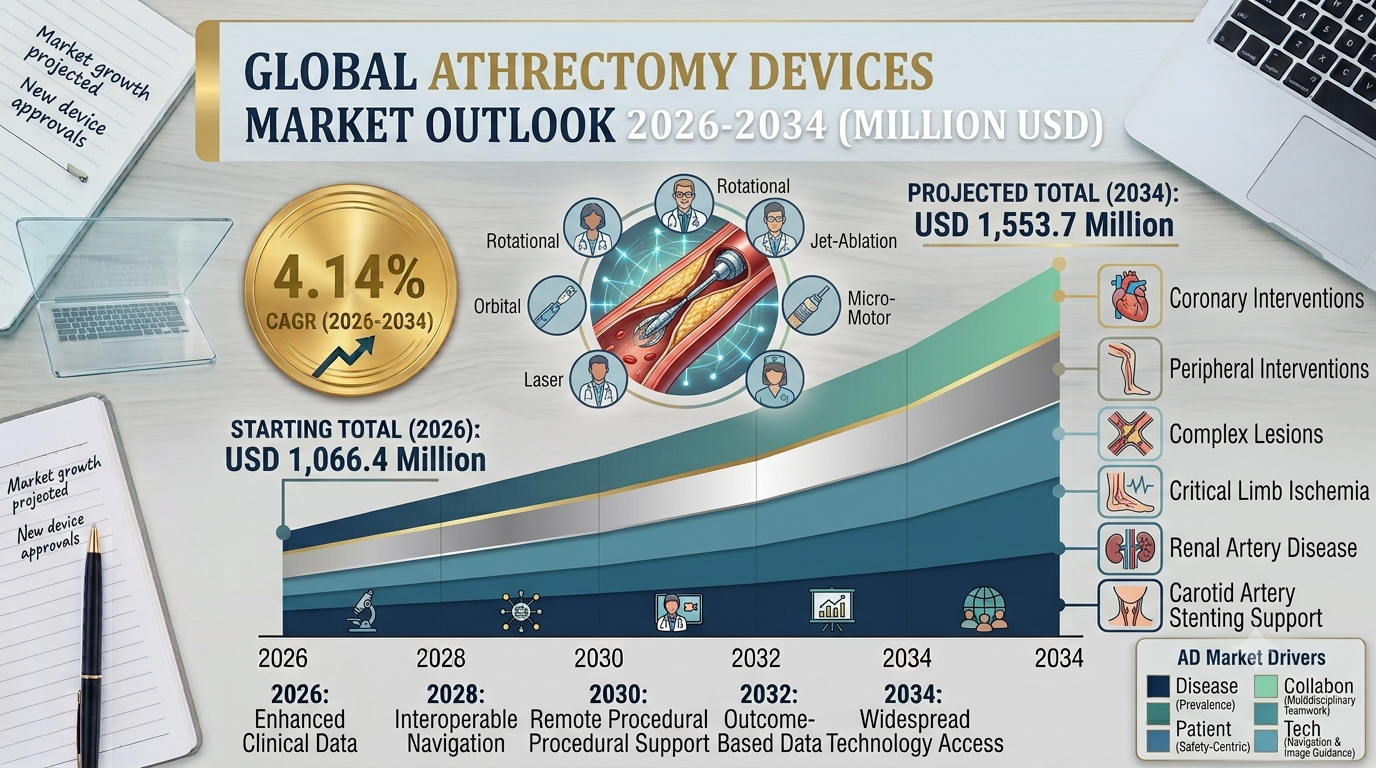
According to IMARC Group, the global atherectomy devices market size reached USD 1,066.4 Million in 2025 and is projected to reach USD 1,553.7 Million by 2034, expanding at a CAGR of 4.14% during 2026–2034. This steady atherectomy devices market growth reflects the rising prevalence of PAD, significant technological advancements, a growing ageing population, the advent of minimally invasive surgeries, healthcare infrastructure development, and supportive reimbursement policies in emerging economies.
Atherectomy Devices Industry Overview
Atherectomy devices provide a minimally invasive approach to removing arterial plaque and are an important alternative in vascular interventions. Instead of relying on open surgery, clinicians use these devices to directly remove or ablate plaque from obstructed arteries, restoring blood flow and improving outcomes for patients with advanced disease. Precision, safety, and faster recovery are the qualities driving their adoption across the vascular care continuum.
Atherectomy devices are available in several technology types, each suited to different clinical needs:
- Directional atherectomy devices: Precisely remove atherosclerotic plaque from obstructed arteries while minimizing vessel wall trauma, and capture and remove plaque during the procedure
- Orbital atherectomy devices: Sand down plaque to reopen blocked leg arteries; a 2020 study suggests orbital atherectomy opens blocked leg arteries 90 percent of the time
- Photo-ablative atherectomy devices: Laser-based plaque ablation; the same 2020 study reports improved blood flow with laser atherectomy 76 percent of the time
- Rotational atherectomy devices: High-frequency rotational technologies that continue to improve the effectiveness and safety of plaque removal
- Support devices: Complementary devices used alongside atherectomy systems during vascular procedures
Global Atherectomy Devices Market Size & Key Statistics
Below are the key atherectomy devices market statistics drawn from IMARC Group's comprehensive market analysis:
|
Report Attribute |
Key Statistics |
|
Base Year |
2025 |
|
Historical Period |
2020–2025 |
|
Forecast Period |
2026–2034 |
|
Atherectomy Devices Market Size in 2025 |
USD 1,066.4 Million |
|
Market Forecast in 2034 |
USD 1,553.7 Million |
|
Market Growth Rate (2026–2034) |
4.14% CAGR |
|
Largest Region |
North America |
|
Leading Product Segment |
Directional Atherectomy Devices |
|
Leading Application |
Peripheral Vascular |
|
Leading End User |
Hospitals |
Request for a Sample Report for Detailed Atherectomy Devices Market Size Evaluation: https://www.imarcgroup.com/atherectomy-devices-market/requestsample
Key Market Drivers & Atherectomy Devices Market Trends in 2026
Several powerful forces are shaping atherectomy devices market trends and supporting sustained growth expectations across the global vascular care landscape:
1. Rising Cases of Peripheral Artery Disease (PAD)
The increasing incidence of PAD, driven by an ageing population and the rise in diabetes and obesity, is a primary force behind Atherectomy Devices Market Growth. PAD affects approximately 8 to 12 million people in the United States, especially those over 50, and about 6.5 million people over the age of 40 have been diagnosed. Atherectomy devices enhance blood flow and reduce symptoms such as leg pain and fatigue by directly cutting away or vaporizing plaque, significantly improving outcomes in patients with severe PAD.
2. Ageing Population and Lifestyle-Related Risk Factors
An older population is more susceptible to cardiovascular and vascular ailments, while rising instances of diabetes, obesity, and smoking are creating indirect demand for plaque-removal devices. Together, these factors expand the patient pool requiring effective, minimally invasive treatment alternatives.
3. Shift Toward Minimally Invasive Procedures
The growing popularity of minimally invasive surgeries is one of the defining Atherectomy Devices Market Trends. Patients and healthcare providers favour these procedures because they reduce the risk of infection, cause minimal pain and trauma, and facilitate faster patient recovery compared with conventional surgery.
4. Technological Advancements in Device Design
Innovations such as directionally controlled devices and high-frequency rotational technologies continue to improve the effectiveness and safety of atherectomy systems. A 2020 study suggests that orbital atherectomy effectively opens blocked leg arteries 90 percent of the time, while laser atherectomy achieves improved blood flow 76 percent of the time. In a multicenter study of 172 patients, Jetstream use delivered 99% device success, with six-month and 12-month clinically driven target-lesion revascularization rates of 15% and 26%, respectively, and a one-year restenosis rate of 38% based on duplex imaging.
5. Rising Popularity of Directional Atherectomy Systems
Directional atherectomy systems are gaining traction because they allow users to target and remove atherosclerotic plaque without damaging the vessel wall. Their ability to treat complex lesions across multiple vessel sizes, combined with the capability to collect and remove plaque during the procedure, makes them a preferred choice among vascular specialists.
6. Expansion into Emerging Markets
Key players are increasingly focusing on emerging economies where healthcare infrastructure is being developed and healthcare spending is growing. The BRICS nations (Brazil, Russia, India, China, and South Africa) are increasingly shaping global demand and supply for medical goods and services. Health spending as a percentage of GDP in 2030 is projected at 8.4% in Brazil, 5.2% in Russia, 3.5% in India, 5.9% in China, and 10.4% in South Africa, opening new fronts for expansion.
7. Healthcare Infrastructure Development and Reimbursement Policies
The growth of healthcare infrastructure and improving reimbursement situations in emerging economies are propelling atherectomy device availability and usage worldwide, further supporting long-term Atherectomy Devices Market Size expansion.
Despite these tailwinds, the market faces challenges, including high device costs and tough regulatory requirements that can delay product launches. However, the rising incidence of PAD, an ageing population, and technology developments that improve device performance and safety continue to create meaningful growth opportunities.
Key Market Segmentation
By Product
Directional Atherectomy Devices – Largest Segment: Directional atherectomy devices represent the largest product segment. They are designed to precisely eliminate atherosclerotic plaque from obstructed arteries, and their accurate control reduces vessel wall trauma, an important factor for patient safety and recovery. Their ability to treat complex lesions in multiple vessel sizes and to collect and remove plaque during the procedure sets them apart in a number of clinical situations.
Orbital Atherectomy Devices: Orbital systems sand down plaque to reopen blocked arteries and are supported by clinical evidence showing strong rates of vessel reopening in leg arteries.
Photo-Ablative Atherectomy Devices: Laser-based systems that ablate plaque and improve blood flow, offering an alternative approach for specific lesion types.
Rotational Atherectomy Devices: Rotational systems benefit from high-frequency rotational technologies that continue to raise procedural effectiveness and safety.
Support Devices: Complementary devices that assist during atherectomy procedures and round out the product portfolio.
By Application
Peripheral Vascular – Largest Application: The use of atherectomy devices in treating peripheral vascular disease is important because of the growing prevalence of PAD. These devices play a key role in reestablishing blood flow in leg arteries, helping relieve pain and mobility problems. Demand is shaped by the minimally invasive nature of the procedure, which allows a shorter recovery period and lower risk of complications than conventional surgery.
Cardiovascular: Atherectomy devices are also used in cardiovascular applications, where plaque removal supports restored blood flow in obstructed arteries.
Neurovascular: The neurovascular segment completes the application landscape covered in the IMARC Group report.
By End User
Hospitals – Largest End-User Segment: Hospitals are the main users of atherectomy devices because these procedures are highly complex and need advanced infrastructure and well-trained healthcare professionals. Segment growth follows the rising number of vascular surgeries performed in hospitals, supported by investments in advanced technologies and training programs for providers. Their ability to deliver complete care, including post-operative requirements, reinforces their dominant position.
Ambulatory Surgery Centers: A key care setting for minimally invasive vascular procedures, benefitting from the shorter recovery times associated with atherectomy.
Research Laboratories and Academic Institutes: These institutions support clinical evaluation and innovation in atherectomy technologies.
Regional Atherectomy Devices Market Analysis
|
Region |
Key Highlights |
|
North America – Largest |
United States & Canada; high prevalence of cardiovascular diseases, developed healthcare system, presence of key market players, favourable reimbursement scenarios, clinical trials, and strong government support for R&D in advanced medical devices |
|
Europe |
Germany, France, United Kingdom, Italy, Spain, Russia, and Others; analysed at country level within the IMARC Group report, with Russia also counted among the BRICS emerging health markets |
|
Asia Pacific |
China, Japan, India, South Korea, Australia, Indonesia, and Others; healthcare infrastructure development and growing healthcare spending are creating new opportunities for key players |
|
Latin America |
Brazil, Mexico, and Others; Brazil is projected to spend 8.4% of GDP on health by 2030, supporting demand for advanced treatment alternatives |
|
Middle East & Africa |
Regional analysis covers the broader Middle East and Africa; South Africa is projected to spend 10.4% of GDP on health by 2030 |
North America leads the global atherectomy devices market size, underpinned by a high prevalence of cardiovascular diseases, a well-developed healthcare system, and the presence of key market players. The United States is the largest market in the region, supported by favourable reimbursement scenarios, clinical trials, and solid government support for research and development in advanced medical devices. The region's commitment to adopting new healthcare solutions continues to drive Atherectomy Devices Market Growth.
Emerging economies are expected to play a growing role as healthcare infrastructure develops, reimbursement situations improve, and access to more advanced treatment alternatives expands the global footprint of atherectomy devices.
Connect for Detailed Atherectomy Devices Market Trends and Regional Analysis – Speak to an Analyst: https://www.imarcgroup.com/request?type=report&id=2766&flag=C
Leading Players in the Global Atherectomy Devices Industry
The atherectomy devices industry is dynamic, with major players pursuing evolving strategies to grow market share and meet rising demand for minimally invasive surgical alternatives. Companies invest significantly in R&D to make their devices more efficient and safer, form strategic alliances and collaborations to share knowledge and improve distribution channels, and pursue mergers and acquisitions to broaden product portfolios and geographic coverage. Regulatory approvals also play a central role as companies work to meet tough safety and efficacy norms across markets. Key companies covered in the IMARC Group report include:
|
Key Market Players |
||
|
Abbott Laboratories |
Avinger |
B. Braun Melsungen AG |
|
Biomerics |
Biotronik |
Boston Scientific Corporation |
|
C.R. Bard (Becton, Dickinson and Company) |
Cardinal Health |
Koninklijke Philips N.V. |
|
Medtronic |
Minnetronix Inc. |
Straub Medical AG (Becton, Dickinson and Company) |
|
Terumo Corporation |
||
Latest Atherectomy Devices Market Industry Developments
November 2023 – Cardinal Health
Cardinal Health announced the U.S. launch of its SmartGown EDGE Breathable Surgical Gown with ASSIST Instrument Pockets, created to give surgical teams safe and convenient instrument access in the operating room.
March 2022 – B. Braun
B. Braun acquired Intermedt Medizin & Technik GmbH, a specialist in the preparation of dialysis concentrates, reflecting the acquisition-led portfolio expansion strategies seen across the medical devices landscape.
About Us
IMARC Group is a leading global market research company providing data-driven insights and expert consulting services to businesses seeking to achieve their strategic objectives. With a multi-disciplinary team of industry experts, IMARC delivers thorough, reliable market intelligence across sectors including Healthcare, Technology, Chemicals, Energy, Food & Beverages, and more.
Contact Us
IMARC Group
United States: +1-201-971-6302
India: +91-120-433-0800
United Kingdom: +44-753-714-6104

 English
 Arabic
 Spanish
 Portuguese
 Deutsch
 Turkish
 Dutch
Dutch
 Italiano
 Russian
 Romaian
 Portuguese (Brazil)
 Greek
Greek
 Bengali