


Global Closed-Loop Centesis Systems Market to Reach USD 1.34 Billion by 2036, India 14.9%, China 14.7% CAGR
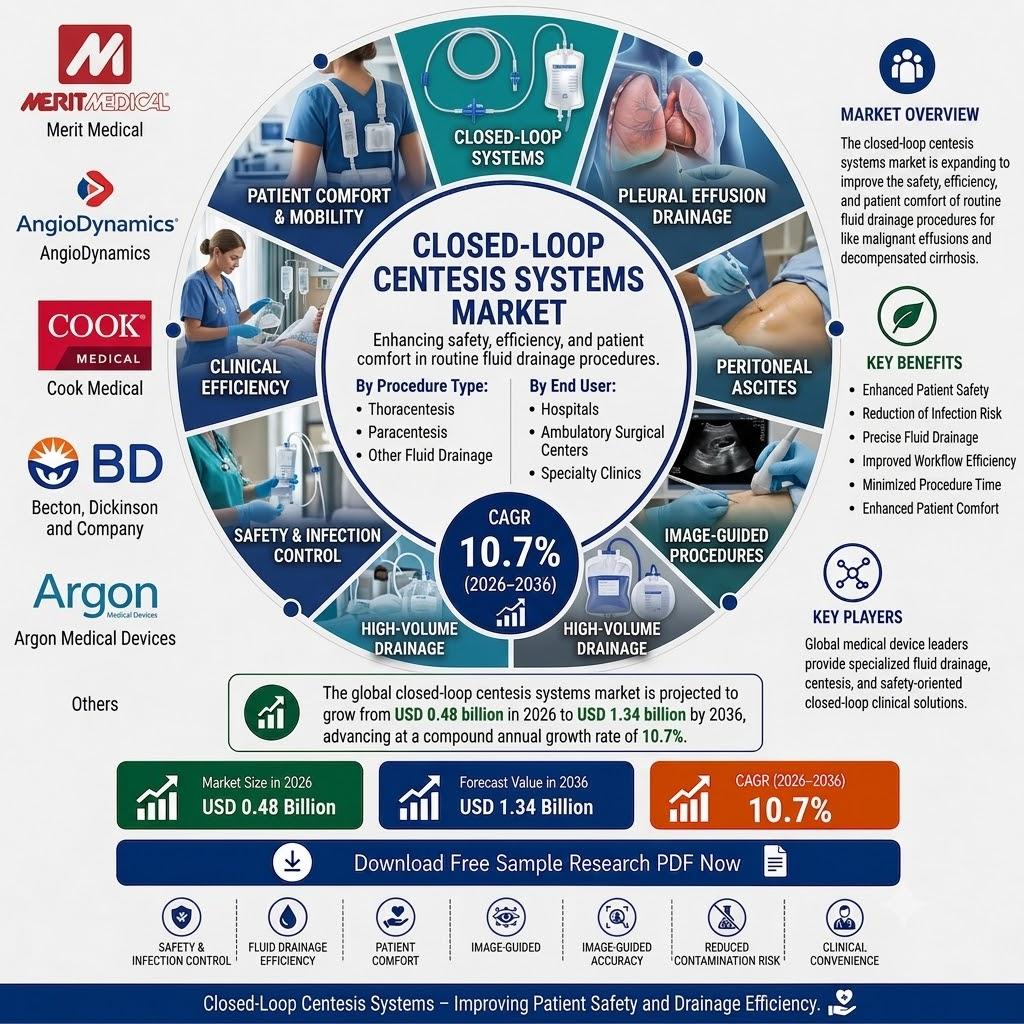
Demand for closed-loop centesis systems is set to rise from USD 0.48 billion in 2026 to USD 1.34 billion by 2036, reflecting a 10.7% CAGR throughout the forecast period, according to Fact.MR. The market is expected to add USD 0.86 billion in absolute opportunity during the next decade as healthcare providers increasingly seek safer and more controlled approaches to fluid drainage.
The shift is being supported by rising procedural volumes associated with fluid accumulation conditions, including pleural effusion and ascites. Hospitals are also placing greater emphasis on infection-controlled procedures, patient comfort, and reduced complications. Closed-loop systems address these requirements by replacing more manual drainage approaches with controlled fluid removal and integrated procedural components. Expansion of hospital infrastructure and outpatient procedural capacity is adding another layer of demand.
Get detailed market forecasts, competitive benchmarking, and pricing trends: https://www.factmr.com/connectus/sample?flag=S&rep_id=13396
Vacuum-Assisted Systems Hold the Leading Position
Vacuum-assisted systems account for 58.8% of systems-type share in 2026, making them the leading category in the closed-loop centesis systems market. Their position reflects the ability to provide physician-controlled negative pressure and more predictable fluid removal. This level of control is particularly relevant in higher-acuity procedures where the rate and volume of drainage need to be carefully managed.
The application landscape is led by thoracentesis, which represents 56.7% of market share in 2026. The procedure is widely used to drain pleural effusions associated with cancer, heart failure, and infection. Its role in providing immediate symptom relief while also enabling diagnostic fluid analysis creates recurring demand for dependable drainage systems.
Hospitals remain the principal end users, accounting for 72.5% of demand in 2026. These facilities handle complex patients with larger effusions, multiple comorbidities, or requirements for concurrent treatment. The concentration of interventional radiologists and pulmonologists, together with stringent sterile-procedure requirements, supports the concentration of closed-loop centesis system use in hospital procedure units and emergency departments.
India and China Drive Country-Level Growth
India is projected to record the highest CAGR among the countries analyzed by Fact.MR, at 14.9% from 2026 to 2036. The country's expansion is linked to the growth of tertiary-care hospital networks and increasing specialization in interventional pulmonology and radiology. Higher diagnosis rates for tuberculosis, cancer, and cardiac diseases associated with effusions are also contributing to greater procedural requirements.
China follows with a 14.7% CAGR through 2036. Modernization of hospital interventional departments and increasing emphasis on procedural standardization are supporting demand for closed-loop solutions. The country's expanding cancer-care infrastructure is creating additional requirements for efficient effusion management, particularly in major urban hospitals where vacuum-assisted systems are gaining traction.
The United Kingdom is forecast to expand at 12.0% CAGR, providing an important European growth market. Adoption is being shaped by clinical evidence and protocol-driven healthcare practices that emphasize technologies capable of reducing procedural risks. Replacement cycles and incorporation of closed-loop systems into hospital-level clinical guidelines are expected to support continued demand.
The report also identifies Brazil at 14.2% CAGR, the United States at 13.7%, and Germany at 11.8%. Brazil's outlook is associated with efforts to standardize high-volume procedures, while the U.S. market benefits from established interventional radiology and pulmonary practices. Germany's growth reflects demand in a protocol-driven healthcare environment where clinical evidence and procedural safety influence technology adoption.
Outpatient Capacity Opens New Opportunities
The expansion of ambulatory procedure centers is creating an opportunity for compact, user-friendly systems capable of supporting higher procedural throughput. As more healthcare facilities look for standardized workflows, ready-to-use centesis kits can simplify preparation and reduce procedural interruptions. Integration with ultrasound guidance and smart monitoring is another emerging direction, with systems increasingly being developed to support real-time needle tracking and monitoring of fluid characteristics and volume.
Cost remains a consideration. Disposable components used in closed-loop systems can have a substantially higher per-procedure expense than basic needle-and-syringe methods, potentially limiting adoption in cost-sensitive settings. Suppliers therefore need to demonstrate practical value through improved workflow, procedural control, and potential reductions in complications and resource use.
The market's development also reflects a broader transition from manual techniques toward integrated, safety-engineered clinical tools. Manufacturers are focusing on system ergonomics, safety needle designs, specialized kits, and solutions tailored to different clinical applications. For hospitals, consistency and ease of use are becoming increasingly relevant as procedural teams manage growing patient volumes.
Key Companies Focus on System Innovation
The competitive landscape includes Merit Medical, AngioDynamics, Cook Medical, Becton, Dickinson and Company (BD), and Argon Medical. These companies are competing through procedural kits, vacuum-assisted drainage technologies, specialized access devices, safety features, and distribution capabilities. The report highlights clinical evidence, system ergonomics, and workflow benefits as important areas of competition.
Merit Medical is profiled for its vacuum-assisted thoracentesis and paracentesis systems, while AngioDynamics participates with integrated fluid-management solutions. Cook Medical focuses on specialized access needles and catheters, whereas BD draws on its broader vascular-access and procedure-kit capabilities. Argon Medical offers vacuum-assisted drainage systems and safety needle devices for fluid evacuation.
As the closed-loop centesis systems market advances toward USD 1.34 billion by 2036, demand will remain connected to rising procedural volumes, hospital infrastructure expansion, infection-control priorities, and the transition toward controlled drainage technologies. The full [LINK: Closed-Loop Centesis Systems Market report] offers detailed forecasts, segment analysis, country-level outlooks, market dynamics, and competitive intelligence for stakeholders assessing this healthcare technology market.
To View Our Related Reports
https://social.mytamam.com/blogs/42937/Immunohistochemistry-Market-to-Reach-USD-5-26-Billion-by-2036
https://net-pals.com/blogs/40346/Immunohistochemistry-Market-Set-to-Reach-USD-5-26-Billion-by
https://uddokta64.com/blogs/9183/Global-Immunohistochemistry-Market-to-Hit-USD-5-26-Billion-by
https://acmingle.com/blogs/22705/Immunohistochemistry-Market-Poised-to-Reach-USD-5-26-Billion-by
About Fact.MR
Fact.MR is a market research and consulting firm providing market intelligence, industry analysis, and forecasting across global markets. Its research covers market size, demand trends, competitive developments, regional dynamics, and emerging opportunities across multiple industries.

 English
 Arabic
 French
 Spanish
 Deutsch
 Turkish
 Dutch
Dutch
 Italiano
 Russian
 Romaian
 Portuguese (Brazil)
 Greek
Greek
 Bengali