


How Laser Technology Is Creating New Opportunities in Welding Equipment
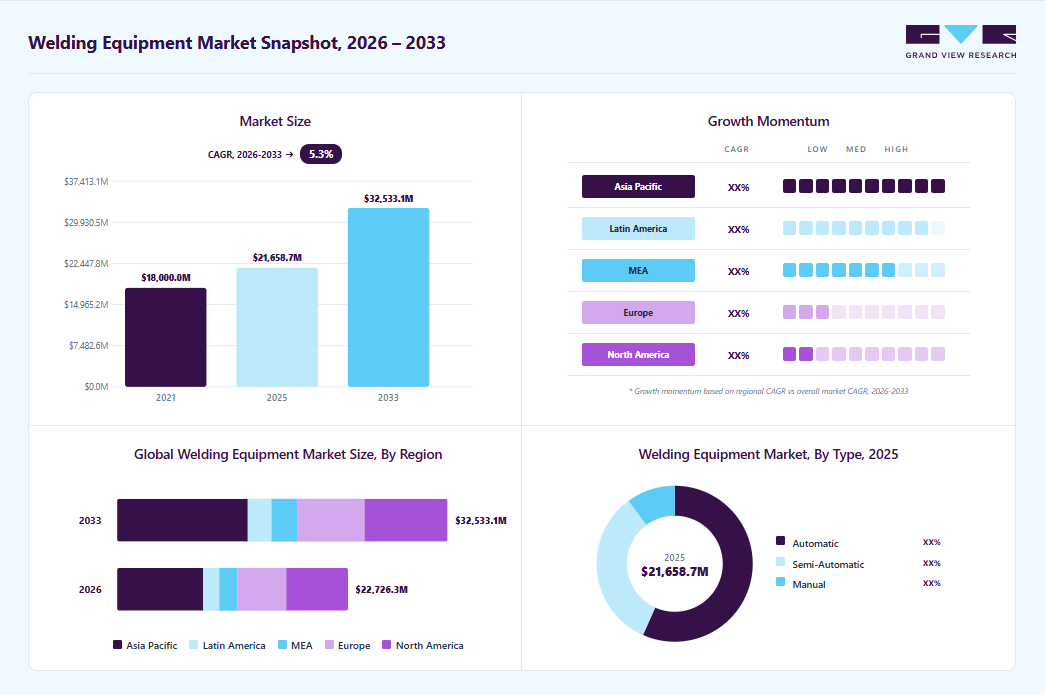
The welding equipment market is gaining momentum as construction, automotive, energy, aerospace, and heavy manufacturing industries continue investing in reliable joining technologies. The market was valued at USD 21,658.7 million in 2025 and is estimated to reach USD 22,726.4 million in 2026. By 2033, the market is projected to reach USD 32,533.1 million, expanding at a 5.3% CAGR from 2026 to 2033. Industrialization, infrastructure development, equipment replacement, and the transition toward automated manufacturing are supporting this expansion.
Industrial Activity Keeps Welding Equipment at the Center of Manufacturing
Welding remains fundamental to transportation, power generation, urban infrastructure, oil & gas, marine fabrication, and general manufacturing. Large-scale projects continue generating demand for arc and resistance welding systems, while fabrication and maintenance activities require equipment that can operate reliably across different environments.
The automotive sector represented 24.9% of market demand in 2025, making it the largest end-use contributor. High production volumes and extensive use of welded components across body-in-white, chassis, and powertrain manufacturing sustain equipment demand. Resistance, MIG, and laser welding technologies are widely used, while continued investments in electric vehicle production are creating additional opportunities for advanced welding systems.
Aerospace is also becoming an important technology-driven application. The segment is expected to register a 4.9% CAGR from 2026 to 2033, supported by aircraft production, lightweight structures, and demand for high-strength components.
Automation Is Changing the Economics of Welding
Manufacturers are increasingly moving from conventional manual processes toward automatic, robotic, and digitally controlled welding systems. Automatic welding equipment accounted for 56.7% of the market in 2025, reflecting its ability to improve productivity, consistency, and repeatability while reducing dependence on manual labor.
Integration with robotic production lines is particularly relevant for automotive, aerospace, and large-scale manufacturing. For smaller manufacturers, semi-automatic systems provide a middle ground between operator control and automation. This segment is projected to grow at a 5.1% CAGR from 2026 to 2033, supported by lower capital requirements and flexibility across fabrication, repair, and manufacturing applications.
Industry 4.0 adoption is further opening opportunities for connected welding equipment. Sensors, software, real-time monitoring, smart power sources, and digital controls are increasingly being incorporated to improve process visibility, quality, and productivity.
Arc Welding Holds the Base While Laser Technology Gains Ground
Arc welding continues to account for the largest technology share, representing 70.3% in 2025. Its versatility, cost-effectiveness, and broad industrial acceptance make it suitable for construction, oil & gas, shipbuilding, general fabrication, infrastructure, and repair activities.
At the same time, laser beam welding is gaining attention where manufacturers require precision, speed, and minimal material distortion. The technology is expected to register the fastest growth among the technology segments, with a 6.6% CAGR from 2026 to 2033. Its compatibility with robotic and automated systems makes it particularly relevant for high-volume production involving lightweight materials and complex assemblies.
Safety, Efficiency, and Equipment Replacement Create Additional Demand
Beyond new industrial projects, replacement of aging equipment represents a steady source of market expansion. Manufacturers are upgrading older systems to improve productivity, safety, energy efficiency, and weld quality.
Worker safety and environmental requirements are also influencing equipment development. Demand is increasing for safer, low-fume, and ergonomically designed systems, while environmental considerations encourage cleaner technologies such as laser and advanced arc welding.
However, advanced systems can involve substantial initial investment and maintenance costs, which may restrict adoption among small and medium enterprises. Skilled labor shortages can also make it difficult to fully utilize automated and high-precision equipment. Raw material price volatility and delayed capital expenditure in some areas add further pressure.
Regional Manufacturing Strength Supports Market Expansion
Asia Pacific accounted for the largest regional share at 37.0% in 2025, supported by strong manufacturing activity, infrastructure development, fabrication capacity, and industrial automation. China, India, and Southeast Asian countries contribute significantly to demand across automotive, construction, and heavy industries.
North America is expected to expand at a 4.3% CAGR, supported by advanced manufacturing, automotive, aerospace, energy, automation, and replacement demand. Europe is seeing continued adoption of laser and robotic systems as industrial modernization, safety, environmental standards, and sustainability influence equipment investment.
The Middle East and Africa market benefits from oil & gas, power, construction, pipeline, and structural fabrication projects, while Latin America is supported by infrastructure and manufacturing expansion.
FAQs
What trends are shaping the welding equipment market?
Automation, robotic welding, laser technology, digital controls, Industry 4.0 integration, real-time monitoring, equipment replacement, safety requirements, and demand for higher productivity are shaping the market. Customized, application-specific welding solutions are also creating opportunities for technology-focused manufacturers.
Which segment leads the welding equipment market?
Arc welding led the technology landscape with a 70.3% share in 2025, while automatic welding equipment held 56.7% of the market by type. The automotive sector represented 24.9% of demand by end use in 2025.
Key Welding Equipment Companies:
· The Lincoln Electric Company
· ACRO Automation Systems, Inc
· Miller Electric Mfg. LLC
· Ador Welding Limited
About us:
Grand View Research, a market research and consulting company, provides syndicated research reports, customized research reports, and consulting services. Grand View Research database is used by the world's renowned academic institutions and Fortune 500 companies to understand the global and regional business environment. Our database features thousands of statistics and in-depth analysis on 46 industries in 25 major countries worldwide.

 English
 Arabic
 Spanish
 Portuguese
 Deutsch
 Turkish
 Dutch
Dutch
 Italiano
 Russian
 Romaian
 Portuguese (Brazil)
 Greek
Greek
 Bengali