


Healthcare Payer Services Market Size, Share, Industry Trends, Analysis and Forecast 2026-2034
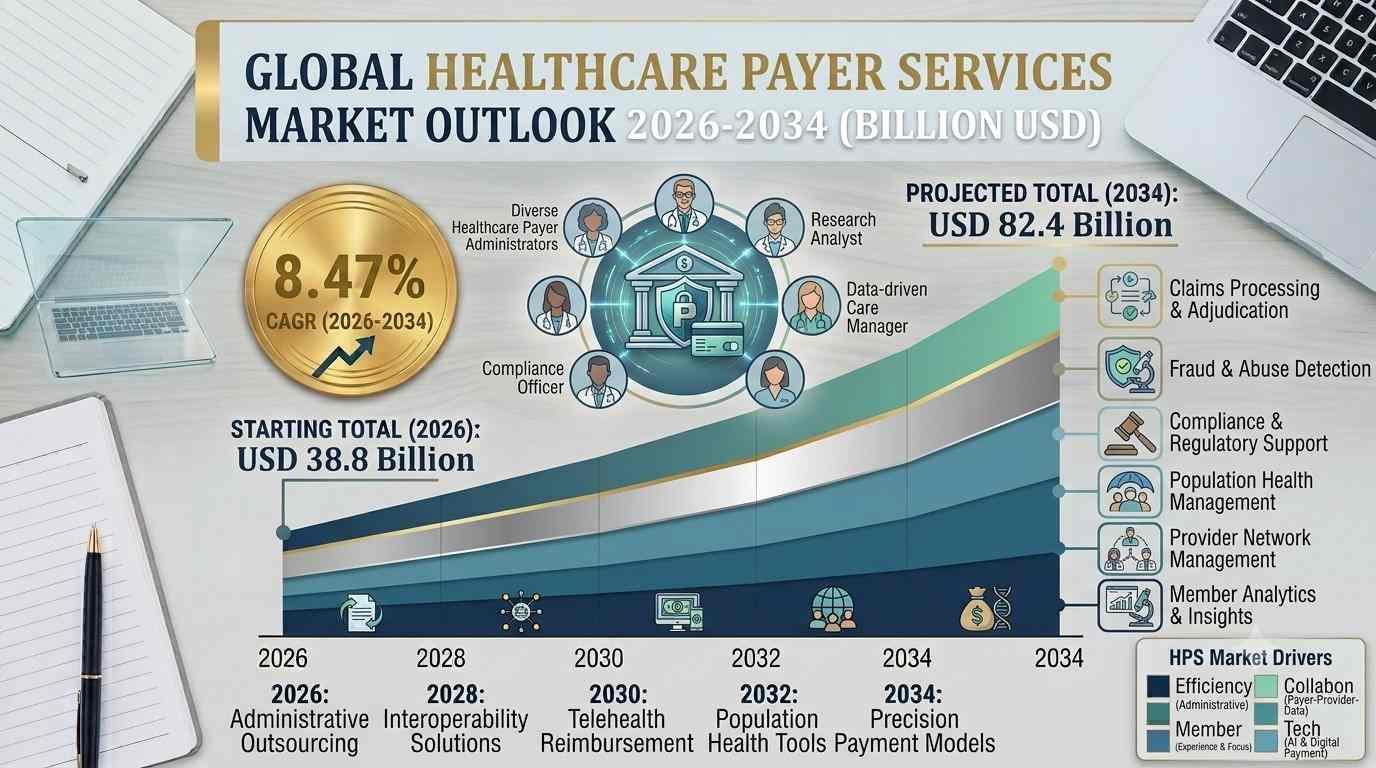
According to IMARC Group, the global healthcare payer services market size reached USD 38.8 Billion in 2025 and is projected to reach USD 82.4 Billion by 2034, expanding at a CAGR of 8.47% during 2026–2034. This robust healthcare payer services market growth reflects rising healthcare costs, the growing adoption of artificial intelligence and data analytics, an increasing aging population, the growing importance of healthcare data security, and the shift toward value-based care models.
Healthcare Payer Services Industry Overview
Healthcare payer services are the outsourced administrative, operational, and analytical functions that health insurers and other payers rely on to run their businesses efficiently. Rising healthcare costs are propelling payers to outsource non-core activities such as claims processing, member services, and analytics, which reduces administrative burdens and improves service quality. By partnering with specialized providers, payers gain access to the expertise, technology infrastructure, and scalable solutions that would be costly and time-consuming to build in-house.
Healthcare payer services are deployed across a broad range of functions:
- Claims management: Data entry, verification, and processing of insurance claims, supported by automation and analytics for faster, more accurate reimbursement
- Analytics and fraud management: Analysis of claims, clinical records, and patient histories to detect fraud, waste, and abuse and to support population health management
- Member management: Enrollment, customer support, and policy management services that improve member experience and retention
- Provider management: Provider network management and payer–provider communication that streamlines healthcare delivery
- Billing and accounts management: Billing, accounts, and related back-office operations that reduce administrative overhead
- Integrated front office, back office, and HR services: End-to-end operational support that lets payers focus on their core competencies
Global Healthcare Payer Services Market Size & Key Statistics
Below are the key healthcare payer services market statistics drawn from IMARC Group’s comprehensive market analysis:
|
Report Attribute |
Key Statistics |
|
Base Year |
2025 |
|
Historical Period |
2020–2025 |
|
Forecast Period |
2026–2034 |
|
Healthcare Payer Services Market Size in 2025 |
USD 38.8 Billion |
|
Market Forecast in 2034 |
USD 82.4 Billion |
|
Market Growth Rate (2026–2034) |
8.47% CAGR |
|
Largest Region |
North America (74.9% share in 2025) |
|
Leading Type Segment |
BPO Services |
|
Leading Application |
Claims Management Services (33.8% share in 2025) |
|
Leading End-Use Segment |
Private Payers (59.0% share in 2025) |
Request for a Sample Report for Detailed Healthcare Payer Services Market Size Evaluation: https://www.imarcgroup.com/healthcare-payer-services-market/requestsample
Key Market Drivers & Healthcare Payer Services Market Trends in 2026
Several powerful forces are shaping Healthcare Payer Services Market Trends and fuelling sustained growth expectations across the global healthcare administration landscape:
1. Increasing Implementation of Digital Technologies in Payer Operations
As healthcare systems embrace digital transformation, payers must adopt cutting-edge technologies to remain competitive and efficient. The World Bank’s commitment to increase digital health spending from 6% to 8% by 2030 underscores the rising significance of digital health worldwide. Artificial intelligence, machine learning, data analytics, and automation are transforming payer operations by enabling streamlined claims processing, fraud detection, and data-driven decision-making. Payers are turning to specialized service providers that offer the expertise and infrastructure needed to navigate digital integration — including telehealth support and digital claims processing — a shift accelerated by the COVID-19 pandemic.
2. Rising Adoption of Analytics in Healthcare
Analytics has become a linchpin of the healthcare industry, helping payers sift through massive volumes of claims, clinical records, and patient histories to identify trends, patterns, and anomalies that might otherwise go unnoticed. This strengthens fraud detection and prevention, improves operational efficiency, and supports population health management by enabling payers to address members’ health needs proactively. According to an industry report, the global big data market in healthcare was valued at USD 67 Billion in 2023 and is projected to grow at a CAGR exceeding 19% during 2023–2035 — making analytics expertise a key catalyst for Healthcare Payer Services Market Growth.
3. Escalating Number of Individuals Opting for Healthcare Insurance
Growing healthcare awareness and the importance of financial protection against medical expenses are pushing more individuals to seek insurance coverage. According to World Economic Forum data, the healthcare insurance sector is anticipated to be strengthened by a 99.5% growth in chronic illnesses by 2050, reflected in rising private health insurance purchases. In the UK, the number of insured people increased by 83% between 2021 and 2022, reaching 11.7 million. This expanding insured base drives higher volumes of claims, policy management, and member services, prompting payers to rely on specialized providers for claims processing, member enrollment, and customer support.
4. Rising Healthcare Costs and the Push for Cost-Effective Outsourcing
Increasing healthcare costs are propelling the need for cost-effective healthcare delivery and enhanced operational efficiency among payers. Outsourcing non-core activities such as claims processing, member services, and analytics reduces administrative burdens and improves service quality, while allowing payers to redirect resources toward patient care, research, and innovation.
5. Shift Toward Value-Based Care Models
The shift toward value-based care is driving payers to seek innovative service providers that can help them achieve better outcomes. In the United States, the growth of value-based payment models — which tie reimbursement to patient outcomes — is encouraging payers to invest in analytics and care management services.
6. Stringent Regulatory Compliance and Data Security Requirements
Changing healthcare regulations and compliance requirements, together with the growing importance of healthcare data security, are pushing payers toward specialized partners. Regulations such as HIPAA in the United States and GDPR in Europe compel payers to follow stringent compliance criteria, while the need for scalable solutions to manage the growing volume of healthcare data further supports outsourcing.
7. Aging Population and Rising Chronic Disease Prevalence
An increasing aging population and the rising prevalence of chronic diseases are raising demand for efficient healthcare management. In Europe, people aged 65 and above accounted for over 20% of the population as of 2023, fuelling demand for care management services that help reduce costs and improve outcomes. Rising patient demand for personalized and accessible healthcare experiences further strengthens the case for high-quality payer services.
Key Market Segmentation
By Type
BPO Services — Largest Segment: BPO services lead the market in 2025, covering critical functions such as claims processing, enrollment, billing, and member services. Outsourcing these processes to specialized BPO providers helps payers significantly reduce operational costs, while providing the scalability to adjust requirements as regulations and market dynamics change. BPO providers’ expertise and technology infrastructure streamline processes, reduce errors, and improve claims turnaround, customer service, and the overall member experience.
ITO Services: Information technology outsourcing services support payers’ digital infrastructure and technology-enabled operations as they adopt AI, analytics, and automation across claims adjudication, enrollment, and member-facing platforms.
KPO Services: Knowledge process outsourcing services deliver expertise-driven support such as analytics and decision support, helping payers turn large volumes of healthcare data into actionable insights.
By Application
Claims Management Services — Largest Application: Claims management services lead the market with a 33.8% share in 2025. Outsourcing this critical function allows payers to offload data entry, verification, and processing to specialized providers, resulting in quicker claims resolution, reduced errors, and improved customer satisfaction. Providers use advanced automation and data analytics to speed up reimbursement, identify potential fraud or errors, and help payers control costs and scale services in line with fluctuating claims volumes.
Analytics and Fraud Management Services: Advanced analytics helps payers identify trends, patterns, and anomalies across claims and clinical data, supporting fraud detection and prevention, predictive analytics, and proactive population health management.
Integrated Front Office Service and Back Office Operations: End-to-end operational support that brings claims, member engagement, and customer support under one roof, reducing complexity for payers.
Member Management Services: Member enrollment and customer support services that help payers deliver a seamless experience for policyholders and improve retention.
Provider Management Services: Provider network management services that streamline payer–provider communication and support efficient healthcare delivery.
Billing and Accounts Management Services: Billing and accounts support that reduces administrative overhead and improves the accuracy of financial operations for payers.
HR Services: Human resources support that lets payers redirect internal resources toward core healthcare operations.
By End Use
Private Payers — Largest End-Use Segment: Private payers, including insurance companies and employer-sponsored health plans, lead the market with a 59.0% share in 2025. They seek efficiency and cost containment, and outsourcing complex claims, enrollment, and customer service processes brings a competitive advantage. High-quality customer service and efficient claims processing are essential to member satisfaction and retention, while service providers offer the flexibility to scale up or down with membership and claims volumes and the compliance expertise to navigate ever-changing regulations.
Public Payers: Government initiatives aimed at expanding healthcare access and improving affordability are encouraging public payers to adopt innovative, cost-efficient service models, supported by the digitalization of claims adjudication and enrollment services.
Regional Healthcare Payer Services Market Analysis
|
Region |
Key Highlights |
|
North America — Largest |
United States & Canada; over 74.9% share in 2025, complex public and private payer network, HIPAA-driven data compliance, expanding adoption of digital health, electronic health records, and telemedicine |
|
Europe |
Germany, France, UK, Italy, Spain, Russia; focus on digital healthcare and universal coverage, European Health Data Space encouraging advanced IT adoption, GDPR compliance needs, over 20% of the population aged 65+ as of 2023 |
|
Asia-Pacific |
China, Japan, India, South Korea, Australia, Indonesia; expanding health insurance coverage and healthcare digitization, India’s Ayushman Bharat targeting 50+ crore people, China’s healthcare spending above USD 49 Billion in 2023 |
|
Latin America |
Brazil, Mexico; Brazil’s Unified Health System (SUS) and Mexico lead with coverage for over 70% of the population, rising private insurance uptake, health expenditure growing at a 3.2% CAGR during 2018–2050 |
|
Middle East & Africa |
Saudi Arabia, UAE, GCC countries; GCC healthcare spending anticipated to reach USD 135.5 Billion by 2027, mandatory health insurance plans, digital transformation boosting member services and claims management |
North America leads the global Healthcare Payer Services Market with a share of over 74.9% in 2025, underpinned by a highly developed healthcare industry with a complex network of public and private payers, robust regulatory frameworks, increasing healthcare expenditures, and the growing adoption of outsourcing for administrative services. The rapid expansion of digital health solutions, electronic health records, and telemedicine, combined with the region’s commitment to data security and compliance under regulations such as HIPAA, continues to strengthen demand.
The United States is the pivotal market within the region. According to the Centers for Medicare & Medicaid Services, U.S. healthcare spending grew 4.1% in 2022 to reach USD 4.5 Trillion, or USD 13,493 per person, pushing payers to outsource administrative and operational duties. More than 40% of outsourced payer services revolve around claims processing, and in 2023, AI-driven claims adjudication increased speed and accuracy by 30%–50% while reducing errors by 30%–50%.
Asia-Pacific is witnessing rapid Healthcare Payer Services Market Growth as health insurance coverage expands and healthcare systems digitize. India’s Ayushman Bharat program aims to insure more than 50 crore people, while China spent more than USD 49 Billion on healthcare in 2023, reflecting the region’s commitment to upgrading healthcare infrastructure and adopting telemedicine and mobile health solutions.
Connect for Detailed Healthcare Payer Services Market Growth Analysis — Speak to an Analyst: https://www.imarcgroup.com/request?type=report&id=3879&flag=C
Leading Players in the Global Healthcare Payer Services Industry
The global healthcare payer services market features a mix of global IT, consulting, business process management, and healthcare services companies. Top players are strengthening their positions by investing in AI, data analytics, and automation, prioritizing data security and compliance, offering end-to-end solutions across claims management, member engagement, customer support, and analytics, and staying agile in response to policy and technology changes. Key companies covered in the IMARC Group report include:
|
Company |
Core Focus Area |
|
Accenture plc |
Consulting, technology, and operations services with expanding healthcare payer capabilities |
|
Cognizant Technology Solutions Corporation |
Digital, IT, and business process services, including generative AI healthcare solutions |
|
Concentrix Corporation |
Customer experience (CX) solutions and technologies |
|
ExlService Holdings Inc. |
Analytics and digital operations services |
|
Genpact Limited |
Digital operations and professional services |
|
HCL Technologies Limited |
IT and business process services |
|
Hinduja Global Solutions Limited |
Business process management and customer experience services |
|
HP Development Company L.P. |
Technology and enterprise services |
|
McKesson Corporation |
Healthcare services and supply solutions |
|
UnitedHealth Group Incorporated |
Diversified health care and insurance services |
|
Wipro Limited |
IT services and business process outsourcing |
|
Xerox Corporation |
Business process, document, and digital services |
Latest Healthcare Payer Services Market Industry Developments
October 2024 — Accenture
Accenture acquired healthcare consulting company Consus Health, integrating its value-based care and payer–provider collaboration skills to strengthen Accenture’s capabilities in healthcare payer services. The acquisition aligns with Accenture’s plan to grow its healthcare consulting business and provide solutions that enhance patient outcomes and lower healthcare system expenses.
September 2024 — CorroHealth
CorroHealth completed the acquisition of Navient’s healthcare revenue cycle management (RCM) division, a strategic portfolio expansion expected to strengthen its capacity to offer complete RCM solutions — including coding, auditing, and financial management services — that increase healthcare providers’ efficiency and compliance.
August 2023 — Accenture
Accenture plc acquired ATI Solutions Group (ATI), a Perth-based consulting service provider, to help clients in Australia automate field operations efficiently and quickly.
August 2023 — Cognizant
Cognizant announced that it would leverage Google Cloud’s generative AI technology to develop innovative healthcare large language model (LLM) solutions, harnessing generative AI to address a range of healthcare-related business challenges and reinforcing the technology-led Healthcare Payer Services Market Trends.
March 2023 — Concentrix
Concentrix Corporation, a prominent global provider of customer experience (CX) solutions and technologies, announced a strategic agreement to merge with Webhelp in a transaction valued at around USD 4.8 Billion, including net debt.
About Us
IMARC Group is a leading global market research company providing data-driven insights and expert consulting services to businesses seeking to achieve their strategic objectives. With a multi-disciplinary team of industry experts, IMARC delivers thorough, reliable market intelligence across sectors including Healthcare, Technology, Chemicals, Energy, Food & Beverages, and more.
Contact Us
IMARC Group
United States: +1-201-971-6302
India: +91-120-433-0800
United Kingdom: +44-753-714-610

 English
 Arabic
 French
 Spanish
 Portuguese
 Deutsch
 Turkish
 Dutch
Dutch
 Italiano
 Romaian
 Portuguese (Brazil)
 Greek
Greek
 Bengali