


AI Search Visibility: How to Optimize Your Business for AI Search
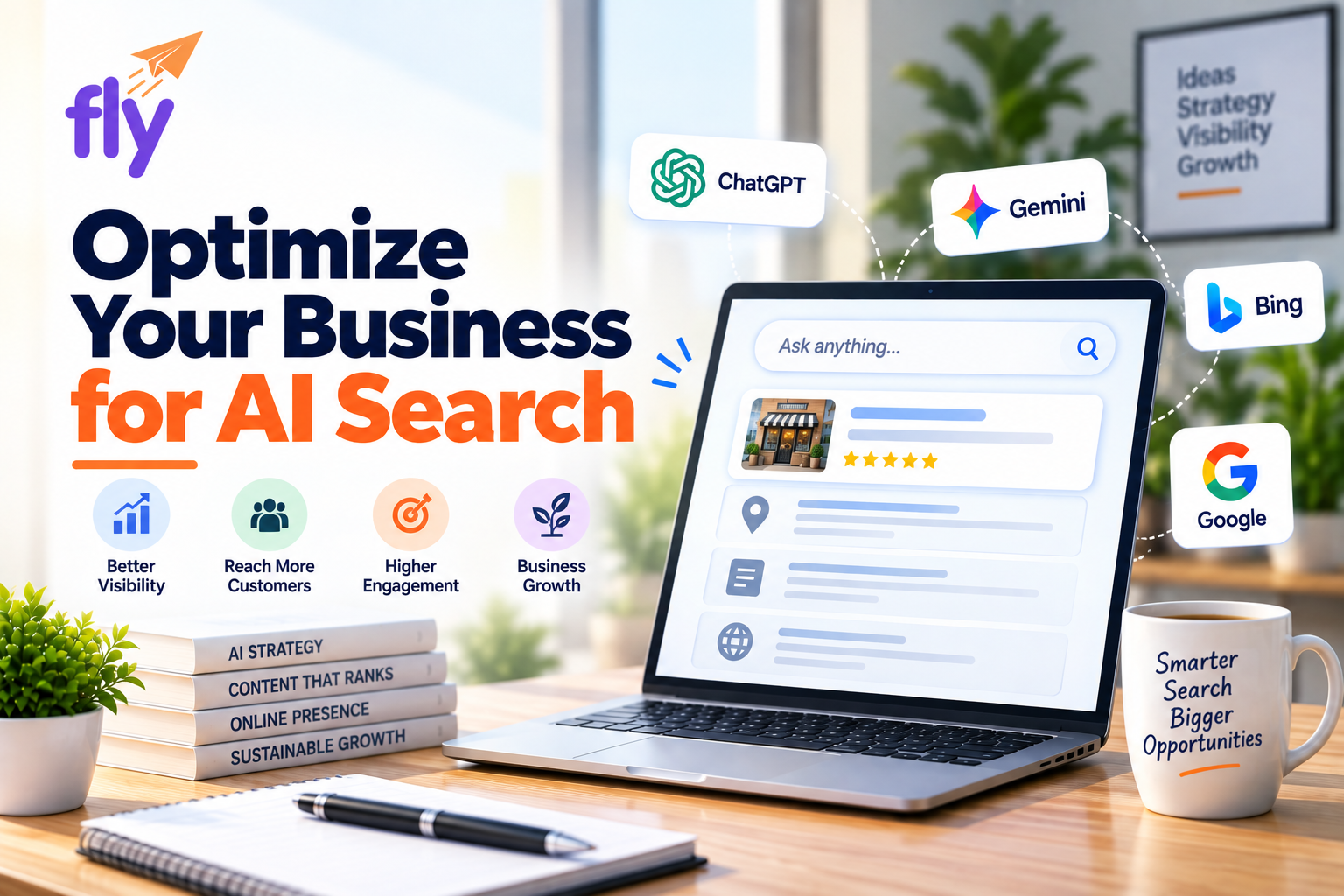
The way people search for businesses, products, and services is changing. Alongside traditional search engines, customers are increasingly using AI-powered platforms such as ChatGPT, Gemini, Claude, and Perplexity to ask questions, compare solutions, and research companies. Businesses can use an AI Search Visibility tool to examine how their brand appears across supported AI platforms, including brand mentions, website citations, visibility, and competitors appearing in relevant responses.
Optimizing for AI search does not mean abandoning traditional SEO or creating content only for AI systems. A stronger approach is to make your business information clear, useful, accessible, credible, and relevant wherever potential customers may discover it.
This involves combining SEO, Answer Engine Optimization (AEO), Generative Engine Optimization (GEO), quality content, strong brand information, and ongoing AI visibility measurement.
Understand How People Search With AI
Traditional searches are often short.
Someone looking for marketing software might search:
“social media management software”
When using an AI assistant, the same person might ask:
“What social media management software is suitable for a small agency managing multiple client accounts?”
The second query contains much more context.
It explains who the user is, what they need, and potentially what type of solution would be relevant.
Businesses should therefore think beyond individual keywords and understand the broader questions customers ask throughout their research journey.
Sales conversations, support inquiries, FAQs, customer reviews, website searches, and keyword research can all reveal useful questions.
These insights can guide both content creation and AI visibility testing.
Make It Clear What Your Business Does
One of the most important steps in AI search optimization is also one of the simplest: clearly explain your business.
A visitor should not need to read several pages before understanding what you offer.
Your website should communicate your primary products or services, who they are designed for, the problems they address, and relevant locations or markets where appropriate.
Avoid relying entirely on vague statements such as “innovating the future” or “empowering businesses through technology.”
Brand messaging can be creative, but important factual information should remain clear.
Review your homepage, About page, product pages, service pages, and contact information to ensure they accurately represent the business.
Keep Strong SEO Foundations
AI search optimization should build on good SEO rather than replace it.
A website still needs accessible pages, logical navigation, useful content, descriptive titles, meaningful headings, internal links, mobile usability, and appropriate technical foundations.
Search intent also remains important.
A person asking for a definition has a different need from someone comparing products or looking for a service provider.
Businesses should create pages around genuine user needs rather than producing multiple similar pages simply to target keyword variations.
Strong SEO creates an important foundation for visibility across the wider search environment.
Use AEO to Answer Questions Clearly
Answer Engine Optimization focuses on making useful answers easy to find and understand.
Businesses can start by identifying questions customers repeatedly ask.
For example:
What does the service include?
Who is it suitable for?
How does the process work?
What should someone consider before choosing a solution?
What is the difference between two available options?
When a page addresses a specific question, provide a direct answer and then add the necessary explanation.
Avoid making readers work through several paragraphs of generic introduction before reaching the information they need.
Clear answers improve the experience for human readers while supporting content designed for conversational search.
Create Content Based on Genuine Expertise
AI search optimization should not encourage businesses to produce more generic articles.
Instead, look for information your company is genuinely qualified to provide.
This might include first-hand observations, real processes, original research, technical documentation, common customer problems, practical examples, or case studies shared with appropriate permission.
For example, an agency could explain recurring problems found during real website audits instead of publishing another generic article about the importance of having a website.
A software company could document implementation questions customers regularly ask.
Useful first-hand knowledge can differentiate your content from pages that simply repeat existing information.
Never invent statistics, research, customer results, or testimonials to make content appear authoritative.
Structure Your Content for Easy Understanding
Good content needs good organization.
Use descriptive headings, focused sections, clear explanations, logical internal links, and lists or tables when they genuinely improve readability.
A heading such as “What Does the Service Include?” provides more context than a vague heading such as “Learn More.”
Important information should also be available as readable text rather than existing only inside graphics or videos.
Structured data may be appropriate for supported page types, but businesses should not treat schema markup as a guaranteed way to gain AI mentions or citations.
The purpose of structure is to make information easier to understand, not to manipulate AI platforms.
Review Your Wider Digital Presence
AI search optimization should not focus exclusively on the company website.
Customers may encounter a business through traditional search, maps, social media, business profiles, reviews, directories, and other relevant sources.
Businesses can explore a broader collection of digital marketing tools to examine different parts of their online presence and identify areas that may require attention.
Review important profiles periodically.
Check whether business descriptions, services, contact information, website links, locations, and other important details are still accurate.
The goal is not to make every profile identical. It is to ensure that important factual information remains clear and consistent.
Build Credible Third-Party Visibility
A business's online presence extends beyond the information published on its own website.
Relevant third-party visibility can include genuine customer reviews, industry publications, professional directories, associations, partnerships, interviews, and media coverage.
Businesses should focus on legitimate opportunities that make sense for their industry.
Avoid artificial reviews, irrelevant directory submissions, low-quality backlinks, or mass-produced mentions designed only to create the appearance of authority.
A credible digital footprint should develop from genuine expertise, business activity, customer experiences, and professional relationships.
Understand AI Mentions and Citations
Businesses should also understand what they are measuring.
An AI brand mention occurs when an AI-generated response names a business, product, or service.
A citation occurs when a website or page is referenced as a source.
These are not necessarily the same thing.
Your business might be mentioned without its website being cited. A page from your website may also be referenced without your company receiving prominent attention in the answer.
Monitoring both provides a more complete understanding of AI search visibility.
Analyze Which Competitors Are Appearing
Competitor visibility can reveal useful information.
If competing businesses repeatedly appear for relevant AI queries while your company does not, investigate their wider digital presence.
Do they explain their products or services more clearly?
Do they answer questions your website overlooks?
Have they published useful research, guides, documentation, or comparisons?
Are they referenced by credible third-party sources?
Competitor research should help identify information gaps rather than encourage copying.
Look for opportunities to provide something clearer, more complete, more accurate, or more original.
Measure AI Visibility Using Relevant Prompts
AI search visibility should be measured using questions connected to genuine customer intent.
Avoid testing random prompts simply to increase the number of queries in a report.
Consider questions customers might ask while identifying a problem, researching possible solutions, comparing providers, or preparing to make a purchase.
Then evaluate patterns across different AI platforms.
Which prompts produce brand mentions?
When is your website cited?
Which competitors appear?
Which topics are associated with your company?
This provides more meaningful information than trying to identify one universal “AI ranking position.”
Monitor Changes Instead of Expecting Fixed Rankings
AI-generated answers can vary.
Different models, platforms, prompts, context, available information, and retrieval methods can influence what appears in a response.
For this reason, businesses should avoid treating one result as permanent.
Create a consistent set of relevant prompts and monitor them periodically.
Look for broader patterns rather than reacting to every individual change.
If your brand consistently fails to appear around an important topic, investigate whether your website clearly covers that subject and whether your wider digital presence supports it.
Measurement should lead to better questions and better decisions.
Final Thoughts
Optimizing your business for AI search is not about finding a secret technique that forces AI platforms to mention your company.
It is about improving the quality of the information surrounding your business.
Clearly explain what you do. Build a useful and technically accessible website. Strengthen traditional SEO. Answer genuine customer questions. Structure content logically. Share real expertise. Maintain accurate information across important platforms and develop a credible presence beyond your own website.
Then use AEO, GEO, and AI visibility measurement to understand how your business appears as search behavior evolves.
No optimization strategy can guarantee that ChatGPT, Gemini, Claude, Perplexity, or another AI platform will mention, cite, or recommend a particular business.
The more sustainable goal is to create a clear, accurate, useful, trustworthy, and discoverable digital presence.
When customers search through Google, AI assistants, social platforms, Maps, or other channels, strong information gives them a better opportunity to understand what your business offers and whether it is relevant to their needs.

 English
 Arabic
 French
 Spanish
 Deutsch
 Turkish
 Dutch
Dutch
 Italiano
 Russian
 Romaian
 Portuguese (Brazil)
 Greek
Greek
 Bengali