


How Digital Marketing Agencies Use AI to Improve Marketing Results
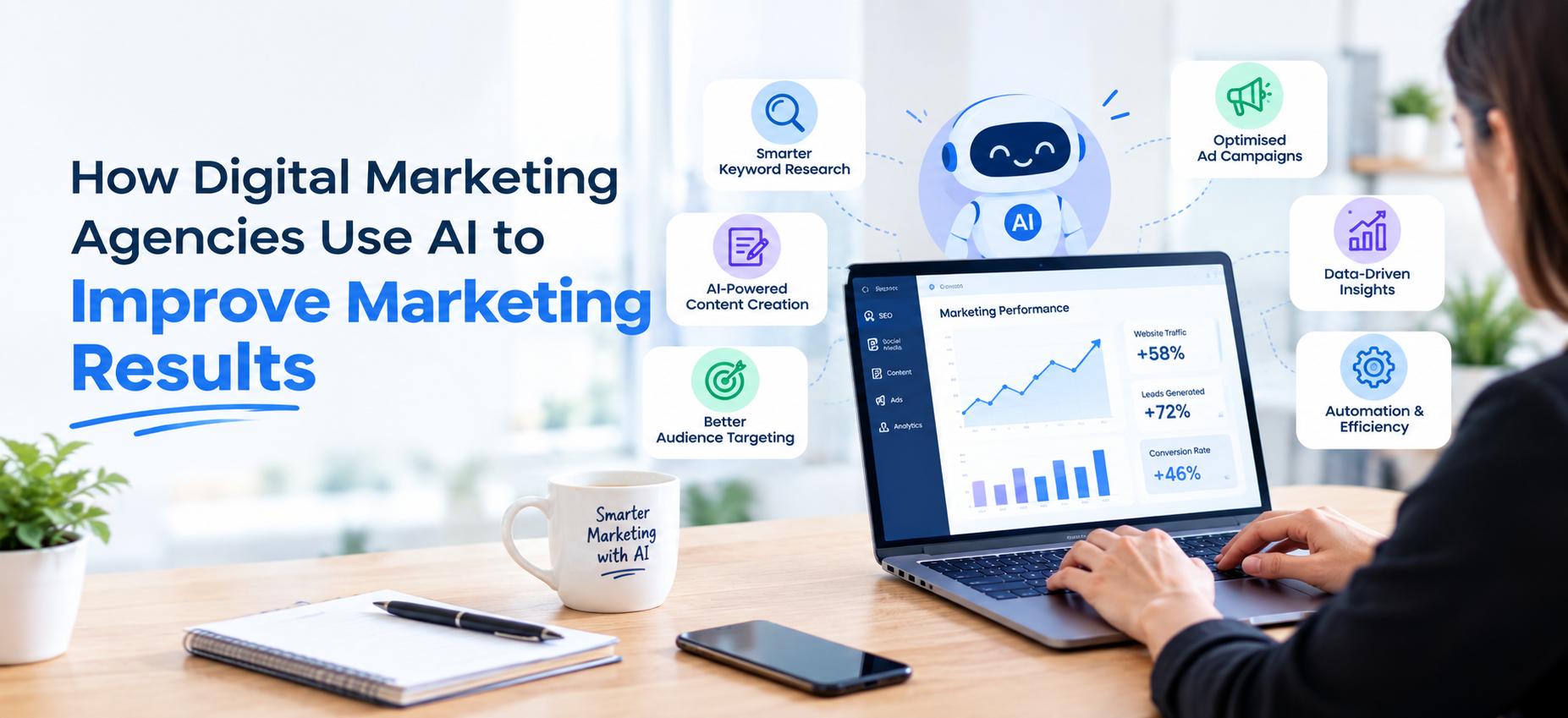
AI is everywhere in marketing conversations right now. Some agencies say it will replace half the team. Others avoid mentioning it at all. If you're a business owner, you probably just want to know: does it actually help, and should I care whether my digital marketing agency uses it?
This guide gives a grounded answer. We'll look at where AI genuinely improves results, where it falls short and how to ask the right questions. We use AI tools at NFlow as helpers, not replacements for thinking, and that view shapes what follows.
What "AI in Marketing" Really Means
When people say AI in marketing, they usually mean a few different things:
-
Generative AI, tools that draft text, images, code or ideas from a prompt.
-
Machine learning in ad platforms, such as automated bidding and audience targeting built into Google Ads and Meta.
-
Predictive analytics, using data to forecast which leads or customers are most likely to convert.
-
Automation, software that handles repetitive tasks like scheduling, reporting and email triggers.
-
Conversational tools, including chatbots for support and lead capture.
Some of these have been around for years. What's new is how accessible and fast generative tools have become.
Where AI Helps Agencies Most
Used well, AI saves time on routine work, which lets specialists spend more energy on strategy and creativity. Here are the main areas.
Research and Analysis
AI can summarize large amounts of information quickly: competitor content, customer reviews, search trends and survey responses. It can group keywords by topic, spot patterns in customer feedback and highlight questions people ask again and again. A strategist still decides what matters, but the first pass takes less time.
Content Ideas and First Drafts
AI can suggest topics, outlines, headlines and rough drafts. This speeds up the early stages of content creation. However, a raw AI draft is rarely good enough on its own. It tends to be generic, and sometimes wrong. The best results come when a subject expert adds real experience, examples and accuracy checks, then an editor polishes the tone.
SEO Support
AI tools can help with keyword clustering, meta description drafts, internal link suggestions, schema markup and technical audits. They can also help analyze search results to see what kind of content ranks. Again, the human choice about which opportunities to pursue and how to serve the reader remains critical.
Paid Advertising
Ad platforms increasingly use machine learning to adjust bids and find audiences. Agencies use AI to create ad copy variations, test multiple creatives and analyze performance faster. But success still depends on feeding the systems good data, clear goals and strong offers. Automation without oversight can spend a lot of money in the wrong direction.
Personalization
AI can help tailor emails, product recommendations and website content to different customer groups based on behavior. When done thoughtfully, this makes marketing feel more relevant and less generic.
Reporting and Insights
AI can compile data from several sources, flag unusual changes and draft plain-language summaries. This cuts down manual reporting time so the team can spend more on interpreting results and deciding actions.
Customer Support and Lead Capture
Chatbots can answer common questions and collect basic details at any hour. They work best when they're clear about being automated and can hand off to a real person easily.
What AI Can't Do Well
It's just as important to know the limits.
It doesn't have real experience. AI can describe how something works, but it hasn't done the work. Content about health, finance, legal matters, or any topic where accuracy matters needs real expert input.
It can be confidently wrong. AI tools sometimes produce facts, statistics or quotes that sound convincing but are false. Every claim needs checking.
It can sound bland. Unedited AI writing often reads the same as everyone else's. Your brand voice, stories and opinions are what make you different.
It doesn't understand your business. It can't sit in on your sales calls, sense customer mood or know your local market the way your team does.
It can't take responsibility. If something goes wrong, a person has to be accountable.
AI and Search Engines: What It Means for Content
Search engines have said that they focus on the quality and helpfulness of content, regardless of how it's made. Content produced mainly to manipulate rankings, with little value for readers, is discouraged. Meanwhile, helpful content that shows real experience, expertise and trustworthiness tends to be favored.
For agencies, this means using AI as an assistant, not a factory. Publishing large volumes of untouched AI text is risky and rarely effective. A better approach is fewer, stronger pieces with real insight, original examples and clear authorship.
Search itself is also changing, with AI-generated summaries appearing in some results. That makes clear expertise, strong brand recognition and trustworthy sources even more valuable. Agencies are adapting by making content easier to understand, well-structured and useful enough to be cited or clicked.
We look at wider trends in top digital marketing services for growing online in 2026.
Human Oversight: The Part That Matters Most
The healthiest way to think of AI is as a fast, tireless junior assistant. It can draft, sort and suggest, but it needs supervision. A good agency will have people who:
-
Set the strategy and goals.
-
Check facts and sources.
-
Add original experience and examples.
-
Edit for tone and clarity.
-
Watch performance and change course.
-
Make ethical decisions about data and claims.
This human layer is where quality and trust come from.
Data Privacy and Ethics
Using AI raises real questions. Agencies should be careful about what data they put into AI tools. Customer details, confidential plans and private information shouldn't be pasted into tools without checking how that data is stored and used.
Transparency matters too. If AI-generated images or chatbots are used, customers shouldn't be misled about it. And no one should use AI to create fake reviews, fake testimonials or false claims.
Ask your agency about their policies. A trustworthy agency will have thought about this.
Questions to Ask Your Agency About AI
-
Which parts of your process use AI, and which are done by people?
-
How do you check facts and quality in AI-assisted content?
-
How do you protect my business and customer data?
-
Will my content be original and reflect my brand voice?
-
Do you disclose when AI is used in customer-facing tools?
-
What do you do when AI gets something wrong?
Good answers are specific and calm. Be careful of two extremes: agencies who claim AI does everything, and agencies who claim they never use it and won't explain why.
Add these to the list in how to choose a digital marketing agency.
Will AI Make Agencies Cheaper?
Possibly, for some tasks. If AI saves hours on routine work, a fair agency may pass some benefit to clients through faster delivery or more output for the same fee. But cost isn't only about hours. You're paying for judgment, strategy and accountability, which AI doesn't replace.
Be wary if a low price is justified by "AI does it all." That can mean thin, generic work.
For today's typical fees, see how much a digital marketing agency costs in 2026.
Practical Ways AI Can Help You Today
Even outside an agency, small businesses can benefit from simple uses of AI: drafting first versions of emails, summarizing customer reviews, brainstorming content ideas, or turning a long transcript into a short post. The rule is to treat the result as a starting point, add your own knowledge and double-check the details.
A Practical Example of Human and AI Working Together
Imagine an agency writing a guide for a legal services firm. AI might help gather common client questions, group them into themes and suggest an outline. A lawyer at the firm then adds real case insights, the writer shapes the draft into a clear, friendly voice and an editor checks every fact and claim. The final piece is faster to produce than one written from scratch, but it still carries the experience and accountability that readers and search engines look for.
How NFlow Uses AI
At NFlow, we use AI to speed up research, organize data and draft early ideas, and we rely on experienced people to guide strategy, check accuracy and give content a real voice. We believe customers can tell the difference between something written with care and something churned out. We're open about how we work, and we're happy to explain how AI fits into your project.
Conclusion
AI is a powerful helper for digital marketing agencies. It speeds up research, drafting, testing and reporting, and it can make campaigns smarter. But it works best when people stay in charge: setting direction, checking facts, adding experience and making judgment calls.
When you talk to an agency about AI, ask how it's used, how it's checked and how your data is protected. If you'd like to see how we combine smart tools with real expertise, the NFlow team is happy to explain.

 English
 Arabic
 French
 Spanish
 Deutsch
 Turkish
 Dutch
Dutch
 Italiano
 Russian
 Romaian
 Portuguese (Brazil)
 Greek
Greek
 Bengali