


Smart Personal Protective Equipment Market: Future Trends
Introduction
The Smart Personal Protective Equipment Market is evolving as industries adopt connected safety technologies that combine traditional protective equipment with sensors, communication systems, data analytics, and intelligent monitoring. Smart PPE can help workers and supervisors identify hazards, monitor environmental conditions, and improve safety awareness in demanding workplaces.
Industries such as construction, manufacturing, mining, oil and gas, utilities, healthcare, and transportation are increasingly exploring connected safety solutions. The development of wearable sensors, Internet of Things (IoT) platforms, Artificial Intelligence (AI), and cloud-based monitoring is expanding the role of personal protective equipment beyond basic physical protection.
The market is also influenced by workplace safety regulations, industrial automation, workforce digitization, and growing interest in predictive safety management. These factors are creating opportunities for smart helmets, connected protective clothing, intelligent footwear, sensor-enabled gloves, and other digitally integrated safety equipment.
Smart Personal Protective Equipment Market Size:
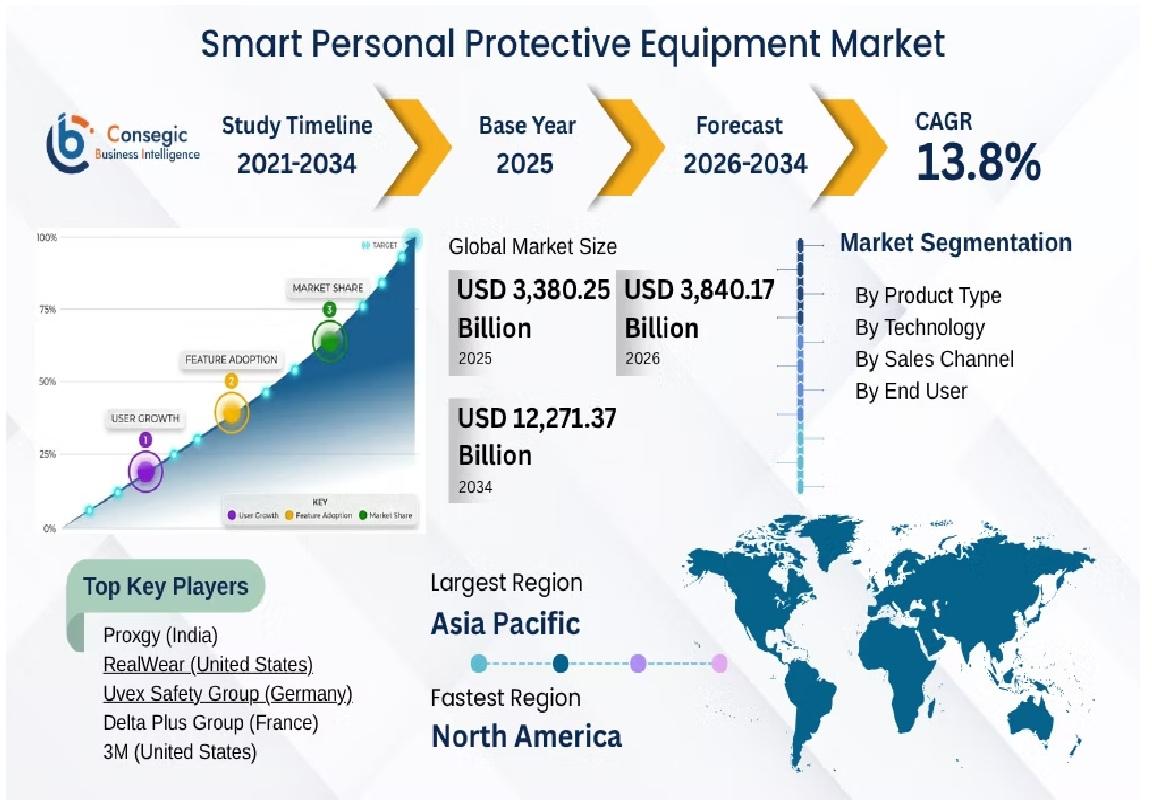
Smart Personal Protective Equipment Market size is estimated to reach over USD 12,271.37 Million by 2034 from a value of USD 3,380.25 Million in 2025 and is projected to grow by USD 3,840.17 Million in 2026, growing at a CAGR of 13.8% from 2026 to 2034.
Market Snapshot
The Smart Personal Protective Equipment Market includes protective equipment equipped with connected sensors, communication technologies, monitoring systems, and digital capabilities. These products can collect information related to worker location, environmental conditions, fatigue indicators, exposure levels, and equipment status, depending on their design.
Key applications include:
-
Worker location and proximity monitoring
-
Hazard and environmental detection
-
Fall detection and emergency alerts
-
Health and fatigue monitoring
-
Exposure monitoring
-
Connected communication
-
Equipment condition tracking
Major end-user industries include construction, mining, manufacturing, energy, utilities, transportation, healthcare, and emergency services.
The market's growth outlook is closely linked to the transition from reactive workplace safety toward data-driven and proactive safety management.
Growth Drivers
Several factors are supporting market development:
-
Increasing workplace safety requirements: Organizations are placing greater emphasis on preventing accidents and improving worker protection.
-
Technological advancements: Miniaturized sensors, wireless communication, batteries, and embedded electronics are making connected PPE more practical.
-
Industrial automation: Automated workplaces require new approaches to monitoring interactions between workers, machines, and operating environments.
-
Government initiatives: Occupational safety frameworks encourage organizations to maintain appropriate protective measures and risk-management practices.
-
Rising adoption across sectors: Connected safety equipment is gaining interest in industries involving hazardous environments or physically demanding work.
-
Infrastructure development: Construction, energy, transportation, and industrial projects create continuing demand for advanced worker protection.
Emerging Trends
AI integration is becoming an important trend in smart safety systems. Artificial Intelligence can analyze sensor information and identify patterns that may indicate unusual workplace conditions. Machine Learning (ML) can support predictive analysis by processing historical and real-time data.
Automation is also improving safety monitoring. Smart PPE can communicate with centralized platforms and automatically trigger alerts when predefined conditions are detected.
Digital Transformation is connecting PPE with enterprise safety systems, while IoT Integration allows equipment, workers, machines, and environmental sensors to exchange information.
Sustainability is another consideration. Manufacturers are exploring durable materials, energy-efficient electronics, recyclable components, and longer product lifecycles. Green Technologies and Circular Economy principles can support efforts to reduce material waste associated with disposable protective products.
Technology Landscape
The technology landscape combines protective materials with electronics, sensors, wireless communication, and software. Smart helmets may incorporate location tracking, communication devices, or environmental sensors, while connected garments can monitor selected worker or workplace conditions.
Advanced Materials can improve protection while reducing equipment weight. Flexible electronics and miniaturized sensors can enable technology to be integrated into clothing and other wearable products without significantly affecting mobility.
Cloud Technologies enable centralized data storage and monitoring across multiple facilities. Data Analytics can help safety managers identify recurring hazards and evaluate workplace patterns.
Predictive Maintenance can also be applied to connected equipment by monitoring usage and equipment condition. Smart Manufacturing, Robotics, and Industry 4.0 technologies are supporting the development of more connected industrial environments where worker safety systems can interact with machines and operational platforms.
Regional Analysis
North America
North America has strong demand for advanced workplace safety technologies across construction, manufacturing, energy, mining, and utilities. Industrial digitization and connected-worker initiatives are supporting interest in smart PPE. Investment opportunities are emerging around wearable sensors, worker monitoring, safety analytics, and integrated workplace platforms.
Europe
Europe is emphasizing workplace safety, industrial digitalization, sustainability, and connected manufacturing. Demand is supported by advanced manufacturing, construction, energy, and logistics industries. Opportunities are developing around smart protective clothing, connected helmets, environmental monitoring, and sustainable PPE materials.
Asia-Pacific
Asia-Pacific represents a significant opportunity because of its large manufacturing base, infrastructure development, construction activity, mining operations, and expanding industrial workforce. Increasing adoption of automation and Industry 4.0 technologies can encourage integration between smart PPE and industrial monitoring systems.
Latin America
Demand in Latin America is associated with mining, construction, manufacturing, energy, and agriculture. Smart PPE can support worker monitoring and hazard detection in remote or higher-risk operating environments. Infrastructure and industrial investment can create additional opportunities for connected safety technologies.
Middle East & Africa
The region offers opportunities across construction, oil and gas, mining, utilities, and infrastructure projects. Extreme environmental conditions and large-scale industrial operations can encourage demand for equipment capable of monitoring workplace conditions and providing rapid alerts.
Investment Opportunities
Investment opportunities are emerging across smart helmets, connected clothing, intelligent footwear, wearable sensors, worker-location systems, safety analytics, and connected emergency-response solutions.
Potential investment areas include:
-
AI-enabled worker safety monitoring
-
Connected protective clothing
-
Smart helmets and head protection
-
Environmental exposure sensors
-
Location and proximity monitoring
-
Cloud-based safety management
-
Sustainable and recyclable PPE materials
Emerging markets can provide additional opportunities as industrial organizations modernize workplace safety systems and adopt connected technologies.
Competitive Environment
Competition is increasingly focused on sensor integration, reliability, comfort, battery performance, connectivity, durability, and compatibility with existing safety systems. Manufacturers are investing in product launches that combine protection with digital monitoring capabilities.
Partnerships between PPE manufacturers, technology companies, sensor developers, industrial automation providers, and software companies can accelerate innovation. Acquisitions and strategic collaborations may also help organizations expand their connected-worker technology capabilities.
Research investments are focusing on lightweight electronics, advanced fabrics, energy-efficient sensors, AI-based analytics, and improved communication technologies. Capacity expansions can support growing demand for specialized connected protective equipment.
Key Statistics
-
Occupational safety remains a major consideration across construction, manufacturing, mining, energy, healthcare, and other industrial sectors.
-
IoT-enabled wearable technologies are expanding the ability to collect real-time workplace and worker-related data.
-
AI and Machine Learning are increasingly being explored for predictive safety analytics and automated hazard identification.
-
Industry 4.0 is encouraging greater integration between workers, machines, sensors, and enterprise systems.
-
Smart PPE development increasingly combines Advanced Materials with embedded electronics and connected communication technologies.
-
Cloud-based Data Analytics can allow organizations to consolidate safety information across multiple facilities.
-
Sustainability is encouraging research into durable, recyclable, energy-efficient, and lower-waste protective equipment.
Future Outlook Through 2034
The Smart Personal Protective Equipment Market is expected to move toward more connected, lightweight, intelligent, and data-driven safety solutions through 2034. Traditional protective functions will remain essential, but digital capabilities are likely to become increasingly integrated into selected PPE categories.
Future systems may combine AI, Machine Learning, IoT Integration, cloud platforms, and real-time analytics to provide more comprehensive workplace visibility. Connected PPE could become part of wider digital safety ecosystems rather than operating as standalone equipment.
Advances in batteries, flexible electronics, Advanced Materials, sensors, and wireless communication may improve comfort and functionality. Green Technologies and Circular Economy approaches could also influence product design as organizations seek longer-lasting and more sustainable protective equipment.
As workplaces become increasingly automated and connected, smart safety technologies are likely to play a growing role in monitoring hazards, supporting emergency response, and improving data-driven occupational safety management.
FAQ Section
Q1. What is the Smart Personal Protective Equipment Market?
The Smart Personal Protective Equipment Market covers protective equipment that combines conventional safety functions with sensors, communication technologies, monitoring systems, and digital capabilities. Smart PPE can include connected helmets, clothing, footwear, gloves, and wearable devices designed to monitor workplace conditions, worker activity, location, or selected safety indicators.
Q2. What factors are driving the market growth?
Market growth is supported by workplace safety requirements, industrial automation, Digital Transformation, IoT adoption, technological advances, and increasing demand for connected worker solutions. AI, Machine Learning, miniaturized sensors, cloud platforms, and Data Analytics are also expanding the capabilities of protective equipment used in industrial environments.
Q3. Which region dominates the market?
Regional development varies according to industrial activity, workplace safety practices, technology adoption, and infrastructure investment. North America and Europe have established industrial safety and digitalization ecosystems, while Asia-Pacific offers significant opportunities because of manufacturing, construction, mining, infrastructure development, and growing Industry 4.0 adoption.
Q4. What are the latest market trends?
Key trends include AI-enabled safety monitoring, connected helmets, smart protective clothing, wearable sensors, IoT Integration, real-time alerts, cloud-based safety platforms, and predictive analytics. Manufacturers are also focusing on lightweight designs, Advanced Materials, longer battery life, sustainability, and improved integration with industrial automation systems.
Q5. What opportunities are expected by 2034?
Opportunities are expected in connected protective clothing, smart helmets, environmental sensors, worker-location systems, AI-based safety analytics, cloud platforms, and sustainable PPE materials. Integration with Industry 4.0, Robotics, industrial automation, and connected-worker systems could further expand the use of smart protective equipment.
About Us
At Consegic Business Intelligence Pvt. Ltd., we empower organizations with actionable market
intelligence, strategic insights, and data-driven research solutions that support informed business decision-making. Our comprehensive market research reports provide in-depth analysis of industry trends, competitive landscapes, emerging opportunities, and future growth prospects across diverse sectors.
Contact Us
Consegic Business Intelligence Pvt. Ltd.
Website: www.consegicbusinessintelligence.com
Email: sales@consegicbusinessintelligence.com
Phone: +1-833-313-3130

 English
 Arabic
 French
 Spanish
 Portuguese
 Deutsch
 Dutch
Dutch
 Italiano
 Russian
 Romaian
 Portuguese (Brazil)
 Greek
Greek
 Bengali