


Battery Importer EPR Registration: Rules, Documents and Compliance Process
India's demand for batteries is increasing across electric vehicles, consumer electronics, solar energy storage, telecom equipment, UPS systems, industrial machinery and portable devices. A large part of this demand is also supported through imported battery cells, battery packs and equipment containing batteries.
For an importer, however, bringing batteries into India is not only a customs and logistics matter. It also creates an environmental compliance responsibility.
Under the Battery Waste Management Rules, 2022, an entity that imports batteries or equipment containing batteries falls within the definition of a Producer. Such importers therefore need to understand Battery Waste EPR Registration, recycling obligations, EPR certificates and ongoing CPCB portal compliance.
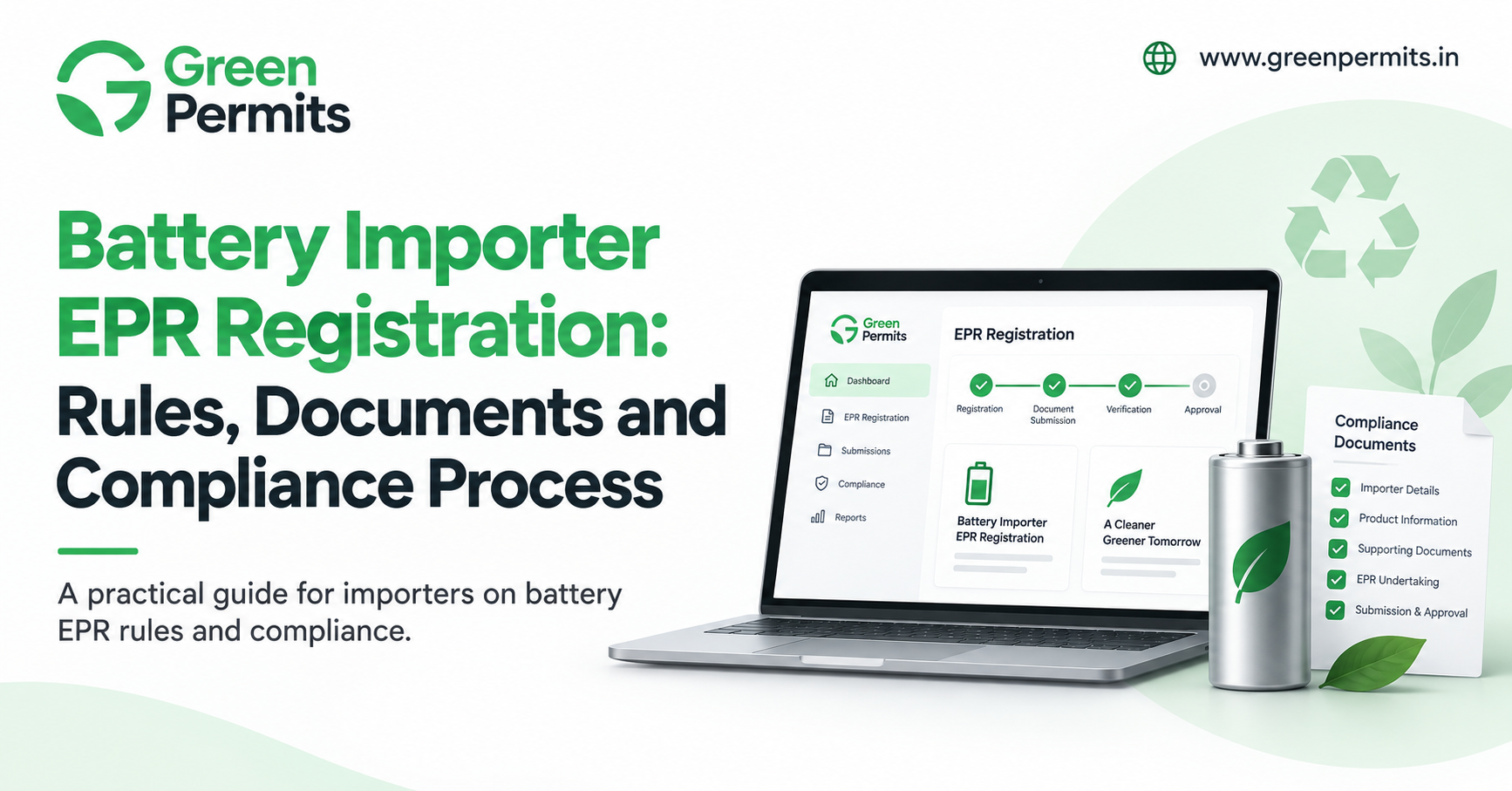
This guide explains Battery Importer EPR Registration in India, the documents generally required, the registration process and the compliance responsibilities that continue after registration.
What Is Battery Importer EPR Registration?
EPR stands for Extended Producer Responsibility.
In simple terms, it means that a business placing batteries in the Indian market also carries responsibility for the environmentally sound management of those batteries when they become waste.
Under the Battery Waste Management Rules, a producer includes an entity that:
- Manufactures and sells batteries under its own brand
- Sells batteries under its own brand that are manufactured by another supplier
- Imports batteries
- Imports equipment containing batteries
Therefore, an importer does not need to manufacture batteries in India to attract EPR obligations. Importing batteries or products containing batteries can itself bring the business within the producer framework.
Registration is managed through the centralised Battery Waste Management portal under the Central Pollution Control Board, or CPCB.
Why Is Battery EPR Important for Importers?
Battery importers frequently focus first on customs clearance, DGFT requirements, BIS applicability, logistics and hazardous-goods handling.
EPR sometimes receives attention only when the shipment is already planned.
That can create problems.
Battery Waste EPR is not simply an environmental certificate that can be obtained once and forgotten. It creates an ongoing compliance system based on the quantity and type of batteries introduced into the Indian market.
The producer has to work towards applicable recycling or refurbishment obligations and maintain records through the regulatory framework.
For an importer, proper EPR compliance helps create a clear connection between:
Battery imports → batteries placed in market → EPR liability → recycling/refurbishment → EPR certificates → compliance reporting
If any one part of this chain is incorrect, the problem may appear later during portal reconciliation or regulatory review.
Who Needs Battery EPR Registration as an Importer?
The requirement is broader than many businesses initially assume.
An importer should examine EPR applicability if it imports batteries directly or imports equipment in which batteries are already installed.
This may include businesses dealing with lithium-ion cells, lithium battery packs, lead-acid batteries, EV batteries, industrial batteries, portable batteries, energy-storage batteries and battery-powered equipment.
The Battery Waste Management Rules apply broadly to battery types irrespective of chemistry, shape, volume, weight, material composition or use, subject to the exclusions provided in the Rules.
This makes EPR relevant to businesses importing products such as electric mobility products, electronics, energy-storage systems, power-backup equipment and industrial products containing batteries.
For compliance purposes, the key question is not only:
"Do we import batteries?"
It should also be:
"Do any of the products we import contain batteries?"
That second question often identifies compliance obligations that businesses initially overlook.
Main Battery Categories under the EPR Framework
Battery classification matters because obligations and reporting need to be mapped to the correct category.
The registration framework identifies major battery categories including:
- Portable batteries
- Automotive batteries
- Electric vehicle batteries
- Industrial batteries
Importers should carefully determine the category applicable to each product instead of selecting a category simply because it appears closest to the commercial description.
For example, a battery used in an energy-storage system may not be treated in the same way as a small rechargeable battery used in portable consumer electronics.
Correct categorisation is important from the first stage because subsequent EPR obligations are linked to the regulatory data submitted by the producer.
Battery Importer EPR Registration Process
The exact screens and portal workflow may change as CPCB updates the system, but the compliance process generally follows a structured sequence.
Step 1: Determine Whether Your Business Is a Producer
Start by examining the import model.
Identify whether you are importing:
- Standalone batteries
- Battery cells
- Battery packs
- Equipment containing batteries
- Products sold under your own brand
- Products marketed under another commercial arrangement
Because importers of batteries and equipment containing batteries are included in the producer definition, the assessment should be completed before regular commercial imports begin.
Step 2: Identify the Correct Battery Category
Prepare a complete product list and map every applicable battery to its regulatory category.
Record details such as:
Battery type, application, chemistry, product name, brand, quantity and weight.
Do not rely only on the commercial invoice description. Technical specifications may be required to classify the battery accurately.
Step 3: Prepare Historical and Business Data
The applicant should organise the company and battery information required for the registration process.
The Rules' producer application format includes details such as the producer's name and registered address, authorised person, GST information, and the type of batteries placed on the market along with brand details.
For an existing importer, historical import and sales data should also be reconciled wherever required by the portal.
Step 4: Apply on the CPCB Centralised Portal
The producer applies through the Battery Waste Management centralised online portal.
Information needs to be entered consistently.
A common practical issue is a mismatch between the legal company name appearing on GST, PAN, incorporation documents and portal information.
Even minor inconsistencies can create unnecessary queries.
Step 5: Upload Documents and Complete the Application
Supporting records are uploaded as applicable.
The application should be reviewed carefully before submission, especially the battery categories and quantities.
Step 6: Respond to CPCB Queries
If CPCB seeks clarification or additional information, the response should address the query specifically.
Uploading unrelated documents or repeating the original information may delay processing.
Step 7: Obtain and Maintain EPR Registration
Once approved, the producer receives its registration under the prescribed framework.
The Rules provide for producer registration through CPCB and state that producer registration is valid for five years, subject to applicable compliance and renewal requirements.
Documents Required for Battery Importer EPR Registration
The exact checklist can vary depending on the applicant and portal requirements, but an importer should generally organise documents and information such as company PAN, GST registration, incorporation or business-registration details, authorised-person information, registered-office details, product and brand details, battery specifications, applicable battery category, import information, and quantity or sales data.
Technical documents are particularly useful where battery classification is not obvious.
For example, specifications may need to establish whether the product is an EV, portable, automotive or industrial battery.
The important point is consistency.
The information in the portal should logically match the supporting records maintained by the importer.
EPR Compliance Does Not End after Registration
Receiving the EPR Registration Certificate is only the first stage.
The producer remains responsible for meeting the applicable EPR obligations relating to batteries it introduces into the market.
Under the Rules, producers have responsibility for ensuring attainment of recycling or refurbishment obligations for batteries placed in the market.
This means importers should maintain ongoing records rather than trying to recreate their entire compliance position at the end of the year.
A practical internal tracker can monitor:
Imports → sales/market placement → applicable EPR liability → certificates available → pending liability
This simple structure can prevent major discrepancies later.
EPR Certificates and Recycling Compliance
The Battery Waste Management framework uses EPR certificates as an important mechanism for meeting producer obligations.
Eligible recycling or refurbishment activity generates certificates through the regulatory system, which producers use against their applicable responsibility.
This means an importer should not wait until a filing deadline to start assessing certificate requirements.
The company should periodically compare the quantity of batteries placed into the market with its EPR obligation and certificate position.
Planning early also helps avoid situations where a business discovers a large compliance gap only during year-end reconciliation.
Annual Return and Ongoing Portal Reporting
Producer compliance also includes reporting obligations.
The Rules provide for annual returns by producers, including information relating to batteries sold, battery types and quantities, EPR obligations and relevant certificates.
Therefore, importers should preserve import, sales and EPR records in a format that can later be reconciled.
The customs team, accounts team and environmental-compliance team should ideally work from the same underlying dataset.
If each department maintains different numbers, problems usually appear when the annual return is prepared.
Marking and EPR Registration Information
Battery compliance has also evolved through later amendments.
The Battery Waste Management Amendment Rules, 2025 introduced options concerning display of the EPR registration number, including the use of a barcode or QR code on specified batteries, battery packs, equipment or packaging, subject to the conditions in the amendment.
For importers, this makes packaging and labelling review another important part of compliance planning.
It is better to examine marking requirements before goods are packed overseas than to discover a problem after the consignment has reached India.
Common Mistakes Made by Battery Importers
One of the most common mistakes is assuming that EPR applies only to companies manufacturing batteries in India.
It also covers importers within the producer definition.
Another problem is overlooking products that contain batteries. A company may consider itself an electronics importer rather than a battery importer, even though every imported unit contains a rechargeable battery.
Incorrect category selection is another major risk.
Portable, automotive, EV and industrial batteries should not be treated as interchangeable categories.
Data mismatch also creates problems. Import quantities, sales data and quantities reported on the CPCB system should be capable of reconciliation.
Finally, many businesses obtain registration but do not create an internal system for EPR certificates, targets and returns.
That usually turns an otherwise manageable annual compliance exercise into a last-minute problem.
Benefits of Proper Battery Importer EPR Compliance
A structured EPR system helps an importer maintain better regulatory control while entering or expanding in India's battery market.
It can help reduce portal discrepancies, improve traceability of battery quantities, simplify annual return preparation, support regulatory verification and provide better visibility of future EPR certificate requirements.
Most importantly, it converts EPR from an urgent year-end task into a routine business process.
How a Battery EPR Consultant Can Help
Battery EPR compliance involves legal interpretation, product categorisation, technical data, import records and CPCB portal work.
A consultant can first assess the importer's product portfolio and determine which products create Battery Waste EPR obligations.
The next stage is to map battery categories and organise supporting records.
For businesses importing hundreds of SKUs, this step can save considerable time because every product does not necessarily require the same treatment.
A Battery EPR consultant can assist with producer applicability assessment, CPCB registration, battery-category mapping, documentation, data reconciliation, EPR obligation tracking, certificate compliance, annual-return preparation and responses to portal queries.
For importers planning new battery products, compliance review can also be performed before shipment so that EPR, labelling and related requirements are considered early in the import cycle.
Conclusion
Battery Importer EPR Registration in India is an important compliance requirement under the Battery Waste Management Rules, 2022.
Importers of standalone batteries as well as businesses importing equipment containing batteries should carefully assess their responsibilities.
The process begins with CPCB producer registration, but long-term compliance requires much more: accurate battery classification, reliable import and sales data, EPR obligation tracking, certificate management and timely reporting.
Green Permits supports manufacturers, importers and businesses with Battery Waste EPR Registration, CPCB portal filing, documentation, EPR target assessment, certificate reconciliation and ongoing compliance management.
Need Help with Battery Importer EPR Registration?
Website: https://www.greenpermits.in
Phone: +91 78350 06182
Email: wecare@greenpermits.in

 English
 Arabic
 Spanish
 Portuguese
 Deutsch
 Turkish
 Dutch
Dutch
 Italiano
 Russian
 Romaian
 Portuguese (Brazil)
 Greek
Greek
 Bengali