


RDF Processing Plant Licences & Approvals in India
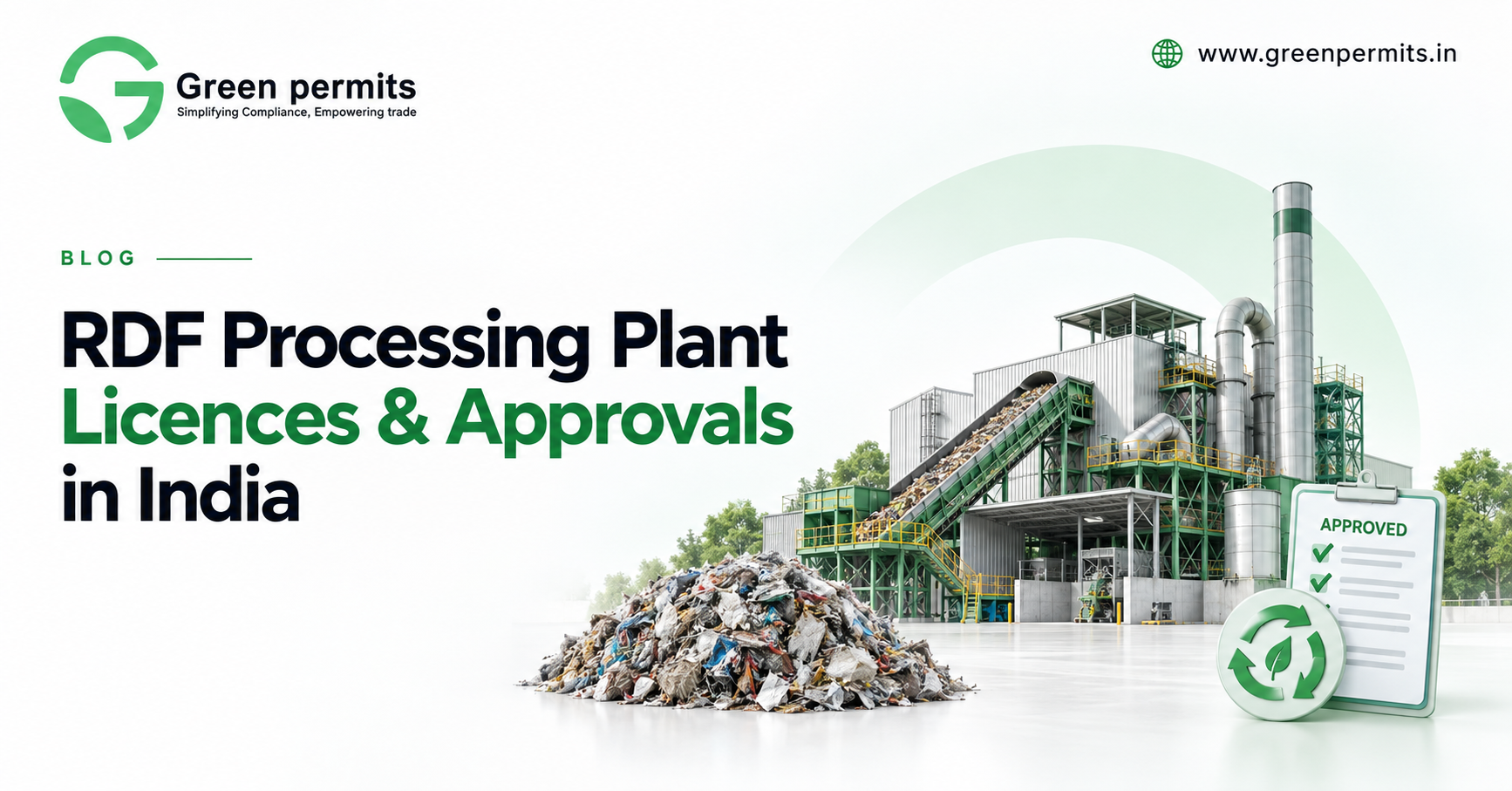
Setting up an RDF Processing Plant in India requires proper planning of waste supply, plant capacity, site, machinery, pollution-control systems and regulatory approvals before commercial operations begin.
RDF - Refuse Derived Fuel - is produced by processing suitable combustible fractions of municipal or other permitted non-hazardous waste. The processed material can be used as an alternative fuel in applications such as cement kilns and other approved industrial facilities.
For investors, the success of an RDF project depends on three things: reliable waste supply, acceptable RDF quality and confirmed buyers. Regulatory approvals should be planned alongside these commercial factors.
Green Permits Consulting supports businesses with RDF plant feasibility studies, DPR preparation, CTE/CTO, waste-management approvals, machinery planning and environmental compliance.
What is an RDF Processing Plant?
An RDF plant separates combustible material from waste and processes it into a more consistent fuel.
A typical process is:
Waste Receiving → Segregation → Shredding → Screening → Metal Removal → Drying / Conditioning → RDF
The final RDF quality depends on moisture, calorific value, ash, chlorine, particle size and contamination.
This is important because a cement plant or industrial buyer may accept only RDF meeting its specified fuel parameters.
Which Approvals Are Required for an RDF Plant?
There is no single licence that covers every RDF processing facility.
The approval requirement depends on the source of waste, plant capacity, site, processing method and final utilisation of RDF.
Projects handling municipal solid waste are generally assessed under the applicable Solid Waste Management framework along with requirements of the concerned State Pollution Control Board or Pollution Control Committee.
A typical approval pathway is:
Waste Supply → Site Selection → DPR → Consent to Establish → Plant Installation → Consent to Operate → Commercial Operations
Additional fire, factory, land-use or local permissions may also apply depending on the project.
Consent to Establish - CTE
Before constructing an applicable RDF facility, the promoter generally needs to assess Consent to Establish - CTE requirements from the concerned State Pollution Control Board.
The application normally explains the proposed waste-processing capacity, machinery, process flow, water requirement, dust generation, wastewater or leachate, rejects and pollution-control arrangements.
The submitted plant layout should clearly show areas for waste receiving, segregation, processing, RDF storage, rejects and internal vehicle movement.
CTE should ideally be addressed before major civil work or machinery installation.
Consent to Operate - CTO
Once the facility is constructed and pollution-control systems are installed, the project generally needs to assess Consent to Operate - CTO requirements before starting regular operations.
The actual plant should match the capacity and process approved during the establishment stage.
For example, if the project was approved for a certain processing capacity, installing significantly larger machinery without reviewing the consent conditions can create compliance issues.
CTE and CTO should therefore be linked with the final plant design.
Solid Waste Processing Compliance
If the plant processes municipal solid waste, the operator may also need to comply with requirements applicable to solid-waste processing facilities.
Where waste is supplied by an Urban Local Body, the project should clearly define responsibility for collection, transportation, processing, rejects and RDF utilisation.
The agreement with the municipal authority or authorised waste supplier can become an important project document.
For investors and lenders, a reliable waste-supply arrangement is often just as important as the machinery.
Waste Supply Before Plant Capacity
One of the biggest mistakes in RDF projects is deciding plant capacity before confirming waste availability.
A 200 TPD plant may look attractive, but if only 120 TPD of suitable waste can be secured consistently, the project may remain underutilised.
The correct planning sequence is:
Waste Availability → Waste Quality → RDF Yield → Buyer Requirement → Plant Capacity
Mixed municipal waste can also contain moisture, inert material and non-combustible fractions. Therefore, one tonne of incoming waste should not be assumed to produce one tonne of RDF.
A proper material balance is essential.
RDF Quality and Buyer Requirement
Producing RDF is only useful when there is a buyer willing to use it.
Cement plants are among the important potential users of RDF as an alternative fuel, but they may specify requirements for calorific value, moisture, chlorine, ash and particle size.
The plant should therefore understand the buyer specification before finalising machinery.
The commercial chain should be:
Waste Characterisation → RDF Specification → Buyer Requirement → Plant Design
This helps avoid producing fuel that cannot be sold at the expected price.
Site Selection for RDF Processing Plant
The site should provide enough space for incoming waste, machinery, RDF storage, rejects, internal roads and pollution-control systems.
Location should also consider distance from the waste source and the final RDF buyer.
Because RDF is relatively bulky, transportation can become a major operating cost.
A site close to waste generation but very far from the cement plant may not be commercially attractive.
The best location usually balances:
Waste Source + Processing Cost + Buyer Distance
rather than only cheap land.
Dust, Leachate and Fire Control
RDF processing can generate dust during shredding, screening and material handling.
The plant may therefore need suitable enclosures, extraction systems, covered conveyors and good housekeeping.
Incoming municipal waste can also contain moisture, requiring proper drainage and leachate management around receiving and storage areas.
Fire safety is another major consideration because RDF contains combustible material. Large uncontrolled storage piles can increase fire risk.
The layout should therefore consider safe storage quantity, firefighting access and appropriate emergency arrangements.
RDF Plant Setup Cost
There is no fixed cost for every RDF processing plant.
Investment depends on processing capacity, waste quality, shredding system, screening, magnetic separation, drying requirement, pollution controls and storage infrastructure.
The project cost should consider:
Land + Building + Machinery + Pollution Controls + Fire Systems + Utilities + Working Capital
A plant receiving reasonably segregated waste may require a different investment from one processing mixed municipal waste with high moisture and inert content.
DPR for RDF Processing Plant
A Detailed Project Report - DPR helps determine whether the RDF project is technically and financially viable before major investment.
The DPR should evaluate waste availability, processing capacity, RDF yield, machinery, site requirement, utilities, approvals, CAPEX, OPEX and transportation.
It should also study the buyer market, expected RDF selling price and cost of handling rejects.
For bank finance or investor discussions, the financial model can include revenue, operating costs, cash flow, break-even and debt servicing.
Common Mistakes in RDF Projects
A common mistake is purchasing machinery before securing the waste source.
Another is assuming high RDF recovery without studying the actual composition of incoming waste.
Projects may also underestimate transportation, reject disposal, fire-safety infrastructure or buyer quality requirements.
The better development sequence is:
Waste Study → Buyer Study → Site → DPR → CTE → Machinery → CTO → Operations
This keeps the commercial model and approvals aligned.
How Green Permits Helps with RDF Processing Plant Setup
Green Permits Consulting supports waste-management companies, investors and project developers with RDF plant feasibility studies, waste and buyer assessment, DPR preparation, plant-capacity planning, machinery evaluation, CTE/CTO and environmental approval support.
The objective is to determine whether the proposed plant has enough waste, suitable technology and a reliable RDF market before major capital is committed.
Learn More About RDF Processing Plant Licences & Approvals
If you are planning an RDF processing plant in India, the project should be evaluated for waste supply, RDF quality, buyer demand, plant capacity and regulatory approvals before machinery is finalised.
Read more about waste-processing and plant setup consulting services here:
👉 https://www.greenpermits.in/09/rdf-plant-licence-india-cte-cto-approval-checklist/
📞 Get Expert Assistance for RDF Processing Plant Setup
If you need help with RDF Processing Plant licences and approvals, DPR preparation, CTE/CTO, machinery planning or environmental compliance, Green Permits Consulting can assist you.
🌐 Website: www.greenpermits.in
📞 Phone: +91 78350 06182
📧 Email: wecare@greenpermits.in

 English
 Arabic
 French
 Portuguese
 Deutsch
 Turkish
 Dutch
Dutch
 Italiano
 Russian
 Romaian
 Portuguese (Brazil)
 Greek
Greek
 Bengali