


How Long Does It Take to Learn Japanese? A Complete Learning Timeline
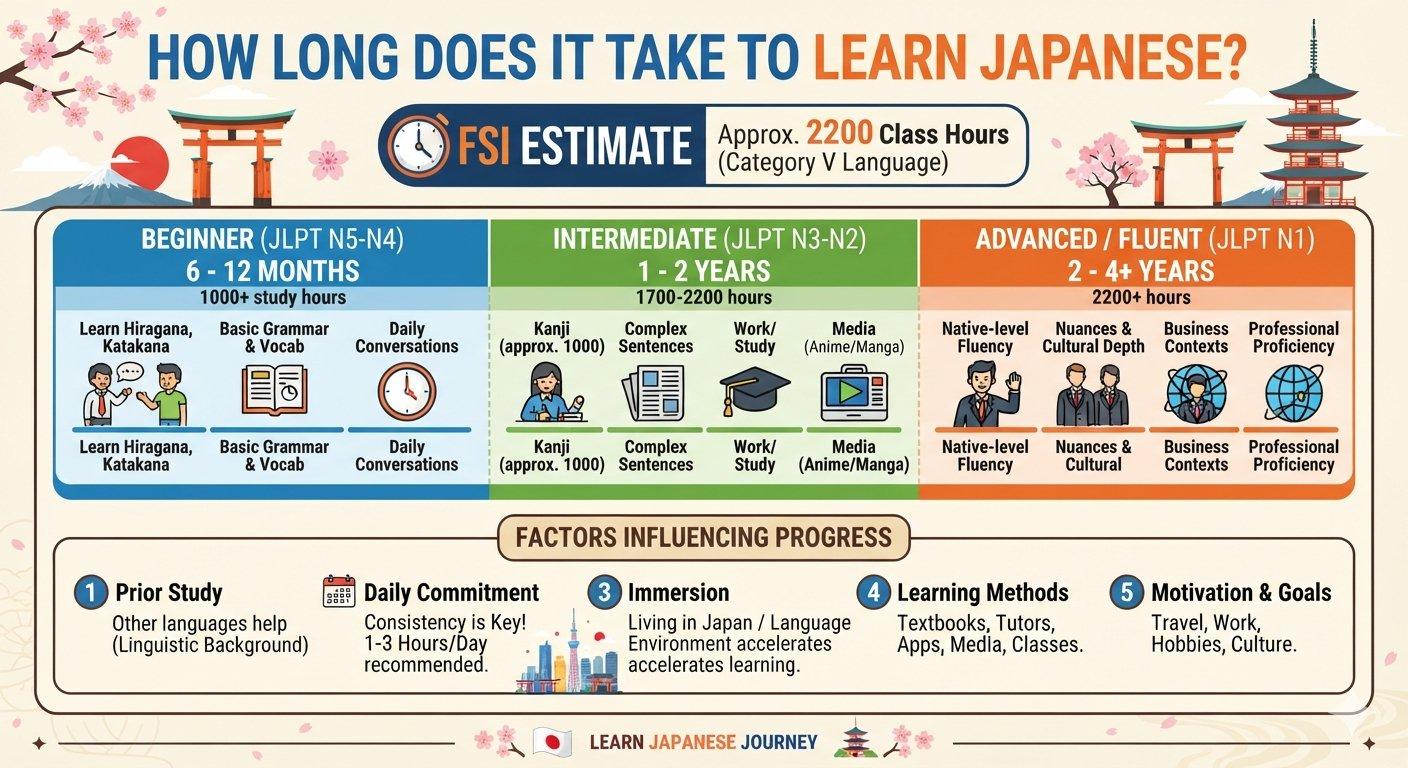
Most learners reach conversational Japanese (JLPT N4–N3) in 18–24 months of consistent daily study, while business-level fluency (N2–N1) typically takes 3–5 years. Actual time depends on your study intensity, native language, and whether you focus on speaking, reading, or writing kanji.
Japanese is consistently ranked as one of the hardest languages for English speakers to learn, mainly due to its writing system and grammar structure. But "hard" doesn't mean impossible it means the timeline looks different from learning Spanish or French. Below is a realistic, stage-by-stage breakdown so you know what to expect at every point in your journey.
Why Japanese Takes Longer Than Other Languages
Quick How Long Does It Take to Learn Japanese The U.S. Foreign Service Institute (FSI) classifies Japanese as a Category IV language the hardest tier for native English speakers requiring significantly more classroom hours than languages like French or Italian.
Three factors drive this:
- Three writing systems: Hiragana, katakana, and kanji all need to be learned separately
- Sentence structure: Japanese follows Subject-Object-Verb (SOV) order, the reverse of English
- Politeness levels: Formal, casual, and honorific speech require separate vocabulary and grammar patterns
None of this means you can't make fast progress early on hiragana and katakana alone can be learned in about 2–3 weeks with focused practice.
Japanese Learning Timeline by Stage
Here's a realistic breakdown based on typical learner progress, using the JLPT (Japanese Language Proficiency Test) as a reference point.
| Stage | JLPT Level | Approx. Study Time | What You Can Do |
|---|---|---|---|
| Beginner | N5 | 3–6 months | Basic greetings, simple sentences, self-introductions |
| Elementary | N4 | 6–12 months | Everyday conversations, simple reading |
| Intermediate | N3 | 1–2 years | Discuss familiar topics, read newspapers with effort |
| Upper Intermediate | N2 | 2–3.5 years | Follow news, workplace conversations, most media |
| Advanced | N1 | 3–5+ years | Near-native comprehension, nuanced expression |
These ranges assume regular, consistent study not occasional practice. Someone studying 30 minutes daily will land at the slower end; someone studying 2+ hours daily with immersion will land at the faster end.
How Study Intensity Changes the Timeline
Casual Learners (30 minutes/day)
Expect N5–N4 level in about a year. This pace works well for hobbyists who want steady progress without burnout, but plateaus are common without added immersion.
Dedicated Self-Learners (1–2 hours/day)
This is the most common serious-learner pace. N4–N3 within 12–18 months is realistic, especially when combining textbook study with listening practice and speaking output.
Immersive Learners (3+ hours/day, living in Japan or intensive programs)
Full-time language school students in Japan often reach N2 within 1–2 years, since classroom instruction is paired with constant real-world exposure.
Key Milestones on the Way to Fluency
1. Hiragana and Katakana (2–4 weeks)
These two phonetic alphabets (46 characters each) are the foundation. Mastering them first makes every later resource textbooks, apps, manga accessible sooner.
2. Basic Grammar and 100–300 Core Words (2–3 months)
This is where you build simple sentences: introducing yourself, asking questions, describing daily routines.
3. Conversational Survival Japanese (6–12 months)
Around N5–N4 level, you can handle travel situations, order food, and have basic exchanges with patient native speakers.
4. Kanji Literacy (Ongoing, 2+ years)
Japanese uses roughly 2,000 commonly used kanji (the Jōyō kanji list) for everyday literacy. This is usually the slowest-moving skill, since it requires continuous review through spaced repetition.
5. Natural Fluency (3–5+ years)
At this stage, you can follow fast native conversation, read novels, and express nuance the kind of fluency most language schools target for N1 certification.
What Actually Speeds Up Learning
- Daily consistency beats occasional cramming 30 minutes every day outperforms 3 hours once a week
- Active output (speaking, writing) cements vocabulary faster than passive reading alone
- Spaced repetition systems (SRS) like flashcard apps are widely used for kanji retention
- Immersion even from home, through Japanese podcasts, shows, or language exchange accelerates listening comprehension significantly
- Structured curriculum prevents the common beginner trap of studying randomly without reinforcing basics
Common Beginner Mistakes That Slow Progress
- Skipping hiragana/katakana and relying only on romaji (romanised Japanese)
- Learning vocabulary in isolation without example sentences
- How to Learn Japanese Language Beginner
- Avoiding speaking practice out of fear of mistakes
- Trying to learn all kanji readings at once instead of learning them in context
Realistic Expectations: What "Fluent" Actually Means
Many learners assume fluency means sounding exactly like a native speaker. In practice, most professional and social goals are achievable at N2 level enough to work, study, and build relationships in Japanese. True native-level nuance (N1 and beyond) is a lifelong refinement process, even for many advanced learners.
FAQ's Top 10: Learn Japanese
Q: Can I learn Japanese in 6 months?
You can reach basic conversational ability (roughly N5 level) in 6 months with daily study, but full fluency isn't realistic in this timeframe.
Q: Is Japanese harder than Chinese or Korean?
All three are considered difficult for English speakers. Japanese grammar is often seen as more approachable than Chinese, but its three writing systems add complexity Korean's single alphabet (Hangul) doesn't have.
Q: Do I need to learn kanji to speak Japanese?
No you can hold conversations using only hiragana and katakana knowledge. Kanji matters primarily for reading and writing fluency.
Q: How many kanji do I need to know to be fluent?
Around 2,000 kanji (the Jōyō list) covers most everyday reading, including newspapers and official documents.
Q: Is Duolingo enough to learn Japanese?
Apps like Duolingo are useful for building habits and basic vocabulary but work best combined with structured grammar study and real conversation practice.
Q: What JLPT level do I need for a job in Japan?
Many companies require at least N2, though this varies by industry and role.
Q: How long does it take to read a Japanese novel unassisted?
Most learners need N2–N1 level, typically 2–4 years of consistent study, to comfortably read native novels without frequent dictionary use.
Q: Does living in Japan guarantee faster fluency?
It accelerates listening and cultural fluency, but active study is still necessary immersion alone doesn't teach kanji or grammar rules.
Q: Is it too late to start learning Japanese as an adult?
No. Adult learners often progress faster in grammar comprehension due to existing study skills, even if pronunciation takes more conscious practice.

 English
 Arabic
 French
 Spanish
 Portuguese
 Deutsch
 Turkish
 Dutch
Dutch
 Italiano
 Russian
 Romaian
 Greek
Greek
 Bengali