


From Ad Spend to Revenue: How AI Is Reshaping Ecommerce PPC Campaigns
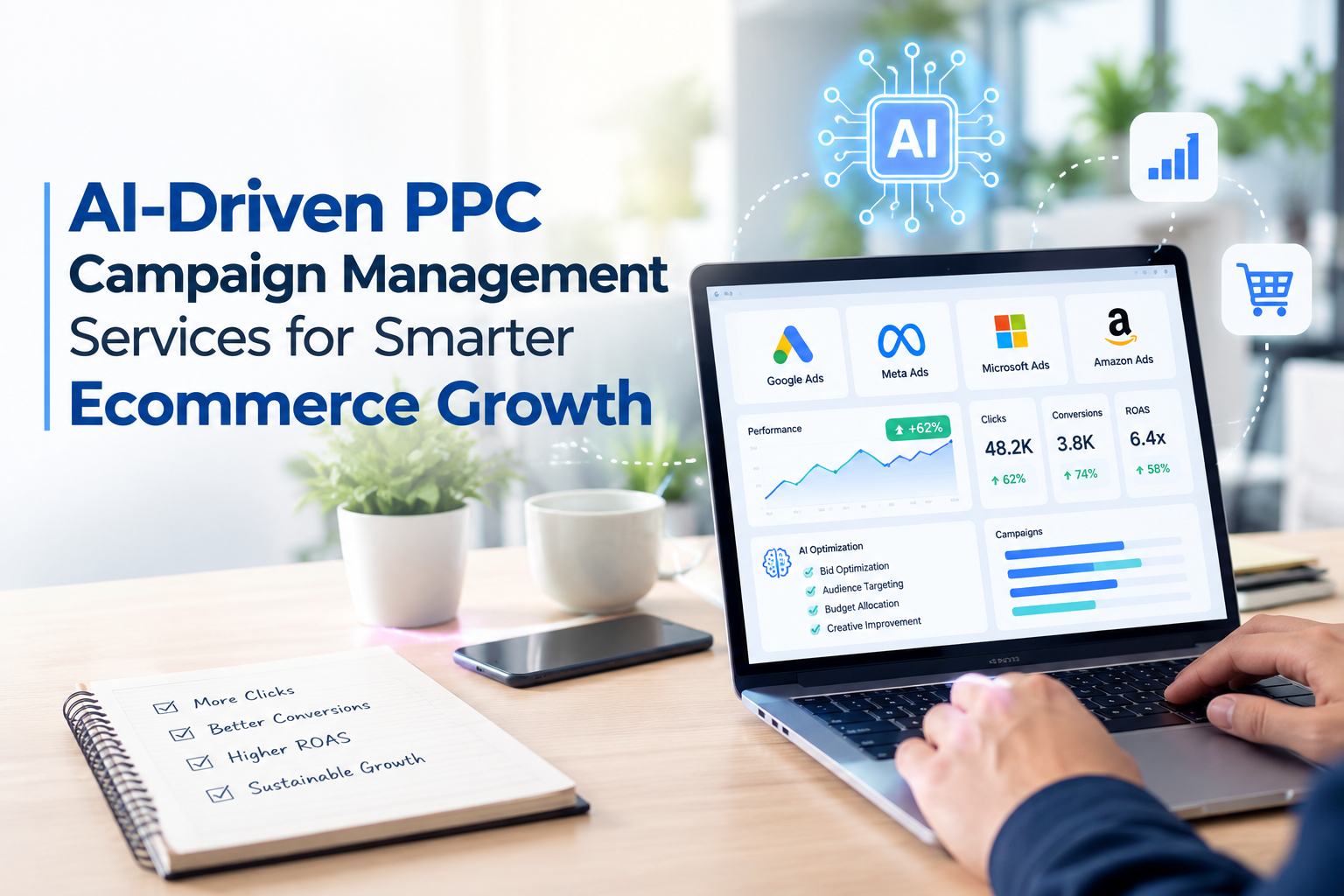
Ecommerce advertising has changed significantly. Businesses can launch campaigns faster than ever, but getting consistent commercial results has become more challenging. Higher competition, changing search behaviour, rising customer acquisition costs, and multiple digital channels make it difficult to know where advertising budgets are producing the greatest value.
This is why many ecommerce businesses are looking beyond traditional PPC management. AI-driven PPC campaign management services offer a data-focused approach that can help businesses understand campaign performance, customer behaviour, and opportunities for optimisation.
The focus is shifting from simply generating traffic to understanding what happens after the click.
The Real Problem With Ecommerce Advertising
A campaign can receive thousands of impressions and hundreds of clicks without generating enough revenue. High traffic does not automatically mean strong business performance.
Ecommerce businesses need to answer more important questions:
- Which products generate profitable sales?
- Which search terms attract buyers rather than browsers?
- Which audiences have higher purchase intent?
- Which campaigns consume budget without sufficient returns?
- Which landing pages lose potential customers?
- Which advertising messages produce better conversions?
These questions require more than basic campaign reporting. They require businesses to connect advertising data with customer and revenue data.
AI-Driven PPC Management Starts With Business Data
AI becomes more useful when it has meaningful data to analyse.
Modern PPC strategies can bring together information from advertising platforms, analytics systems, ecommerce stores, product feeds, and conversion tracking.
This can help marketers identify patterns across:
- Search queries
- Product categories
- Customer segments
- Geographic locations
- Devices
- Conversion rates
- Advertising costs
- Revenue
- Repeat purchases
Instead of reviewing individual metrics in isolation, marketers can use these signals to understand how campaigns contribute to commercial outcomes.
Reducing Wasted Advertising Spend
One of the biggest challenges in competitive PPC markets is wasted spend.
Businesses may pay for clicks that have limited purchasing potential because of broad targeting, irrelevant search queries, weak ad messaging, or poorly matched landing pages.
AI-assisted analysis can help identify unusual spending patterns and performance differences that deserve investigation.
For example, a business may discover that one product category generates substantial traffic but very few purchases, while another receives less traffic but produces significantly stronger revenue.
This information can support more informed budget decisions.
AI does not guarantee lower advertising costs. Instead, it gives marketers additional tools for identifying where optimisation may be necessary.
Moving From Keywords to Customer Intent
Modern ecommerce advertising should not treat every keyword equally.
Consider the difference between:
"winter jackets"
and
"buy waterproof winter jacket men's medium."
Both searches relate to the same broad product category, but their potential intent can be very different.
AI-assisted search-term analysis can help businesses identify patterns in customer queries and organise campaigns around different stages of the buying journey.
This can lead to more relevant:
- Keywords
- Ad copy
- Landing pages
- Product recommendations
- Offers
- Audience segments
Understanding intent can be particularly valuable in markets where advertising competition is high.
Why Ecommerce Digital Marketing Services Need a Wider View
PPC does not exist separately from the rest of digital marketing.
Ecommerce digital marketing services can combine paid advertising with SEO, content marketing, social media, email marketing, analytics, and conversion rate optimisation.
This broader approach allows businesses to use information from one channel to improve another.
For example, PPC data may reveal that customers frequently search for a particular product feature. That insight could influence:
- Product-page content
- Blog topics
- SEO strategies
- Social media content
- Email campaigns
- Landing-page messaging
In this way, paid campaigns can become a source of customer intelligence rather than simply an advertising channel.
The New Search Journey Includes AI Answers
The customer journey is also changing because people increasingly use conversational and AI-powered search experiences to research products and services.
A potential customer may ask an AI system:
- Which product is suitable for a particular need?
- What features should I compare?
- Which brands offer a specific solution?
- What should I consider before purchasing?
This creates a growing need for businesses to provide clear, structured, useful information.
Answer Engine Optimization Services focus on making business content easier for answer-focused search systems to understand and retrieve.
While AEO is different from PPC, both address modern customer discovery from different directions.
PPC can provide paid visibility for targeted searches, while AEO can help businesses build useful informational visibility across answer-oriented search experiences.
Landing Pages Are Part of the Advertising Strategy
A common mistake is to focus heavily on the advertisement and overlook the destination.
A user who clicks an advertisement expects the landing page to immediately provide relevant information.
For ecommerce websites, effective landing pages should generally provide:
- A clear value proposition
- Relevant product information
- High-quality images
- Transparent pricing
- Strong product benefits
- Reviews or trust signals
- Mobile-friendly navigation
- Fast loading
- Simple purchasing options
If the landing page does not match the user's intent, even highly targeted PPC traffic can produce disappointing results.
From Campaign Management to Revenue Management
The future of PPC management is increasingly connected to business performance.
Instead of asking only:
"How many clicks did we receive?"
businesses should also ask:
"What value did those clicks create?"
This requires tracking metrics such as:
- Conversion rate
- Cost per acquisition
- Revenue
- Return on ad spend
- Average order value
- Customer lifetime value
- Repeat purchase rate
These metrics help shift PPC discussions from advertising activity toward commercial performance.
How Businesses Can Prepare for the Next Stage of PPC
Businesses can create a stronger foundation for AI-assisted PPC by focusing on several areas:
- Improve conversion tracking so advertising decisions are based on meaningful actions.
- Organise product and customer data to make performance analysis more useful.
- Review search intent regularly as customer behaviour changes.
- Test landing pages instead of assuming every page converts equally.
- Connect PPC with SEO and content to share insights between channels.
- Monitor profitability, not just traffic.
- Use AI as decision support while keeping strategic oversight with experienced marketers.
Frequently Asked Questions
What are AI-driven PPC campaign management services?
They involve using AI-assisted technologies, automation, campaign data, and predictive analysis to support PPC planning, monitoring, targeting, and optimisation.
Can AI guarantee better PPC results?
No. AI can help analyse data and identify optimisation opportunities, but campaign outcomes also depend on competition, pricing, product-market fit, creative quality, website experience, budget, and conversion tracking.
How can AI help reduce wasted PPC spend?
AI-assisted analysis can identify patterns such as poor-performing search terms, audiences, products, or campaigns. Marketers can then review and adjust those areas based on actual performance.
Why should ecommerce businesses combine PPC with SEO?
PPC can provide paid visibility, while SEO can support long-term organic discovery. PPC data can also reveal valuable search terms and customer interests that inform SEO strategies.
What role does AEO play in ecommerce marketing?
Answer Engine Optimization Services focus on creating clear, structured, useful content for answer-oriented and AI-powered search experiences. This complements paid advertising by addressing customers researching through conversational search.
What should businesses measure beyond PPC clicks?
Businesses should consider conversions, CPA, ROAS, revenue, average order value, customer lifetime value, and repeat purchases to understand commercial performance.
Conclusion
The future of ecommerce PPC is moving beyond clicks, impressions, and basic campaign management. Businesses increasingly need to understand how advertising spend connects with customer intent, website behaviour, product performance, and revenue.
AI-driven PPC campaign management services can support this shift by helping marketers analyse complex datasets and identify opportunities for optimisation.
When combined with ecommerce digital marketing services and Answer Engine Optimization Services, PPC can become part of a broader strategy focused on reaching customers, understanding their intent, and improving the path from discovery to purchase.

 Arabic
 French
 Spanish
 Portuguese
 Deutsch
 Turkish
 Dutch
Dutch
 Italiano
 Russian
 Romaian
 Portuguese (Brazil)
 Greek
Greek
 Bengali