


How Tablet Coating Can Protect Moisture-Sensitive Supplement Ingredients
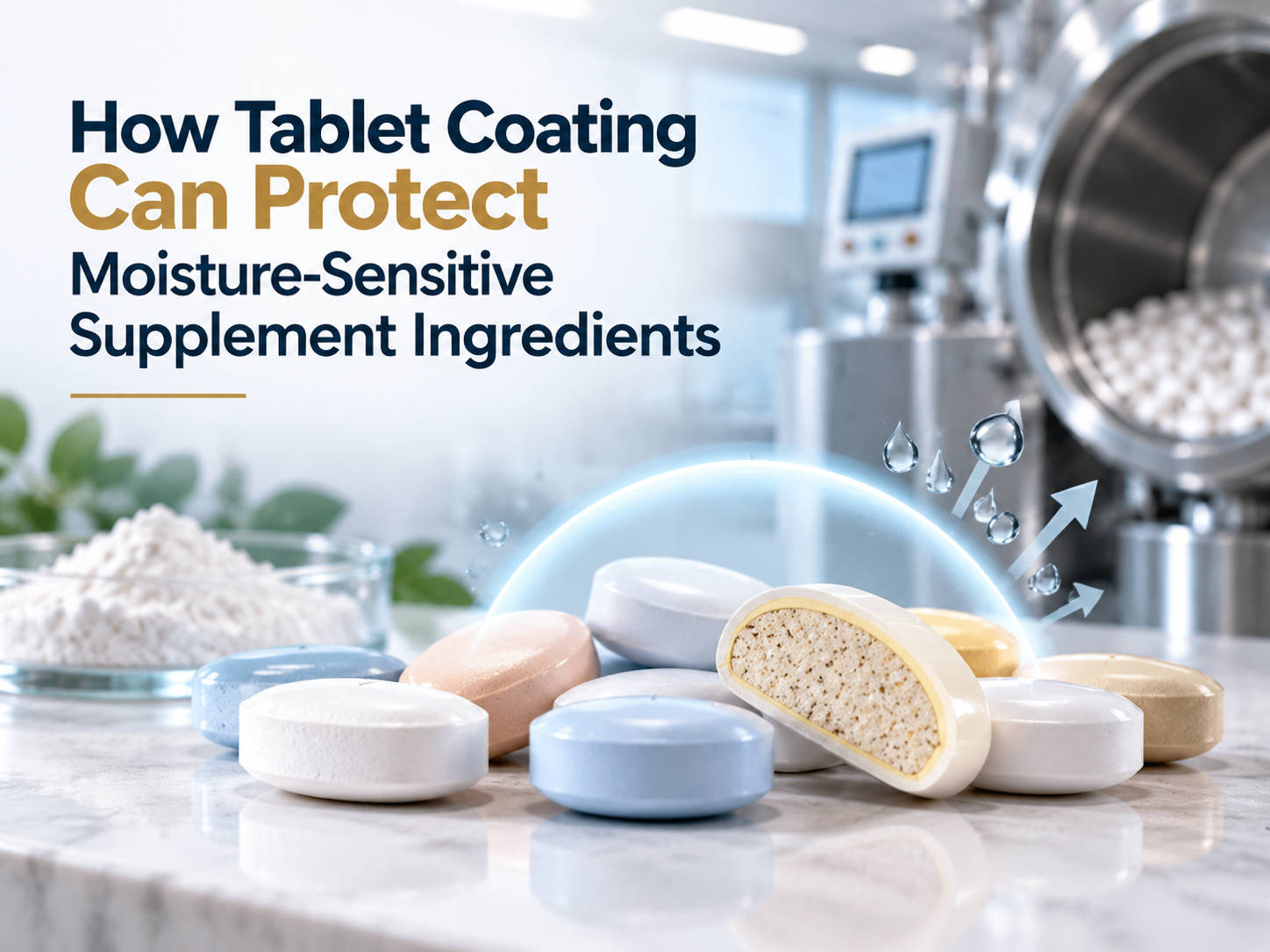
Developing a successful supplement product involves more than selecting high-quality ingredients. Many active ingredients used in vitamins and nutraceutical products are sensitive to environmental conditions, especially moisture.
Exposure to humidity during manufacturing, transportation, or storage can affect ingredient stability, tablet appearance, and overall product quality.
This is why many supplement brands consider moisture resistant tablet coating as part of their product development strategy.
A properly designed coating system can create an additional protective layer around tablets, helping reduce moisture exposure while supporting the stability and performance of the finished supplement.
For supplement manufacturers, understanding how coating works and when it should be used can help create products with better shelf stability and consumer experience.
Why Are Some Supplement Ingredients Sensitive to Moisture?
Some supplement ingredients naturally attract and absorb water from the surrounding environment. These are often called hygroscopic ingredients.
When moisture enters a tablet, it may affect:
- Ingredient stability
- Tablet hardness
- Texture and appearance
- Shelf life
- Product consistency
- Overall quality
Common moisture-sensitive supplement ingredients may include:
- Certain vitamins
- Minerals
- Herbal extracts
- Amino acids
- Probiotics
- Plant-based compounds
For supplement brands, moisture protection is especially important because products may experience changing humidity conditions during manufacturing, shipping, warehouse storage, and consumer use.
A stable formulation requires more than simply selecting effective ingredients. The entire product system, including formulation, packaging, and coating, should work together.
What Is Moisture Resistant Tablet Coating?
Moisture resistant tablet coating is a protective coating applied to tablets to help reduce exposure to environmental moisture.
The coating creates a thin barrier between the tablet core and outside conditions.
Depending on the coating formulation, it may help:
- Reduce moisture absorption
- Improve tablet durability
- Protect sensitive ingredients
- Maintain product appearance
- Support supplement stability
However, coating is not a replacement for proper formulation or packaging. The effectiveness of a coating depends on the coating materials, tablet composition, manufacturing process, and storage conditions.
A successful coating strategy considers the complete product lifecycle.
How Tablet Coating Protects Moisture-Sensitive Ingredients
1. Creates a Protective Barrier Around the Tablet
The main function of a protective tablet coating is creating an outer layer around the tablet surface.
This layer can reduce direct contact between the tablet core and environmental humidity.
For moisture-sensitive formulations, this additional protection can help maintain product consistency during storage and transportation.
The effectiveness depends on factors such as:
- Coating material selection
- Coating thickness
- Application process
- Tablet composition
- Packaging conditions
2. Supports Better Supplement Stability
A major concern for supplement brands is maintaining product quality throughout its intended shelf life.
Supplement stability involves ensuring that ingredients maintain their identity, quality, and performance over time.
Moisture exposure can contribute to:
- Ingredient degradation
- Changes in tablet structure
- Reduced product consistency
A well-designed tablet coating formulation can become one part of a broader stability strategy.
Brands should evaluate coating together with:
- Ingredient selection
- Manufacturing conditions
- Packaging solutions
- Stability testing
3. Protects Sensitive Ingredients During Storage and Shipping
Supplements often travel through different environments before reaching customers.
A product manufactured in California may later be shipped across regions with different humidity levels.
During this process, moisture exposure may occur through:
- Warehouse conditions
- Transportation environments
- Packaging openings
- Temperature changes
A suitable moisture barrier coating can provide additional protection by reducing environmental interaction with the tablet core.
How the Tablet Coating Process Works
The tablet coating process involves applying a coating material onto compressed tablets under controlled manufacturing conditions.
Although processes vary by manufacturer, the general steps include:
Step 1: Tablet Preparation
Before coating begins, tablets are evaluated for:
- Hardness
- Shape
- Surface quality
- Weight consistency
The tablet core must be suitable for coating application.
Step 2: Coating Application
During coating, tablets move inside specialized equipment while coating materials are applied evenly across the surface.
The coating solution typically contains:
- Film-forming polymers
- Plasticizers
- Colorants (when needed)
- Other functional ingredients
Step 3: Drying and Film Formation
Controlled airflow and temperature help remove moisture from the coating solution, allowing a consistent film to form around each tablet.
A properly controlled process helps prevent issues such as:
- Uneven coating
- Cracking
- Poor adhesion
- Tablet damage
Film Coating for Tablets: Why It Is Commonly Used
Film coating for tablets is one of the most widely used approaches in nutraceutical manufacturing.
Compared with traditional coatings, film coating creates a thinner layer while offering several functional benefits.
Advantages may include:
- Improved tablet appearance
- Better handling
- Taste masking
- Moisture protection
- Easier swallowing
For many supplement brands, film coating provides a balance between product protection and consumer experience.
The Role of HPMC Tablet Coating in Moisture Protection
HPMC tablet coating uses hydroxypropyl methylcellulose, a plant-derived polymer commonly used in pharmaceutical and nutraceutical coating applications.
HPMC is popular because it can provide:
- Good film-forming properties
- Smooth tablet coverage
- Flexible coating layers
- Compatibility with different formulations
The correct coating material depends on the specific product requirements.
A manufacturer may consider:
- Ingredient sensitivity
- Desired protection level
- Release requirements
- Consumer expectations
- Product positioning
Choosing the Right Tablet Coating Materials
Selecting appropriate tablet coating materials is an important decision during supplement development.
Factors to consider include:
Ingredient Characteristics
Different ingredients respond differently to moisture exposure.
A coating solution should match the needs of the formula.
Product Goals
Brands should define what the coating needs to achieve:
- Moisture protection
- Taste masking
- Appearance improvement
- Swallowability
- Controlled release
Manufacturing Requirements
The coating must also work effectively at commercial production scale.
A coating that performs well in testing must also provide consistent results during manufacturing.
Common Mistakes Supplement Brands Make With Tablet Coating
Treating Coating as Only a Cosmetic Feature
Many brands think coating is mainly about appearance.
In reality, coating can influence product stability, consumer experience, and ingredient protection.
Selecting Coating Before Understanding the Formula
The coating should support the supplement formula, not the other way around.
Ingredient characteristics should guide coating decisions.
Ignoring Packaging and Storage
Even the best coating cannot solve every stability challenge.
Packaging, environmental control, and testing remain important parts of supplement manufacturing.
How Supplement Brands Can Improve Product Stability With Coating
A practical approach is:
1. Identify Sensitive Ingredients
Understand which ingredients may be affected by moisture.
2. Define the Protection Goal
Determine whether the main objective is moisture resistance, taste masking, appearance, or another function.
3. Select Appropriate Coating Materials
Work with experienced manufacturers to evaluate suitable coating options.
4. Validate Through Testing
Confirm that the finished product meets quality expectations.
This approach helps brands create reliable products instead of simply adding a coating as an afterthought.
Working With an Experienced Supplement Coating Partner
For supplement companies developing tablets with moisture-sensitive ingredients, choosing the right manufacturing partner is an important step.
Experienced nutraceutical tablet coating services providers can help evaluate:
- Coating formulation
- Material compatibility
- Manufacturing requirements
- Product quality goals
PureNSM provides professional supplement coating services designed to support supplement brands with coating solutions for different tablet applications, including protection, appearance improvement, and consumer experience enhancement.
Learn more about supplement coating services and how coating technology can support your product development process.
Key Takeaways
- Moisture can impact the stability and quality of supplement ingredients.
- Moisture resistant tablet coating creates an additional protective layer around tablets.
- Coating can support supplement stability, ingredient protection, and product consistency.
- HPMC and film coating systems are commonly used in nutraceutical applications.
- The best coating solution depends on the ingredients, product goals, and manufacturing requirements.
- Coating should be considered as part of the complete supplement development strategy.
Frequently Asked Questions
Can tablet coating protect supplements from humidity?
Yes, certain coating systems can help reduce moisture exposure. However, performance depends on the coating materials, formulation, packaging, and storage conditions.
What is the best coating for moisture-sensitive supplements?
The best coating depends on the ingredient characteristics and product goals. Film coatings, including some HPMC-based systems, are commonly considered for nutraceutical applications.
Does tablet coating increase supplement shelf life?
Tablet coating may support product stability, but shelf life depends on multiple factors, including formulation, packaging, testing, and storage conditions.
What are moisture-sensitive supplement ingredients?
Moisture-sensitive ingredients are compounds that may be affected by humidity or water exposure, potentially impacting product quality and stability.
Why do supplement brands use film coating?
Brands use film coating to improve tablet appearance, support protection, mask taste, improve swallowability, and enhance product handling.
How early should brands consider tablet coating?
Ideally, coating should be considered during product development because formulation, ingredients, manufacturing, and packaging decisions are connected.

 English
 Arabic
 French
 Spanish
 Portuguese
 Deutsch
 Dutch
Dutch
 Italiano
 Russian
 Romaian
 Portuguese (Brazil)
 Greek
Greek
 Bengali