


Do Table Runner and Placemats Really Need to Match? Here's How to Pair Them
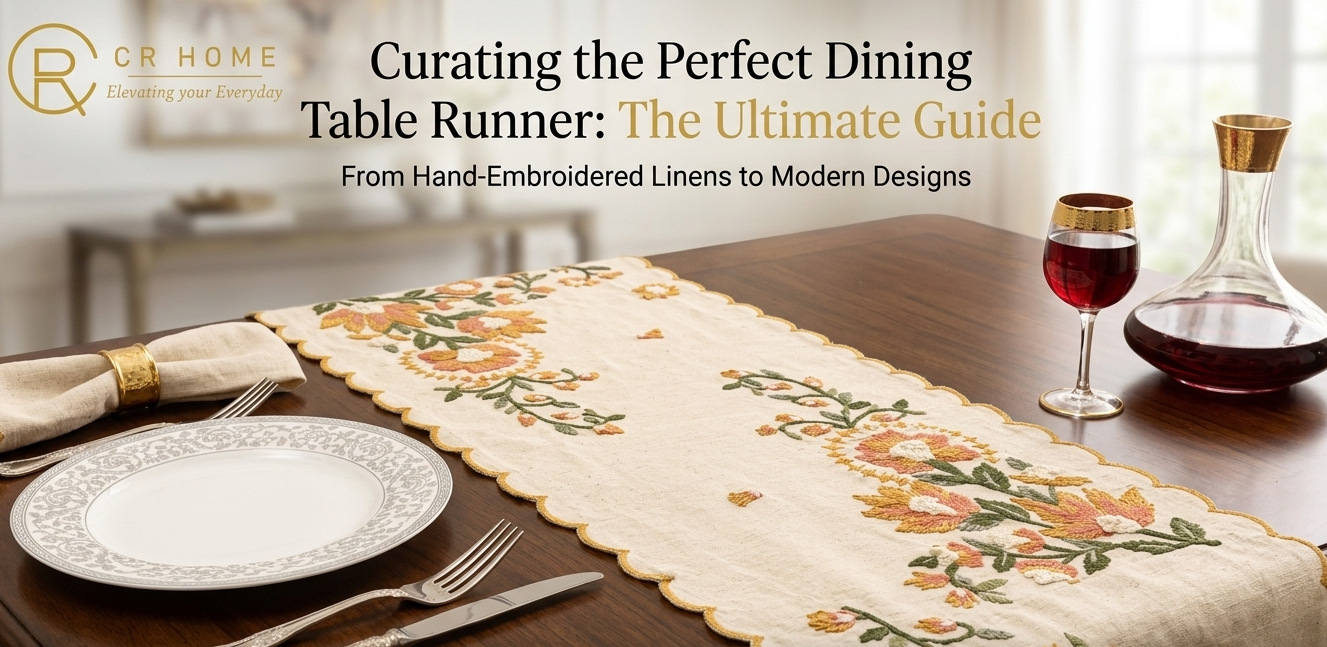
You already own a runner you like. The placemats are a different pattern, maybe a different color entirely, and now you're standing at the table wondering if the two are allowed to sit together. The short answer is no — Table Runner and Placemats don't need to match exactly. What actually matters is whether they coordinate, and coordination is a much lower bar than matching.
This distinction trips people up more than it should. A lot of home décor advice treats "matching" and "coordinated" as the same thing, when really they're two different approaches with different results. At CR Home, the tables we find most interesting are rarely the ones where every textile came from a single boxed set. They're the ones where someone picked pieces that talk to each other without repeating themselves.
Matching Isn't the Same as Coordinating
Matching means identical colors, identical patterns, usually purchased as one set. Coordinating means the pieces share something — a color, a texture, a level of formality — without being copies of each other. A striped runner and a solid placemat in the same shade of blue are coordinated. A floral runner and a checked placemat that both lean toward warm terracotta tones are coordinated. Neither pairing matches, and both work.
This is really the whole answer to whether Table Runner and Placemats need to match: they don't, as long as something ties them together. That "something" can be color, texture, pattern scale, or even just a shared sense of formality — a linen runner and linen napkins read as coordinated even if their colors differ slightly.
Start With Color, Not a Matching Set
Color is the easiest thread to pull. If your placemats are a muted sage green, a runner in cream, oatmeal, or a deeper olive will sit comfortably next to them without needing to be the exact same fabric. Neutrals are forgiving this way — a beige or stone-colored runner works with almost any placemat color because it doesn't compete, it just supports.
Where people get stuck is picking one accent color and building around it. If your placemats have a rust-orange stripe, a solid runner in that same rust tone — or even just a hint of it — creates a visual echo without forcing everything else to match. Warm tones tend to sit well together, and so do cool ones, but mixing a very warm placemat with a very cool runner can look accidental rather than intentional unless there's a neutral in between to bridge them.
Mix Patterns Without Making the Table Look Busy
Two patterns can share a table, but usually only one of them should be doing the loud talking. A bold, large-scale pattern on the runner reads best with a simple, small-scale or solid placemat underneath each plate. Flip it, and a patterned placemat can carry the visual interest while a plain runner keeps things grounded.
What tends to go wrong is two busy patterns competing at the same scale — a floral runner next to a geometric placemat, both fighting for attention. The table ends up looking cluttered even if every individual piece is attractive. A stripe and a solid almost always work because the stripe has structure and the solid gives it room to breathe.
Let Texture Do Some of the Work
When colors and patterns don't line up neatly, texture can still hold things together. A woven cotton placemat next to a smoother linen runner still feels cohesive because both read as natural, unfussy materials. Embroidered detailing on one piece can echo a subtle texture on the other, even without shared color.
This is especially useful if you're mixing everyday placemats with something dressier — a Premium Table Runner in a heavier weave can anchor simpler placemats without either piece feeling out of place. Texture is often the quiet fix when color pairing feels like too much effort.
Consider the Table, Dinnerware and Centerpiece
The runner and placemats aren't styling in isolation — they're one layer in a table that also includes the plates, glassware, napkins, and whatever sits in the middle. A wood table with warm undertones will pull a runner and placemats toward earthy colors whether you plan it or not. White dinnerware is neutral enough to sit on almost any combination, while patterned plates need a quieter table beneath them.
Before adding candles or a centerpiece, look at the runner and placemats together as a base layer. If they already feel busy, keep the centerpiece simple. If they're both fairly plain, that's your opening to add color or texture elsewhere. Browsing a table décor collection with this layered approach in mind, rather than shopping one item at a time, tends to produce a more settled-looking table.
When Matching Table Runner and Placemats Can Work
None of this means matching is wrong. For formal dinners, festive occasions, or a deliberately minimalist, monochromatic table, a matched set can look clean and intentional rather than boring. Matching works particularly well when the goal is a quiet, unified look with no visual competition at all — a single color story from runner to napkin.
The point is that matching is a choice, not a rule. Some tables benefit from that uniformity. Plenty of others look more interesting with pieces that coordinate rather than replicate.
How to Choose Pieces When Shopping Table Runner Online
If you're buying separately rather than as a set, a few things are worth checking before you order:
- Table length and width, so the runner and placemats actually fit proportionally
- The room's existing color palette, so new pieces don't clash with what's already there
- Fabric weight and care instructions, especially for everyday use
- Whether the pattern scale on one piece is loud enough to need a plain partner
- How the pieces will be used — daily meals versus occasional entertaining
Shopping Table Runner and Placemats separately, rather than defaulting to a matched box set, gives you more flexibility to build a table that actually fits your space. CR Home's table runners are worth browsing with your existing placemats in mind rather than starting from scratch.
How to Create a Luxury-Looking Table Without Everything Matching
A refined table setting usually comes down to restraint rather than uniformity. Limiting the palette to two or three colors, keeping fabric quality consistent, and leaving some visible negative space between pieces will do more for a polished look than an exact match ever could.
A Luxury Table Runner paired with simple, solid placemats often looks more considered than a fully matched set, because the eye reads it as a deliberate choice rather than a packaged one. The same goes for a Premium Table Runner used with understated dinnerware — the quality of the fabric carries the table, and it doesn't need every other piece shouting for attention.
Quick Pairing Rules to Remember
- Match one element — color, texture, or pattern — not the whole set
- Let one piece carry the pattern while the other stays quiet
- Use texture to bridge pieces that don't share a color
- Step back and look at the runner and placemats together before adding more
- Keep proportions comfortable so there's still room for plates and serving dishes
FAQ
Do Table Runner and Placemats have to match?
No. They need to coordinate through color, texture, or pattern, but an exact match isn't necessary for the table to look put together.
Can patterned placemats be used with a plain runner?
Yes, and it's often the easier direction to style. A solid runner gives a patterned placemat room to stand out without competing for attention.
How do you mix colors between a runner and placemats?
Pick one shared color or tone between the two pieces, even a subtle one, and let the rest of the palette stay neutral so the table doesn't feel scattered.
Can a Luxury Table Runner work with simple placemats?
Yes — this pairing often looks more sophisticated than a matched set, since the runner's fabric quality becomes the focal point rather than being diluted by a busier placemat.
What should I check before buying a Table Runner Online?
Confirm your table's measurements, check the fabric care instructions, and consider how the pattern or color will sit next to placemats or dinnerware you already own.

 Arabic
 French
 Spanish
 Portuguese
 Deutsch
 Turkish
 Dutch
Dutch
 Italiano
 Russian
 Romaian
 Portuguese (Brazil)
 Greek
Greek
 Bengali