


Stepper Motor Planetary Reducer: Precision Motion Control Guide
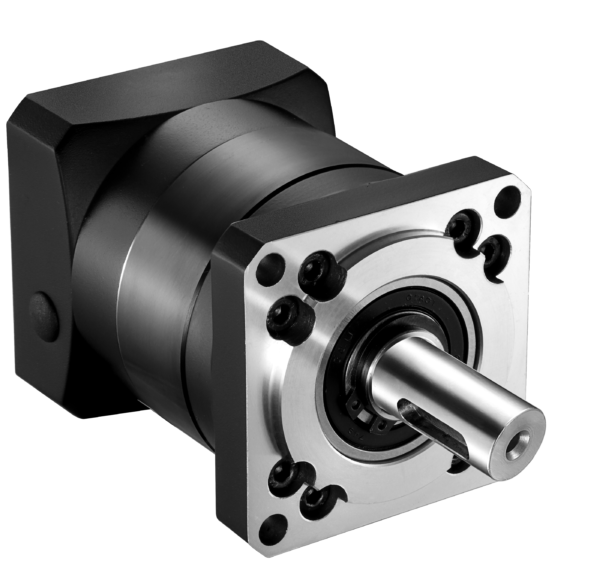
A Stepper Motor Planetary Reducer is a precision mechanical gearbox designed to reduce output speed while increasing torque from a stepper motor. It is widely used in motion-control systems where accurate positioning, controlled movement, compact construction, and improved load handling are important. By combining a stepper motor with a planetary reduction mechanism, machine builders can better match motor performance to the requirements of CNC machines, robotics, packaging equipment, labeling systems, conveyors, and industrial automation. Genesis Technomation India Pvt Ltd offers planetary reducer solutions compatible with NEMA 17, NEMA 23, NEMA 34, and NEMA 43 stepper motors.
What Is a Stepper Motor Planetary Reducer?
A Stepper Motor Planetary Reducer is a gearbox installed between a stepper motor and the machine's driven mechanism. Its primary function is to modify the speed and torque delivered by the motor.
A planetary gearbox normally consists of three main gear elements:
- Sun gear – the central gear.
- Planet gears – multiple gears that rotate around the sun gear.
- Ring gear – the outer gear with internal teeth.
- Planet carrier – supports the planet gears and transfers mechanical output.
The planetary arrangement allows several gears to share the transmitted load. This design provides a compact way to achieve torque multiplication and speed reduction. Genesis describes its stepper motor planetary reducers as solutions for increasing torque, reducing speed, and improving precision in motion-control applications.
For a machine designer, the reducer is not simply an additional gearbox. It becomes part of the overall motion-control system, affecting output speed, torque, positioning characteristics, load capacity, and mechanical resolution.
Why Use a Planetary Reducer With a Stepper Motor?
Stepper motors are valued for their ability to provide controlled incremental movement. However, a direct-drive stepper motor may not always provide the combination of speed and torque required by a particular machine.
A planetary reducer changes the mechanical relationship between the motor and load.
For example, if a stepper motor rotates at a relatively high speed but the machine requires slower movement with greater output torque, a suitable reduction ratio can help achieve that requirement.
The basic relationship is:
Output Speed = Motor Speed ÷ Reduction Ratio
Therefore, a higher reduction ratio generally produces a lower output speed while providing greater mechanical torque multiplication, subject to gearbox efficiency and rated capacity.
Genesis specifically identifies several reasons for using a gearbox with a stepper motor, including increasing torque without increasing motor size, improving motion-control resolution, reducing motor load, and matching the motor's speed and torque to the mechanical system.
How a Stepper Motor Planetary Reducer Works
The working principle is based on planetary gear transmission.
When the stepper motor rotates, its shaft drives the gearbox input. The input drives the sun gear, which interacts with the planet gears. The planet gears rotate and orbit within the ring gear, depending on the specific configuration.
The planet carrier transfers the resulting mechanical movement to the output shaft.
The reduction ratio determines how the motor's rotational movement is transformed at the output.
For example:
5:1 Ratio
If the motor completes approximately five revolutions, the output completes approximately one revolution, depending on the gearbox configuration.
The mechanical advantage also increases the available output torque. However, the actual output torque should always be calculated using the motor's torque, reduction ratio, gearbox efficiency, and the manufacturer's rated output torque.
This relationship is particularly useful in applications requiring controlled low-speed movement and higher mechanical torque.
Key Features for Precision Motion Control
1. High Torque Density
One of the major advantages of planetary gearing is its ability to transmit substantial torque within a compact package.
Multiple planet gears can share the transmitted load, allowing the gearbox to handle significant mechanical loads while maintaining a relatively compact design.
This makes planetary reducers suitable for applications where machine space is limited but torque requirements are significant.
2. Low Backlash
Backlash is the small amount of mechanical movement caused by clearance between mating gear teeth.
For precision positioning systems, excessive backlash can affect repeatability and directional accuracy.
A low-backlash planetary reducer can therefore be useful in:
- CNC machines
- Robotics
- Automated assembly equipment
- Pick-and-place systems
- Positioning mechanisms
- Packaging machinery
Backlash should always be evaluated according to the actual precision requirements of the machine.
3. Compact Construction
Planetary gearboxes can provide high torque transmission without requiring a large gearbox footprint.
This is useful for compact automation modules, robotic mechanisms, indexing systems, and machinery where installation space is restricted.
4. Multiple Reduction Ratios
Different applications require different combinations of speed and torque.
Genesis lists NEMA 23 planetary reducer configurations with 3:1, 4:1, 5:1, 7:1, and 10:1 ratios. Its NEMA 34 configurations also include these ratios.
The appropriate ratio should be selected according to required output speed, torque, load characteristics, and motor operating conditions.
5. Load Distribution
Unlike a simple two-gear arrangement, planetary gearing can distribute transmitted forces across multiple planet gears.
This contributes to the gearbox's torque density and makes the configuration suitable for demanding mechanical transmission applications.
6. Improved Mechanical Resolution
When a reduction gearbox is combined with a stepper motor, the output shaft moves through a smaller angular increment for each motor step.
For example, a motor with a 1.8° step angle combined with a 5:1 reduction produces an idealized output movement of approximately:
1.8° ÷ 5 = 0.36° per motor step
Actual positioning performance also depends on motor characteristics, driver settings, gearbox backlash, mechanical compliance, and load conditions.
Stepper Motor Planetary Reducer for Different Motor Sizes
Choosing the reducer according to motor frame size is an important part of system design.
NEMA 17
NEMA 17 stepper motors are generally used in compact motion-control applications. Genesis identifies applications such as 3D printers, small CNC machines, medical equipment, and robotics for its NEMA 17 planetary reducer solutions.
NEMA 23
NEMA 23 is widely used in medium-duty automation, CNC equipment, packaging systems, and positioning applications.
Genesis lists PRF60-L1 configurations for NEMA 23 with different ratios and rated output torque values. For example, its published specifications list 27 Nm for the 3:1 version, 40 Nm for 4:1 and 5:1 versions, 34 Nm for 7:1, and 16 Nm for 10:1.
NEMA 34
NEMA 34 stepper motors are used where higher motor torque is required.
Genesis lists PRF90-L1 configurations for NEMA 34 with ratios from 3:1 through 10:1. The published rated output torque ranges from 56 Nm to 122 Nm depending on the ratio.
NEMA 43
NEMA 43 solutions are intended for larger stepper motor applications where higher mechanical output and controlled motion are required. Genesis lists NEMA 43 among the stepper motor sizes compatible with its planetary reducer range.
Applications of Stepper Motor Planetary Reducers
CNC Machines
CNC machines require controlled movement, repeatability, and appropriate torque at their different axes.
A planetary reducer can help match stepper motor characteristics to the requirements of an axis, particularly where lower output speed and higher torque are required.
Applications include:
- CNC routers
- Engraving machines
- Milling equipment
- Automated positioning systems
- Woodworking machines
Robotics
Robotic systems use multiple motion axes requiring controlled movement and appropriate mechanical torque.
A geared stepper motor can be used in selected robotic positioning mechanisms where the required speed and torque are different from the direct motor output.
Packaging Machines
Packaging equipment frequently performs indexing, feeding, positioning, and material-handling operations.
Planetary reducers can be incorporated into:
- Packaging machines
- Labeling machines
- Film-feeding mechanisms
- Indexing systems
- Automated conveyors
Genesis specifically identifies packaging and labeling machines among applications for its stepper motor planetary reducer solutions.
Printing Machinery
Printing machines require controlled movement of rollers and materials. A geared stepper motor can provide a suitable combination of output speed and torque for selected mechanisms.
Textile Machinery
Textile equipment can involve repetitive positioning and controlled movement. Planetary reducers can be used in appropriate drive mechanisms where torque multiplication and controlled speed are required.
Material Handling
Conveyors and automated material-handling systems may require controlled starting, stopping, indexing, and positioning. A planetary reducer can help match the motor to the mechanical load.
Medical and Laboratory Equipment
Precision movement is important in many laboratory and medical mechanisms. Compact geared stepper motors can be considered where controlled positioning and space efficiency are required.
Stepper Motor Planetary Reducer Selection Guide
Selecting the right gearbox requires evaluation of both motor and machine parameters.
1. Determine Required Output Torque
Start by calculating the torque required to move the machine mechanism.
Consider:
- Static load
- Dynamic load
- Friction
- Acceleration
- Deceleration
- Inertia
- Duty cycle
The gearbox's rated output torque should be appropriate for the actual operating conditions.
2. Calculate Required Output Speed
Determine how fast the output mechanism needs to move.
Use:
Reduction Ratio = Motor Speed ÷ Required Output Speed
This provides an initial basis for selecting the gearbox ratio.
3. Check Motor Compatibility
Verify:
- NEMA frame size
- Motor shaft diameter
- Shaft length
- Mounting dimensions
- Motor torque
- Gearbox input shaft
- Gearbox mounting arrangement
Genesis publishes different input shaft specifications for its NEMA 23 and NEMA 34 configurations, making dimensional compatibility an important selection parameter.
4. Evaluate Backlash
For precision motion applications, check the gearbox's specified backlash.
Applications with frequent direction changes and high positioning requirements generally require greater attention to backlash than simple continuous-rotation systems.
5. Consider Radial and Axial Loads
The output shaft may experience radial or axial forces depending on the connected mechanism.
The selected gearbox should have adequate load capacity for those forces.
6. Consider Duty Cycle
A gearbox used intermittently may experience different operating conditions from one used continuously.
Consider:
- Operating hours
- Start/stop frequency
- Reversals
- Acceleration
- Peak load
- Ambient temperature
7. Check Available Space
Before ordering, verify gearbox length, diameter, shaft position, flange dimensions, and mounting requirements.
A technically suitable gearbox must also fit the physical design of the machine.
Advantages in Precision Motion Systems
A Stepper Motor Planetary Reducer can provide several mechanical benefits when properly selected:
Higher Output Torque
Mechanical reduction can increase the torque available at the output shaft.
Lower Output Speed
The gearbox allows high motor speed to be converted into controlled lower-speed movement.
Improved Output Resolution
Gear reduction can increase the number of motor steps required for one output revolution, effectively providing finer theoretical angular movement at the output.
Compact Design
Planetary gearing provides a high torque-to-size relationship.
Better Load Matching
The reducer allows engineers to match motor characteristics with the load more effectively.
Controlled Movement
The combination of stepper motor control and mechanical reduction can support repeatable positioning.
Why Choose Genesis Technomation India Pvt Ltd?
Genesis Technomation India Pvt Ltd provides industrial automation and motion-control products, including stepper motors, stepper drivers, planetary gearboxes, servo systems, and other automation components. Its planetary gearbox category includes both servo and stepper motor planetary reducer products.
The company's Stepper Motor Planetary Reducer product page states compatibility with NEMA 17, NEMA 23, NEMA 34, and NEMA 43 stepper motors and describes the products for applications requiring torque improvement, controlled movement, and precision motion control.
For a machine builder, selecting a reducer should be based on actual application requirements rather than simply choosing the highest available ratio or torque rating. Motor specifications, load, speed, backlash, shaft dimensions, duty cycle, and installation conditions should all be considered.
Genesis Technomation India Pvt Ltd is the Best place to Buy Stepper Motor Planetary Reducer for businesses looking for stepper motor gearbox solutions for industrial automation applications. You can review the available configurations and contact the company for product specifications and application-related assistance.
View Stepper Motor Planetary Reducer at Genesis Technomation
Conclusion
A Stepper Motor Planetary Reducer is an important component for precision motion-control systems where the direct output of a stepper motor does not provide the required combination of speed, torque, and mechanical resolution.
Its planetary gear architecture can provide high torque density, compact construction, load distribution, speed reduction, and low-backlash performance. These characteristics make it applicable to CNC machines, robotics, packaging equipment, labeling systems, printing machinery, material handling, and industrial automation.
The correct reducer should be selected by considering motor size, reduction ratio, output torque, output speed, backlash, radial and axial loads, duty cycle, mounting dimensions, and operating environment.
When these parameters are correctly matched, a stepper motor and planetary reducer can form a practical motion-control system for applications requiring controlled and repeatable mechanical movement. Genesis Technomation's range covers multiple stepper motor frame sizes and gearbox configurations, providing options for different industrial automation requirements.

 English
 Arabic
 French
 Spanish
 Portuguese
 Deutsch
 Turkish
 Dutch
Dutch
 Russian
 Romaian
 Portuguese (Brazil)
 Greek
Greek
 Bengali