


Vehicle-to-Grid Market 2026-2034: Size, Share, Key Trends, Growth Analysis & Industry Report
Market Overview
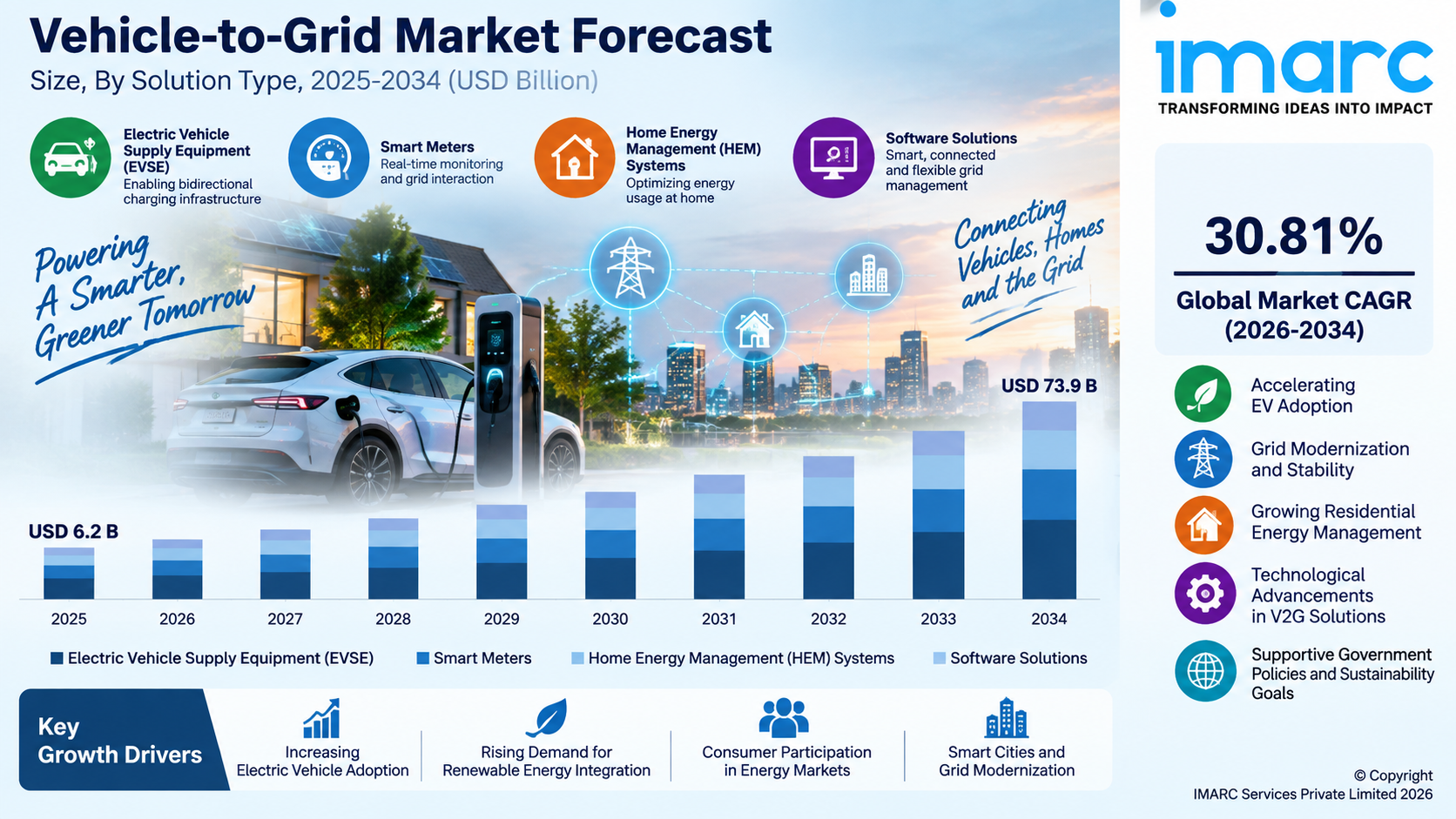
According to a research report by IMARC Group, the global vehicle-to-grid market size reached USD 6.2 Billion in 2025. Looking forward, IMARC Group expects the market to reach USD 73.9 Billion by 2034, exhibiting a growth rate (CAGR) of 30.81% during 2026-2034. Europe currently leads the regional landscape, accounting for 36.6% of the market share in 2025, supported by aggressive decarbonization targets, increasing EV adoption, supportive government policies, and growing investments in smart grid infrastructure. The rising adoption of electric vehicles, increasing demand for smart energy solutions, growing renewable energy deployment, and advancements in battery and smart charging technologies are some of the major factors positively influencing the market.
Market Drivers, Challenges & Opportunities
Major Market Drivers:
-
Increasing EV Production and Sales: Growing EV adoption is expanding the number of vehicles that can potentially serve as distributed energy storage resources.
-
Supportive Government Initiatives: Government policies, incentives, regulations, and R&D investments are encouraging vehicle-to-grid deployment.
-
Growing Smart Grid Adoption: Smart grids provide the infrastructure needed to intelligently manage energy flows between EVs and the electricity grid.
-
Renewable Energy Integration: Increasing wind and solar deployment is creating demand for flexible energy storage and grid-balancing solutions.
-
Advancements in Battery and Charging Technologies: Improvements in battery performance and smart charging systems are making vehicle-to-grid applications increasingly practical.
Key Challenges:
-
Infrastructure Requirements: Vehicle-to-grid deployment requires compatible EVs, bidirectional chargers, communication systems, and grid infrastructure.
-
Technology Coordination: Effective implementation requires coordination among automakers, utilities, charging providers, software companies, consumers, and regulatory bodies.
-
Battery Management: Frequent charging and discharging require appropriate battery management strategies to maintain reliable vehicle and energy-storage performance.
Emerging Opportunities:
-
Bidirectional Charging Expansion: Growing demand for bidirectional charging is creating opportunities for EV and charging infrastructure manufacturers.
-
Smart Grid Modernization: Continued investment in grid modernization is opening new avenues for vehicle-to-grid integration.
-
Fleet Applications: Commercial fleets with vehicles that remain parked for extended periods can provide substantial energy storage capacity.
-
Renewable Energy Integration: Vehicle-to-grid systems can help store surplus renewable electricity and supply it during periods of higher demand.
-
Energy Cost Optimization: Vehicle-to-grid technology can help users and businesses manage electricity consumption and potentially generate revenue from stored energy.
Request for a Sample Report for Detailed Evaluation: https://www.imarcgroup.com/vehicle-to-grid-market/requestsample
What Is Driving Vehicle-to-Grid Market Growth in 2026?
Increasing Production and Sales of EVs
A surge in electric vehicle production and sales is positively influencing the vehicle to grid technology market. According to the information provided in the report, global EV sales grew by approximately 30% annually from 2013 to 2023, while nearly 14 million new EVs were registered worldwide in 2023. The International Energy Agency (IEA) further reported that EV sales in 2023 were 3.5 million higher than in 2022, representing a 35% increase.
As EV adoption continues to expand, the potential to use vehicle batteries as mobile energy storage assets is also increasing. Consumers are becoming more familiar with the benefits of EVs and increasingly accepting the concept of using vehicle batteries for both transportation and energy storage or energy transfer. This evolving consumer perception is supporting the adoption of vehicle-to-grid systems and contributing to the growth of the vehicle-to-grid chargers market. The increasing deployment of charging infrastructure and bidirectional charging solutions is further creating opportunities for the expansion of the global vehicle-to-grid chargers market.
Supportive Government Initiatives and Policies
Supportive government initiatives and policies are creating a favorable outlook for the vehicle-to-grid market. Such measures can reduce cost barriers for consumers and businesses while encouraging investment in vehicle-to-grid infrastructure and technologies. Governments are also establishing regulations and standards that promote renewable energy integration and grid stability.
Public investments in research and development activities are further helping advance vehicle-to-grid technologies and make them more efficient and accessible. For instance, in 2024, China's National Development and Reform Commission (NDRC) issued an order to establish preliminary technical standards for incorporating new energy vehicles into the grid by 2025. The initiative also anticipated that new energy vehicles would form a significant part of the country's new storage infrastructure by 2030.
Furthermore, the NDRC intended to initiate more than 50 pilot projects in areas considered suitable for vehicle-to-grid integration, including the Yangtze River Delta, Beijing, Sichuan, the Pearl River Delta, and Chongqing.
Growing Adoption of Smart Grids
The widespread adoption of smart grids is propelling vehicle-to-grid market growth. Smart grids enable intelligent management of electricity supply and demand, improving grid stability, reliability, and efficiency. Vehicle-to-grid systems can function as flexible energy resources within these networks by storing surplus electricity during periods of low demand and supplying power back to the grid during peak demand.
This load-balancing capability can optimize electricity distribution and support grid stability. Smart grid deployment is also encouraging renewable energy integration, which is important for the development of vehicle-to-grid systems. According to the IEA, spending on electricity grids increased by about 8% in 2022 as developed and developing regions invested in electrification and renewable energy integration.
The European Union intended to allocate EUR 584 Billion by 2030, including EUR 400 Billion for distribution networks. China announced USD 77 Billion for 2023 and USD 329 Billion throughout its 14th Five-Year Plan, while Japan launched a YEN 20 Trillion fund aimed at new grid technologies. India also introduced a USD 36.8 Billion program for smart meters, while the US Department of Energy proposed a USD 10.5 Billion initiative for grid enhancement.
Advancements in Battery and Smart Charging Technologies
Advancements in battery performance and smart charging systems are making vehicle-to-grid technology more practical and reliable. Improved battery technologies can support the repeated charging and discharging required for vehicle-to-grid applications, while intelligent charging systems provide greater control over energy flows.
These developments are helping address concerns associated with vehicle-to-grid implementation and enabling more efficient management of electricity. Utilities, energy providers, fleet operators, and EV owners can increasingly utilize smart charging capabilities to manage electricity consumption, support peak demand requirements, and integrate renewable energy.
Vehicle-to-Grid Market Segmentation Analysis
By Solution Type
-
Electric Vehicle Supply Equipment (EVSE)
-
Smart Meters
-
Home Energy Management (HEM) Systems
-
Software Solutions
Electric vehicle supply equipment (EVSE) accounted for 83.5% of the market share in 2025, representing the leading solution type. EVSE serves as the primary connection between EVs and the power grid and manages electricity flow between vehicles and the grid.
Advanced EVSE supports two-way charging and energy transfer while facilitating communication between vehicles and the grid. Features such as load balancing, real-time monitoring, and remote control are important for vehicle-to-grid operations. As EV adoption increases, demand for reliable and intelligent charging infrastructure is expanding.
Manufacturers are continuing to develop advanced charging units capable of efficiently managing bidirectional energy flows. Utilities and energy providers are also utilizing EVSE for applications such as peak shaving, grid balancing, and renewable energy integration, supporting its dominant position across residential and commercial applications.
By Vehicle Type
-
Battery Electric Vehicle (BEV)
-
Fuel Cell Electric Vehicle (FCEV)
-
Plug-In Hybrid Electric Vehicle (PHEV)
Battery electric vehicles (BEVs) accounted for 64.4% of the market share in 2025. BEVs hold a leading position due to their substantial battery capacities, which provide considerable energy storage capabilities. Vehicle-to-grid technology enables BEVs to store and release electricity to the grid, helping manage energy supply and demand.
The increasing adoption of BEVs, supported by improvements in battery technology, government initiatives, and growing environmental awareness, is further strengthening the segment. According to the IEA's yearly outlook information provided in the report, BEVs and PHEVs were expected to account for nearly two-thirds of worldwide automobile sales by 2035.
In 2024, sales of these vehicles increased by more than 20%, reaching 17 Million compared with nearly 14 Million in 2023. The growing penetration of BEVs is consequently creating a larger base of vehicles capable of participating in vehicle-to-grid applications.
By Charging Type
-
Unidirectional Charging
-
Bidirectional Charging
Bidirectional charging accounted for 78.4% of the market share and represents the leading charging type. It enables EVs to both receive electricity from and supply electricity to the grid, allowing vehicles to function as mobile energy storage resources.
Bidirectional charging supports renewable energy integration by storing surplus electricity during periods of low demand and supplying it during periods of higher demand. It can also help lower electricity expenses for users and create potential revenue opportunities, supporting adoption.
For instance, in June 2023, Renault announced plans to implement bidirectional charging in the all-electric Renault 5, which was expected to become the first Renault model featuring this technology. The vehicle-to-grid service was planned for launch with the Renault 5 in France and Germany in 2024 and subsequently in the UK in 2025 under Renault's mobility brand, Mobilize.
By Application
-
Peak Power Sales
-
Spinning Reserves
-
Base Load Power
-
Others
Peak power sales accounted for 46.3% of the market share, representing the leading application. During periods of high electricity demand, EV batteries can supply additional electricity to the grid, creating potential compensation opportunities for vehicle owners while supporting grid stability.
Peak power sales can reduce reliance on conventional power generation during periods of high demand and facilitate renewable energy integration. The economic benefits for EV owners and grid benefits for utilities are contributing to the importance of this application.
For instance, in February 2024, Nissan Motor Co., Ltd. announced the introduction of its Nissan Energy Share service in Japan to increase the value of EVs. The service utilized energy management technology to manage EV battery charging and discharging for businesses and local governments. It provided load shifting through intelligent charging, peak reduction through controlled discharge during periods of high demand, and optimized renewable energy utilization through solar panel integration.
By Region
-
North America
-
United States
-
Canada
-
-
Asia Pacific
-
China
-
Japan
-
India
-
South Korea
-
Australia
-
Indonesia
-
Others
-
-
Europe
-
Germany
-
France
-
United Kingdom
-
Italy
-
Spain
-
Russia
-
Others
-
-
Latin America
-
Brazil
-
Mexico
-
Others
-
-
Middle East and Africa
Europe holds the leading position in the global vehicle-to-grid market, accounting for 36.6% of the market share in 2025. The region's market is supported by aggressive decarbonization targets, rapid EV adoption, regulatory support for smart grid integration, and increasing renewable energy penetration.
According to Eurostat, the European Union recorded a 2.6% decrease in greenhouse gas emissions during Q2 2024 compared with Q2 2023. The European Union's Green Deal and Fit for 55 package are supporting efforts to reduce carbon emissions and promote energy efficiency and renewable energy integration, creating a favorable environment for vehicle-to-grid systems.
Countries such as the Netherlands, the UK, Germany, and France are supporting vehicle-to-grid deployment through pilot programs, funding, and national energy strategies. Increasing wind and solar energy deployment is also creating demand for flexible energy resources capable of managing renewable energy intermittency.
According to the information provided, Europe added 16.4 GW of new wind power capacity in 2024, bringing total capacity to 285 GW. Between 2025 and 2030, the region is projected to add 187 GW of new wind energy capacity, taking total installations to 450 GW by 2030.
Key Regional Insight: Europe's Strategic Position
Europe's leading position in the vehicle-to-grid market is supported by its strong focus on decarbonization, growing EV penetration, renewable energy deployment, and smart grid development. The region's increasing reliance on intermittent renewable sources such as wind and solar is creating a greater need for flexible energy resources.
Vehicle-to-grid technology can help manage electricity demand and supply by enabling EV batteries to store surplus electricity and provide power when required. Automakers and energy companies are also forming partnerships to develop vehicle-to-grid solutions, supporting technology deployment across the region.
North America Vehicle-to-Grid Market Analysis
North America is characterized by strong EV adoption, advanced technology development, and supportive government policies. The region has an established EV infrastructure and a growing network of smart charging stations. Automakers, technology companies, utilities, research institutions, and start-ups are investing in vehicle-to-grid research and development.
Utilities are exploring vehicle-to-grid systems to support grid stability and reduce peak electricity demand, while government initiatives are promoting clean energy and funding vehicle-to-grid pilot projects. Increasing electricity demand and investments in renewable energy and grid modernization are also creating opportunities for flexible energy solutions.
According to Statistics Canada, electricity utilization in Canada increased by 7.4% in December 2024 compared with 2023, reaching 59.9 Million MWh. This growing electricity demand, combined with EV adoption and grid modernization initiatives, is supporting the development of vehicle-to-grid technology across the region.
United States Vehicle-to-Grid Market Analysis
The United States vehicle-to-grid market accounted for 88.90% of the North American market, driven by growing EV adoption, supportive government policies, and increasing focus on grid resilience and energy decentralization. According to the Smart Electric Power Alliance (SEPA), 320,000 EVs were sold in the United States during Q1 2023, representing a 60% increase compared with Q1 2022.
As EV penetration increases, utilities and grid operators are increasingly considering EV batteries as distributed energy storage resources. Vehicle-to-grid technology enables bidirectional power flow between EVs and the electricity grid, allowing stored battery energy to support peak demand, renewable energy integration, and ancillary services such as frequency regulation.
Federal and state initiatives are supporting vehicle-to-grid pilot projects and infrastructure development. Utilities are also exploring incentives for vehicle-to-grid-compatible chargers, while automakers are introducing models capable of supporting bidirectional energy transfer.
The growing occurrence of extreme weather events and power outages is also highlighting the potential role of decentralized energy storage. Fleet operators, including those involved in school transportation and logistics, are exploring vehicle-to-grid systems as a means of utilizing idle battery capacity.
Asia-Pacific Vehicle-to-Grid Market Analysis
The Asia-Pacific vehicle-to-grid market is expanding on account of rising EV penetration, increasing renewable energy deployment, and strong government support for smart energy infrastructure. Countries such as China, Japan, South Korea, and Australia are investing in EV ecosystems and grid modernization.
Japan has been a pioneer in vehicle-to-grid innovation, utilizing its EV ecosystem and disaster-preparedness policies to support bidirectional charging. China is also investing heavily in EVs and renewable energy, increasing the need for flexible energy storage solutions.
According to the information provided in the report, renewable energy sources accounted for 29% of electricity generation in Asia in 2024. Wind and solar energy represented 18% of China's electricity generation in 2024. Increasing investment in renewable energy, distributed energy systems, and peak load management is consequently supporting vehicle-to-grid adoption across the region.
Latin America Vehicle-to-Grid Market Analysis
In Latin America, the market is being supported by increasing EV adoption, government focus on grid modernization, and the growing need for energy resilience in urban areas. Brazil, Chile, and Colombia are expanding EV infrastructure while exploring smart grid technologies to manage electricity demand and integrate renewable energy.
Brazil registered 52,000 new EV registrations in 2023, representing a growth of 181.1% compared with 2022. The increasing adoption of EVs is creating a larger base of potential mobile energy storage resources.
Vehicle-to-grid technology can support grid stability in regions with variable solar and hydroelectric generation. Growing interest in decentralized energy systems and partnerships with international energy companies are also supporting pilot projects aimed at evaluating the technical and economic potential of vehicle-to-grid systems.
Middle East and Africa Vehicle-to-Grid Market Analysis
The Middle East and Africa vehicle-to-grid market is witnessing growth due to increasing investments in electric mobility, renewable energy expansion, and efforts to enhance energy security. For instance, Saudi Arabia incorporated 2,100 MW of renewable energy capacity into the grid in 2022, increasing total installed capacity to 2,800 MW.
Countries such as the UAE are promoting EV adoption alongside ambitious solar and wind energy targets, creating demand for grid-balancing technologies such as vehicle-to-grid systems. The technology is also being explored for optimizing energy utilization in high-demand urban areas and reducing reliance on fossil fuel-based generation during peak periods.
Competitive Landscape in the Vehicle-to-Grid Industry
The competitive landscape of the global vehicle-to-grid market includes EV manufacturers, charging infrastructure providers, battery manufacturers, software companies, energy companies, and utilities. These players are developing technologies that enable bidirectional energy flows, intelligent charging, energy management, and real-time coordination between EVs and electricity grids.
EV manufacturers are introducing vehicles with bidirectional charging capabilities, while charging infrastructure companies are developing smart charging stations capable of managing two-way energy exchange. Battery manufacturers are also improving energy storage performance to support frequent charging and discharging.
Energy companies and utilities are collaborating with technology providers to conduct pilot projects and develop scalable vehicle-to-grid solutions. For instance, in June 2024, Toyota Motor North America partnered with local energy provider Pepco for vehicle-to-grid research in Maryland using the Toyota bZ4X BEV. The project aimed to investigate bidirectional power flow and examine how EV owners could charge their vehicles and supply electricity back to the local grid.
Key Vehicle-to-Grid Market Players Include:
-
AC Propulsion Inc.
-
Coritech Services Inc.
-
DENSO Corporation
-
Enerdel Inc.
-
ENGIE Group
-
EV Grid
-
Hitachi Ltd.
-
Nissan Motor Company Ltd.
-
NRG Energy Inc.
-
OVO Energy Ltd.
-
and others
Note: The above represents a partial list of companies covered in the report. The complete list of companies has been provided in the full report.
Recent Developments:
-
In May 2025, Mercedes-Benz and the Mobility House announced a Europe-wide collaboration focused on promoting vehicle-to-grid integration. The companies planned to combine their expertise in charging technologies and electromobility to connect Mercedes-Benz EVs with energy infrastructure and provide homes with unidirectional and bidirectional smart charging solutions.
-
In April 2025, the Kerala State Electricity Board (KSEB) collaborated with IIT Bombay to initiate a pilot project evaluating the viability of vehicle-to-grid technology in Kerala. The initiative aimed to assess the use of EVs for grid management and renewable energy integration.
Market Drivers, Challenges & Opportunities
Major Market Drivers:
-
Increasing EV Production and Sales: Growing EV adoption is expanding the number of vehicles that can potentially serve as distributed energy storage resources.
-
Supportive Government Initiatives: Government policies, incentives, regulations, and R&D investments are encouraging vehicle-to-grid deployment.
-
Growing Smart Grid Adoption: Smart grids provide the infrastructure needed to intelligently manage energy flows between EVs and the electricity grid.
-
Renewable Energy Integration: Increasing wind and solar deployment is creating demand for flexible energy storage and grid-balancing solutions.
-
Advancements in Battery and Charging Technologies: Improvements in battery performance and smart charging systems are making vehicle-to-grid applications increasingly practical.
Key Challenges:
-
Infrastructure Requirements: Vehicle-to-grid deployment requires compatible EVs, bidirectional chargers, communication systems, and grid infrastructure.
-
Technology Coordination: Effective implementation requires coordination among automakers, utilities, charging providers, software companies, consumers, and regulatory bodies.
-
Battery Management: Frequent charging and discharging require appropriate battery management strategies to maintain reliable vehicle and energy-storage performance.
Emerging Opportunities:
-
Bidirectional Charging Expansion: Growing demand for bidirectional charging is creating opportunities for EV and charging infrastructure manufacturers.
-
Smart Grid Modernization: Continued investment in grid modernization is opening new avenues for vehicle-to-grid integration.
-
Fleet Applications: Commercial fleets with vehicles that remain parked for extended periods can provide substantial energy storage capacity.
-
Renewable Energy Integration: Vehicle-to-grid systems can help store surplus renewable electricity and supply it during periods of higher demand.
-
Energy Cost Optimization: Vehicle-to-grid technology can help users and businesses manage electricity consumption and potentially generate revenue from stored energy.
Vehicle-to-Grid Market FAQs
1. What is the current size of the vehicle-to-grid market?
The global vehicle-to-grid market reached USD 6.2 Billion in 2025 and is projected to reach USD 73.9 Billion by 2034, registering a CAGR of 30.81% during 2026-2034.
2. What is driving the growth of the vehicle-to-grid market?
The market is driven by increasing EV production and sales, supportive government initiatives and policies, growing smart grid adoption, renewable energy integration, advancements in battery technology, and the development of smart and bidirectional charging systems.
3. Which region dominates the vehicle-to-grid market?
Europe leads the global vehicle-to-grid market, accounting for 36.6% of the market share in 2025, supported by EV adoption, decarbonization targets, regulatory support, renewable energy deployment, and smart grid integration.
4. Which segment holds the largest share in the vehicle-to-grid market?
Electric vehicle supply equipment (EVSE) leads by solution type with an 83.5% share, battery electric vehicles (BEVs) lead by vehicle type with a 64.4% share, bidirectional charging leads by charging type with a 78.4% share, and peak power sales lead by application with a 46.3% share.
5. What are the key trends in the vehicle-to-grid market?
Key trends include increasing EV adoption, growing use of EVs as distributed energy resources, increasing deployment of bidirectional charging, expansion of smart grids, integration of renewable energy, supportive government policies, and advancements in battery and smart charging technologies.
About the Author:
IMARC Group is a leading global market research company providing data-driven insights and expert consulting services to businesses seeking to achieve their strategic objectives. With a multi-disciplinary team of industry experts, IMARC delivers thorough, reliable market intelligence across sectors including Energy and Mining, Construction and Manufacturing, Automotive, Chemicals and Materials, and more.
Media & Sales Contact:
IMARC Group
United States: +1-201-971-6302
India: +91-120-433-0800
United Kingdom: +44-753-714-6104

 English
 Arabic
 Spanish
 Portuguese
 Deutsch
 Turkish
 Dutch
Dutch
 Italiano
 Russian
 Romaian
 Portuguese (Brazil)
 Greek
Greek
 Bengali