


Lithium-Ion Cell Manufacturing Subsidy in India
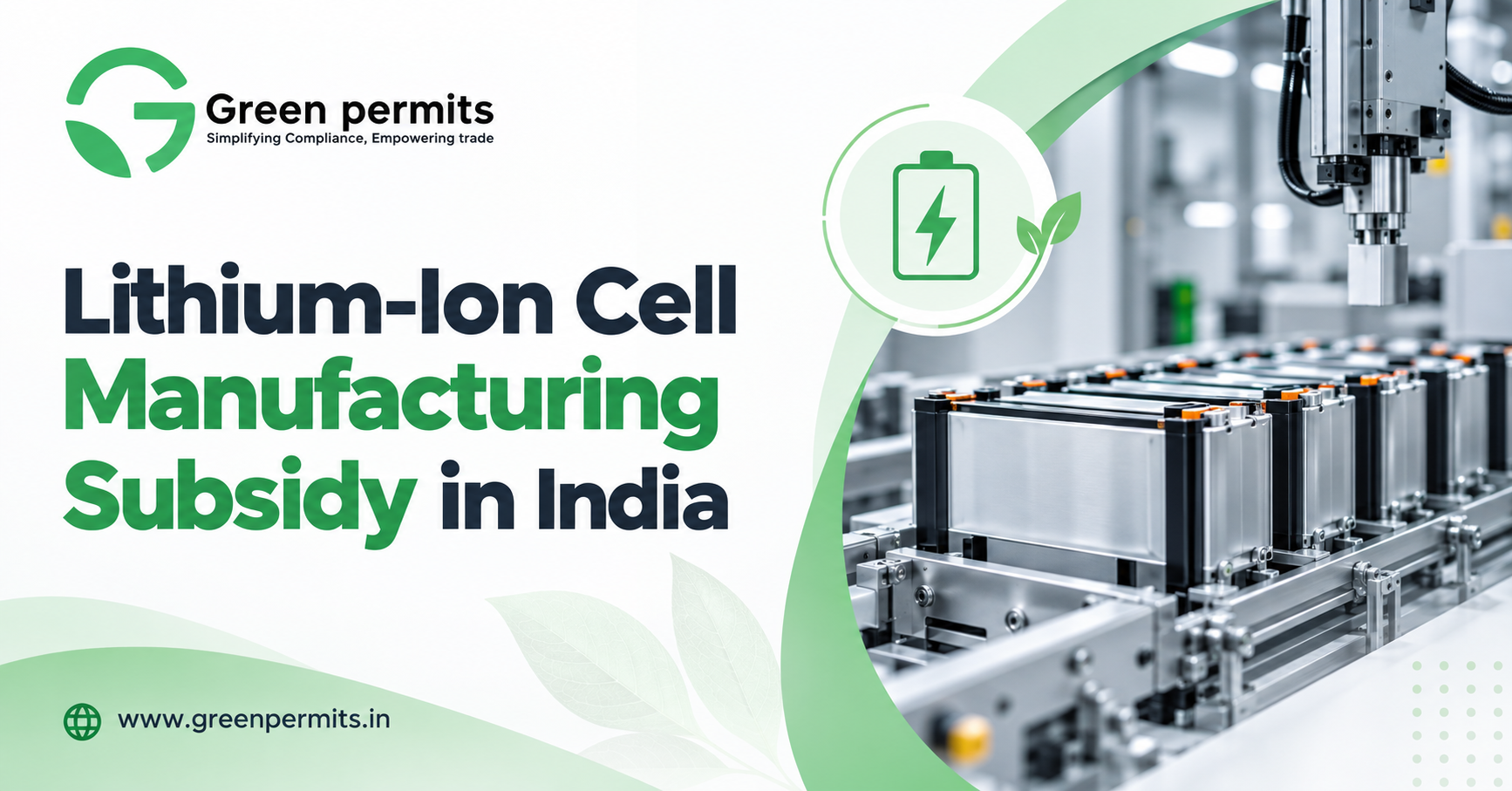
Setting up a lithium-ion cell manufacturing plant in India requires substantial investment in production machinery, dry rooms, utilities, laboratories, automation, fire-safety systems and working capital. Because of this high capital requirement, government incentives and industrial subsidies can play an important role in project planning.
India is actively encouraging domestic battery cell production to reduce dependence on imported Advanced Chemistry Cells and support electric vehicles, Battery Energy Storage Systems and other energy applications.
The Government of India's major central support programme is the Production Linked Incentive Scheme for Advanced Chemistry Cell Battery Storage - PLI ACC. The scheme has an approved outlay of ₹18,100 crore and targets 50 GWh of domestic ACC manufacturing capacity. As of 2026, 40 GWh had already been allocated to four beneficiary companies.
Green Permits Consulting supports investors with battery cell manufacturing feasibility studies, subsidy assessment, DPR preparation, plant-capacity planning, project finance and regulatory approvals.
Why Lithium-Ion Cell Manufacturing is Growing in India
Lithium-ion cells are increasingly required for electric two-wheelers, cars, buses, commercial vehicles, consumer electronics and stationary energy-storage projects.
India currently imports a significant portion of its battery cells. The government's ACC programme is therefore designed to develop domestic manufacturing capability and create a local supply chain for cells and battery materials.
Government data also shows that manufacturers outside the existing PLI beneficiaries have announced significant additional battery-cell manufacturing capacity, indicating growing private investment in the sector.
For a new investor, however, growing national demand alone is not enough. The project still needs the right cell chemistry, customer base, plant capacity, technology and financing structure.
What is the ACC Battery PLI Scheme?
The National Programme on Advanced Chemistry Cell Battery Storage provides production-linked incentives for selected large-scale battery cell manufacturing projects.
The scheme is technology agnostic, meaning manufacturers can use different advanced cell technologies provided they satisfy the applicable performance and scheme conditions.
Under the scheme, beneficiary companies must achieve prescribed levels of domestic value addition. The Ministry of Heavy Industries states that value addition must reach at least 25% initially and increase to 60% within the prescribed period. The scheme also specifies a mandatory investment benchmark of ₹225 crore per GWh of committed capacity for applicable beneficiaries.
This ₹225 crore/GWh figure is a scheme investment condition, not a universal estimate of the total cost of every lithium-ion cell plant.
Is Subsidy Available to Every Lithium-Ion Cell Manufacturer?
No.
A company does not automatically receive PLI incentives simply because it establishes a battery cell manufacturing facility.
The ACC PLI operates through a competitive beneficiary-selection process. Out of the targeted 50 GWh, 40 GWh had been allocated by 2026. In July 2026, the Ministry of Heavy Industries opened a fresh global tender for the remaining 10 GWh, specifically earmarked for Grid-Scale Stationary Storage applications. The tender's stated submission deadline is 13 October 2026.
This means investors should verify the current scheme window and eligibility rather than building the entire financial model around an assumed subsidy.
A stronger project structure is:
Commercially Viable Plant + Confirmed Incentive Eligibility = Stronger Project Economics
State Government Subsidies
Apart from the central ACC PLI scheme, battery manufacturing projects may also qualify for incentives under state industrial policies.
Depending on the selected state and investment size, support may relate to capital investment, electricity, land, stamp duty, employment generation, interest support or other manufacturing incentives.
States such as Gujarat, Tamil Nadu and Karnataka already host ACC projects under the current PLI programme.
However, location should not be selected purely because one state advertises a higher subsidy.
The investor should compare:
Subsidy + Power Cost + Land + Logistics + Labour + Customer Proximity + Supply Chain
A smaller incentive in a better industrial location can sometimes create stronger long-term economics.
LFP, NMC and Other Cell Technologies
A lithium-ion cell project should define the target chemistry before machinery planning begins.
LFP - Lithium Iron Phosphate is increasingly used in electric mobility and stationary energy storage because of its cycle life, thermal characteristics and material-cost profile.
NMC - Nickel Manganese Cobalt cells may be used where higher energy density is important.
Technology selection affects raw materials, equipment, customer requirements, plant design and project economics.
The investor should therefore avoid purchasing machinery before deciding which market the plant intends to serve.
Selecting the Right Plant Capacity
Battery cell plants are generally planned in GWh of annual production capacity.
A promoter may consider a 1 GWh, 5 GWh or larger manufacturing facility, but the optimum capacity should depend on realistic demand.
For example, a 5 GWh plant needs enough customers to absorb several years of production. The promoter should therefore identify potential EV manufacturers, BESS developers, battery-pack companies and industrial customers before finalising capacity.
The correct sequence is:
Customer Demand → Cell Specification → Capacity → Technology → Machinery → Investment
A very large plant operating at low utilisation can create higher manufacturing cost and greater debt pressure.
Major Investment Areas in a Cell Manufacturing Plant
Lithium-ion cell manufacturing is significantly more complex than battery-pack assembly.
The process may include electrode mixing, coating, drying, calendaring, slitting, cell assembly, electrolyte filling, formation, ageing, testing and grading.
The project also needs supporting infrastructure such as dry rooms, HVAC, electrical systems, laboratories, fire-safety systems and material-handling facilities.
A complete investment estimate should therefore consider:
Land + Building + Production Machinery + Dry Room + Utilities + Laboratory + Safety Systems + Pre-Operative Expenses + Working Capital
Machinery price alone does not represent the total project cost.
Raw Materials and Working Capital
Raw materials can form a major portion of battery-cell manufacturing cost.
Depending on chemistry, inputs may include cathode active material, graphite, separator, electrolyte, copper foil, aluminium foil and other specialised materials.
A new Indian plant may initially depend partly on imported raw materials.
This creates exposure to foreign-exchange movements, shipping costs, inventory requirements and supplier concentration.
Working capital should therefore be calculated carefully.
A factory may have enough funding for machinery and construction but still face operational difficulty if it cannot finance several months of raw-material inventory.
Project Finance for Lithium-Ion Cell Manufacturing
Large battery manufacturing projects are generally financed through a combination of promoter equity, strategic investment, term loans and working-capital facilities.
Banks and investors will typically examine the project's technology, capacity, machinery suppliers, raw-material sourcing, customers, promoter contribution and expected cash flow.
Customer offtake becomes particularly important.
A plant with identified EV, battery-pack or energy-storage customers can present a stronger financing case than a project relying only on future market forecasts.
The financial model should also use a realistic production ramp-up instead of assuming 100% capacity utilisation from the first year.
DPR for Lithium-Ion Cell Manufacturing Plant
A Detailed Project Report - DPR helps convert the manufacturing concept into a bankable investment plan.
The DPR should assess market demand, cell chemistry, plant capacity, manufacturing process, machinery, raw materials, land, utilities, environmental requirements and total project cost.
The financial section can evaluate revenue, operating expenses, working capital, cash flow, break-even and debt servicing.
Sensitivity analysis is equally important because the project should understand what happens if raw-material prices increase, commissioning is delayed or capacity utilisation remains below expectations.
Subsidy Should Support the Project, Not Create the Project
One of the biggest mistakes is starting with the question, "How much subsidy can we get?"
The first question should be whether the proposed battery cell plant is commercially viable.
Government incentives can improve returns, but the project should still have a strong market, suitable technology and reliable customers.
A better project-development sequence is:
Market Study → Cell Technology → Capacity → Location → Subsidy Assessment → DPR → Project Finance → Plant Setup
This gives lenders and investors a much stronger basis for evaluating the project.
How Green Permits Helps with Lithium-Ion Cell Manufacturing Projects
Green Permits Consulting supports investors and manufacturers with lithium-ion battery market studies, plant feasibility, location analysis, subsidy assessment, DPR preparation, machinery planning, CAPEX and OPEX estimation, project finance documentation and environmental approval planning.
The objective is to understand the complete project before major capital is committed.
Learn More About Lithium-Ion Cell Manufacturing Subsidy in India
If you are planning a lithium-ion battery cell manufacturing facility, the project should be evaluated for technology, plant capacity, customers, machinery, raw materials, central and state incentives, working capital and financing before investment.
Read more about manufacturing plant setup and DPR consulting services here:
👉 https://www.greenpermits.in/09/li-ion-cell-manufacturing-subsidies-finance-in-india/
📞 Get Expert Assistance for Lithium-Ion Cell Manufacturing Plant
If you need help with Lithium-Ion Cell Manufacturing Subsidy in India, feasibility study, DPR preparation, subsidy assessment or project finance, Green Permits Consulting can assist you.
🌐 Website: www.greenpermits.in
📞 Phone: +91 78350 06182
📧 Email: wecare@greenpermits.in

 English
 Arabic
 French
 Spanish
 Deutsch
 Turkish
 Dutch
Dutch
 Italiano
 Russian
 Romaian
 Portuguese (Brazil)
 Greek
Greek
 Bengali